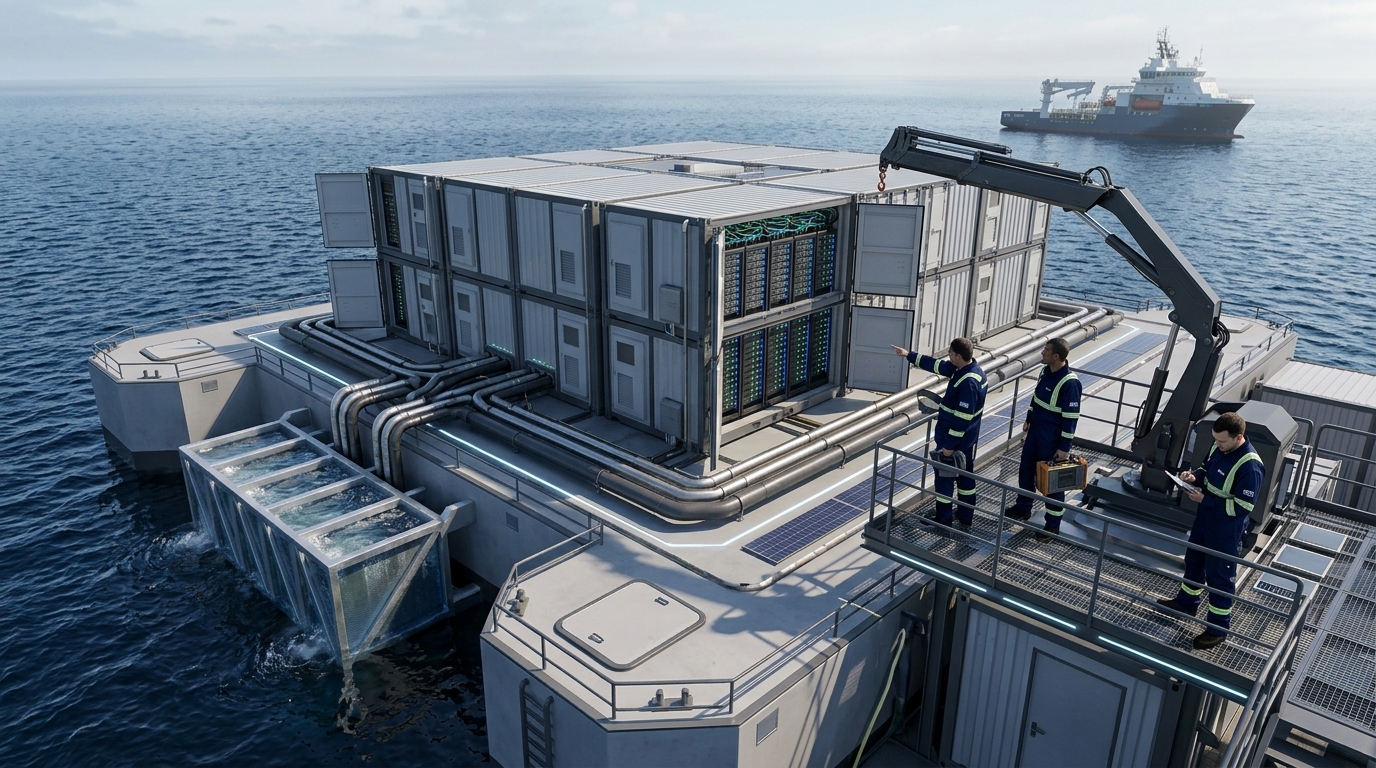
In an era where Artificial Intelligence (AI) is reshaping every facet of the global economy, an unexpected alliance is emerging between Silicon Valley and the traditional maritime industry. The rapid expansion of generative AI models has triggered an unprecedented demand for data centers, which currently face two major hurdles on land: lack of available space and exorbitant energy costs for cooling. The solution appears to lie in the water, with floating data centers (FDCs) now representing the next major investment frontier for the shipping sector.
The 'Blue Cooling' Advantage and Energy Efficiency
The primary challenge for modern data centers supporting AI applications is heat management. Latest-generation processors (GPUs) operate at temperatures that require sophisticated cooling systems, which on land can consume up to 40% of a facility's total energy. The ocean offers a natural, inexhaustible heat sink. By utilizing heat exchangers that leverage cold seawater, floating data centers can drastically reduce their energy footprint and carbon emissions.
According to market analysts, the move to water is not just an ecological choice but a financial necessity. Placing these units near coastal megacities—where the majority of the global population resides—also reduces latency in data transmission. This is critical for real-time applications such as autonomous driving, high-frequency trading, and the burgeoning metaverse, where every millisecond counts.
Shipyards and Shipowners: The New Tech Powerhouses
The pivot toward floating data centers is opening a new business cycle for shipyards worldwide. It is no longer just about building tankers or bulk carriers; it’s about constructing specialized barges and semi-submersible platforms designed to house thousands of servers. Major shipbuilding groups in Asia and Europe are already retooling their production lines to accommodate what is being called "digital shipbuilding."
For shipowners, the opportunity is twofold. Firstly, they can diversify their portfolios by investing in infrastructure that is decoupled from traditional trade freight rates. Secondly, their expertise in managing marine assets and complex logistics is essential for the maintenance and security of these floating "brains."
"Shipping is no longer just moving goods; it's moving information. The convergence of these two worlds is inevitable," industry leaders suggest.
Challenges: Corrosion, Environment, and Security
Despite the promising outlook, the journey to the sea is fraught with challenges. Saltwater corrosion is the primary enemy of sensitive electronic equipment. Engineers are developing advanced sealing systems and nitrogen-enriched internal atmospheres to protect servers from the harsh marine environment. Furthermore, environmental concerns persist: discharging warmer water back into the ocean could disrupt local ecosystems, necessitating strict regulatory oversight and innovative discharge designs.
Finally, security takes on a new dimension. A floating data center in international waters or near coastlines is a target not only for cyberattacks but also for physical sabotage. Protecting these critical infrastructure assets will require a new synergy between private security firms and naval forces, creating a new geopolitical framework for data sovereignty and protection at sea.
Conclusion: The Birth of the Blue Digital Economy
As we progress through the mid-2020s, the sight of massive floating platforms powering global AI will become commonplace. Shipping, one of the oldest sectors of human activity, is once again proving to be the most versatile ally of progress. The "Blue Digital Economy" is no longer a science fiction scenario but an emerging reality that will define technological dominance in the 21st century.