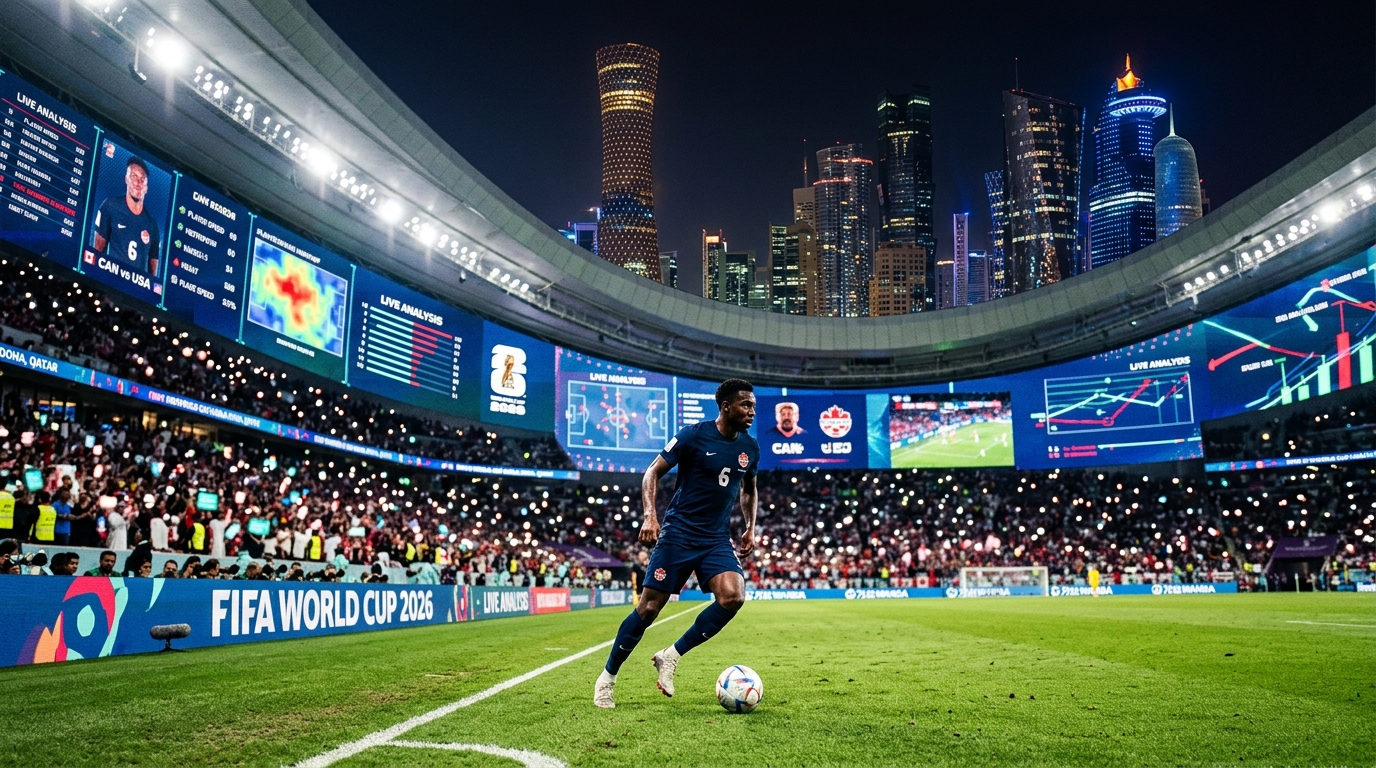
Today, July 4, 2026, as the United States celebrates its 250th anniversary, the FIFA World Cup co-hosted with Canada and Mexico is delivering much more than just a sporting spectacle. We are witnessing the most significant technological intervention in the history of sports. Artificial Intelligence (AI) is no longer a promise for the future; it is the central pillar managing everything from the validity of a goal to the flow of millions of fans across North American metropolises.
This year's tournament, the first to feature 48 teams, would have been impossible to manage without the aid of algorithms. The scale is unprecedented, and technology serves as the connective tissue uniting three nations and 16 different cities into a single, digital ecosystem.
Semi-Automated Offside and Digital Justice
The most visible change for the average fan is the evolution of Semi-Automated Offside Technology (SAOT). Unlike in 2022, the systems used in 2026 stadiums employ 12 dedicated tracking cameras mounted under the stadium roof and an IMU (Inertial Measurement Unit) sensor inside the ball. The system processes 500 data points per second for every player, mapping 29 different body points.
- Millimeter Precision: AI can now determine the exact moment of a pass and the position of players with millimeter accuracy, eliminating the frustrating delays seen in the early days of VAR.
- 3D Visualization: Within seconds, a 3D animation is broadcast on stadium screens and TV feeds, explaining the decision to fans with absolute clarity.
"Technology isn't replacing the referee; it's giving them the eyes of a superhuman," a FIFA officiating committee member stated at the tournament's opening.
The 'Connected' Player and Real-Time Data
Every player in this World Cup has access to the 'FIFA Player App' immediately after the final whistle. Through AI, the app analyzes player performance using high-definition optical data. Athletes can see when they created space, the pressure they applied to opponents, and heat maps of their movements.
This data isn't just for the athletes. Coaches on the benches use tablets receiving real-time predictive analytics. Algorithms can predict the likelihood of a player getting injured based on fatigue levels and movement patterns, suggesting substitutions before a mishap occurs. This proactive use of AI is shifting national team strategies, turning football into a high-tech game of chess.
Smart Stadiums: Security and Fan Experience
With 104 matches across three countries, security is the top priority. The use of AI in crowd management is decisive. Computer vision systems analyze fan flow at entrances and concourses, predicting bottlenecks before they form. In case of an emergency, AI suggests optimal evacuation routes in real-time.
For the fan in the stands, the experience has been transformed via Augmented Reality (AR). Using their smartphones, spectators can point their cameras at the pitch and see player names, running speeds, and live statistics overlaid on the action. It is an experience reminiscent of a video game, but it's happening live before their eyes.
The Challenge of Ethics and Privacy
Despite the benefits, the extensive use of biometric data and facial recognition in American and Mexican stadiums has sparked debate. The balance between security and personal liberty remains a burning issue. FIFA maintains that data is anonymized, but critics fear the World Cup is serving as a testing ground for mass surveillance.
In conclusion, the 2026 World Cup marks the end of football as we knew it and the beginning of a new era where technology is inseparable from the sport. The success of this venture will dictate the future of all major sporting events in the 21st century.