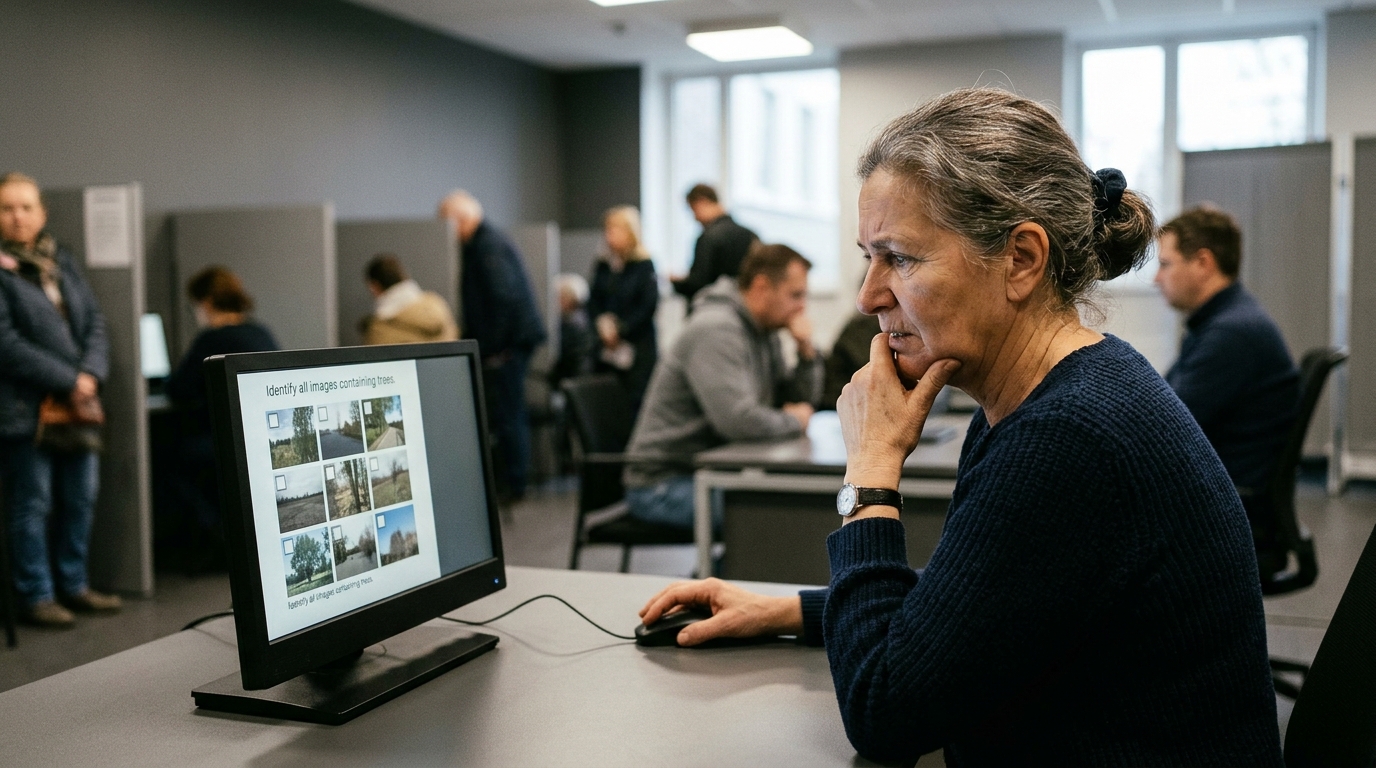
The era when "I am not a robot" simply meant clicking on a few photos of traffic lights or crosswalks is long gone. Today, we stand on the threshold of a new, disturbing reality: real humans, from artists and writers to everyday social media users, are being forced to take "humanity exams" to maintain their digital presence. This phenomenon, which began as a technical necessity to filter out bots, is evolving into an ontological crisis that threatens to reshape how we interact in the digital sphere.
The Rise of Algorithmic Gaslighting
The term "algorithmic gaslighting" describes the experience where a human creator is accused by automated systems—or a suspicious community—of their work being the product of artificial intelligence. Artists who spend hundreds of hours on a painting find themselves facing bans from platforms because their style was deemed "too perfect" or "suspiciously similar" to the outputs of Generative AI models. The irony is tragic: AI was trained on human creativity, and now that very creativity is being flagged as a derivative of the machine.
This climate of suspicion is not limited to the arts. In academia, students have found themselves accused of AI plagiarism, with AI detection tools frequently producing false positives. The pressure to prove one is "real" creates an additional psychological burden, turning digital creation into a minefield where authenticity is constantly under question.
The Dead Internet Theory and Reality
The "Dead Internet Theory," once considered a fringe conspiracy theory, is beginning to gain terrifying ground in reality. The theory posits that most internet traffic and content is now produced by algorithms for algorithms, aimed at manipulating public opinion and consumer behavior. As the internet becomes flooded with "synthetic media," the need to verify human presence becomes imperative.
- Loss of Trust: Every comment, article, or video is met with skepticism.
- Isolation: Users withdraw from public discussions for fear of talking to bots.
- Quality Degradation: The web is filled with low-value, recycled content.
In this environment, platforms are introducing increasingly intrusive identification methods. From mandatory ID submission to the use of biometric data, the line between security and privacy violation is becoming razor-thin.
The Commodification of "Proof of Personhood"
This is where the concept of "Proof of Personhood" enters. Companies like Sam Altman’s Worldcoin propose using biometric iris scans as the only foolproof way to prove one is human. This creates a new economic and social paradigm: our very biological existence becomes the "key" to accessing digital services.
"Soon, access to truth and communication will require a biometric passport. The freedom to be anonymous online is dying under the weight of the need for authenticity," industry analysts note.
However, this approach carries immense risks. What happens to those who refuse to hand over their biometric data? Will they become "digital pariahs," excluded from the economic and social life of the 21st century? The need to prove we are not machines may ultimately lead us to a society of total surveillance, where our humanity is measured by code and sensors.
Conclusion: A Return to the Physical World?
Perhaps the greatest consequence of this identity crisis will be the gradual devaluation of the digital space as a realm for genuine human expression. If the effort to prove our humanity online becomes too costly—in terms of time, privacy, or peace of mind—then a return to analog, face-to-face interactions may not just be a stylistic choice, but an act of resistance. Artificial Intelligence is forcing us to redefine what makes us unique, and perhaps the answer lies not in any digital certificate, but in the very imperfection and unpredictability of human contact.