In an era where the digital revolution promises to solve every problem with the click of a button, a question arises that touches the core of human existence: Are we, in our quest to automate the world, ultimately automating our own thought process? Philippe Bernard's recent article in BusinessDaily, titled "The End of Thought?", sounds an alarm for a society that is gradually ceding its most precious privilege—the process of questioning and synthesis—to machines.
The Trap of Cognitive Ease
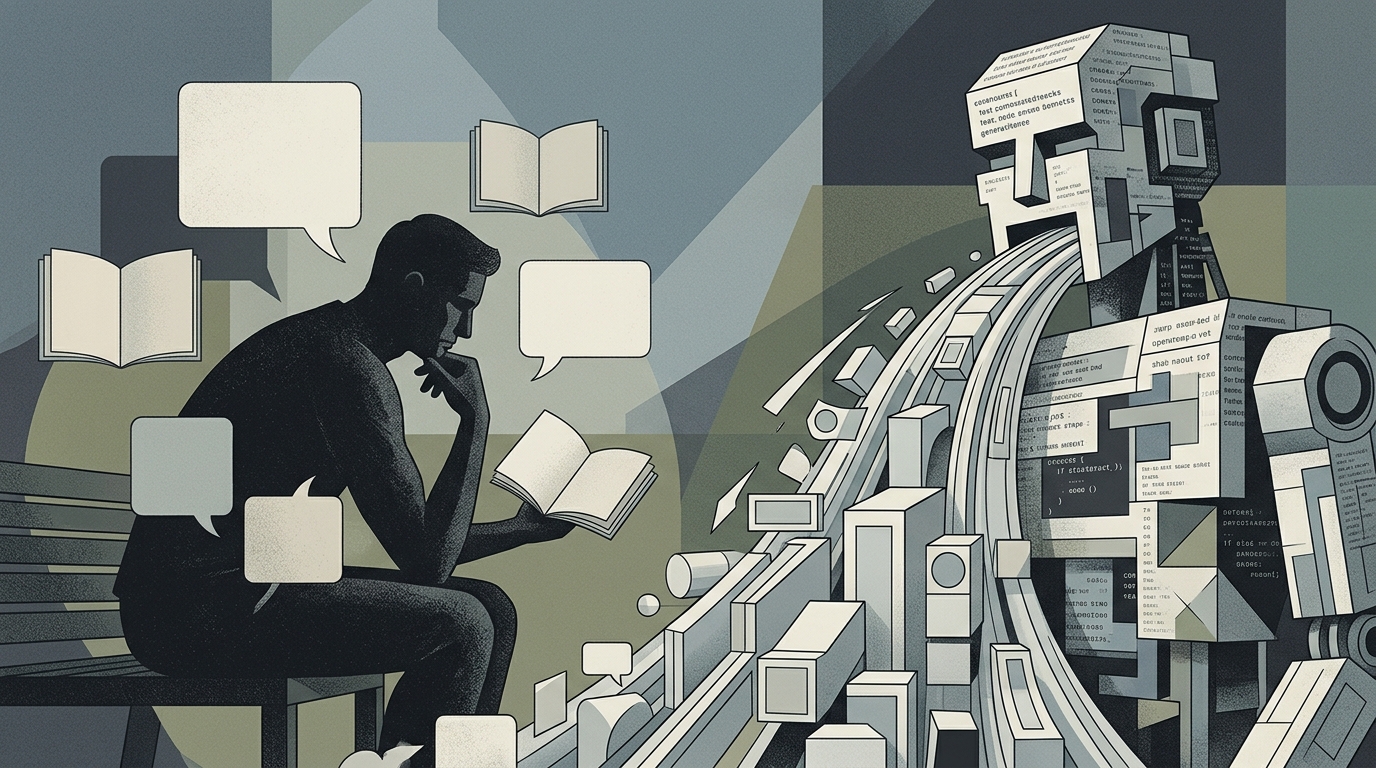
Artificial Intelligence (AI) is no longer a tool on the periphery of our work; it is the invisible editor of our emails, the researcher of our data, and, increasingly, the shaper of our opinions. The "ease" offered by Large Language Models (LLMs) acts as a double-edged sword. On one hand, productivity skyrockets. On the other, "cognitive friction"—that painful but necessary process where the brain grapples with conflicting ideas to give birth to something new—tends to vanish.
As Bernard points out, the danger lies not in the technology itself, but in how we integrate it. When AI provides a ready-made answer, we bypass the stages of research, source evaluation, and internal deliberation. The result is "shallow thinking," where information is confused with knowledge and speed with wisdom.
Education: From Creation to Curation
The field of education is at the center of this crisis. For decades, the goal was to develop a student's ability to synthesize arguments. Today, the challenge is shifting from writing to "curation." Students are learning to provide prompts rather than produce original text. This transition carries the risk of "algorithmic homogenization."
- The Loss of Uniqueness: As everyone uses the same AI models, responses tend to converge toward a statistical mean, eliminating radical or unconventional ideas.
- Memory Atrophy: The certainty that information is always available reduces the need for deep understanding and the memorization of structures.
- The Crisis of Authenticity: How can we evaluate intellectual effort when the final product is the result of a human-machine collaboration with blurred boundaries?
"Thinking is not merely the production of words; it is the process through which a human being constitutes themselves against the world. If we outsource this process, we outsource our freedom."
The Political Dimension: Algorithmic Conformism
Beyond the individual level, the "end of thought" has profound political implications. Democracy relies on the existence of informed citizens capable of critical analysis. In an environment where AI filters reality and produces persuasive but often hollow narratives, the public's ability to distinguish propaganda from truth weakens. Philippe Bernard warns that reliance on AI could lead to a new type of totalitarianism, not through violence, but through intellectual lethargy.
Algorithms tend to reproduce the biases of the data they were trained on. If we stop questioning the "logical" suggestions of AI, we risk being trapped in an endless cycle of recycling old ideas, dressed in the cloak of technological objectivity. Critical thinking is the only defense against the "dictatorship of the average."
Toward a New Digital Humanism
The solution is not to reject technology, which would be utopian and regressive. The challenge is to build a new "digital humanism." We must redefine our relationship with machines, placing them at the service of human creativity rather than as substitutes for it. This requires:
- Strengthening Metacognition: Teaching people how to think about the way they think, recognizing their own cognitive biases.
- Institutional Protection: Regulatory frameworks that ensure algorithmic transparency and the protection of intellectual property.
- Cultural Resistance: Cultivating the value of "slow thinking" in a world that demands instantaneous answers.
The question posed by Bernard remains open. Whether AI will signal the end of thought or the beginning of a new era of intellectual expansion depends entirely on our will to remain the masters of our tools. Thinking is an act of resistance; let us not surrender it without a fight.