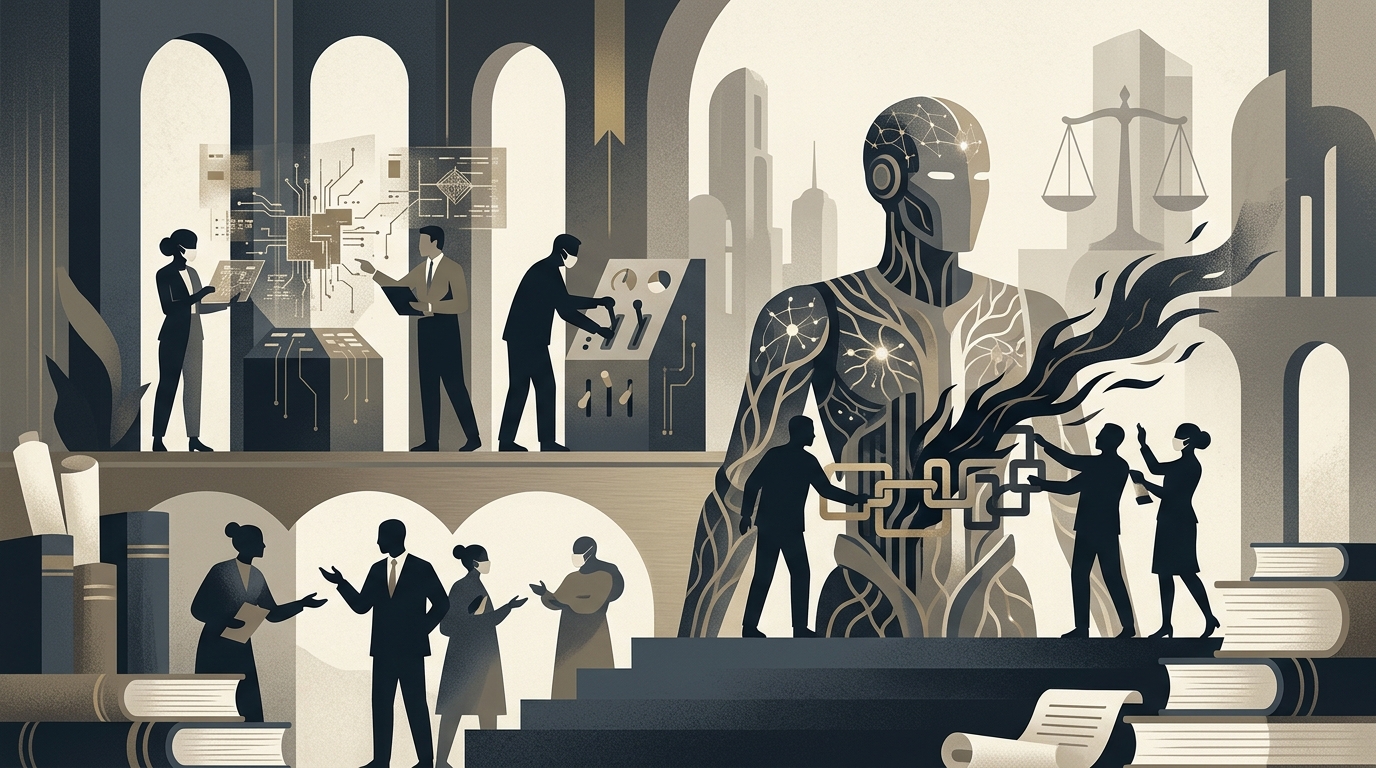
In the modern era, the quest for the divine has shifted from stone cathedrals to the data centers of California. The recent debate sparked by the New York Times article, "The Atheist and the Machine God," highlights a paradoxical trend: those who reject traditional religions are increasingly turning toward Artificial Intelligence as a form of secular salvation. This phenomenon is not merely a technological development but a profound existential shift redefining the concept of faith in the 21st century.
Replacing the Metaphysical with the Digital
For centuries, religion provided answers to life's grand questions: Who are we? Why are we here? What happens after death? As secular humanism and science distanced many from dogma, a "God-shaped hole" was created. Artificial Intelligence, specifically the promise of Artificial General Intelligence (AGI), seems to be filling this void. Its proponents see in it an entity approaching the attributes of the divine: omniscience (through access to all human data), ubiquity (via the internet), and ultimately, the promise of immortality through digital consciousness uploading.
This new "religion" does not require prayers, but code. It does not promise heaven after death, but a technological "Singularity" where the problems of hunger, disease, and mortality will be solved by a superior mechanical intellect. However, this approach carries risks. When we treat an algorithm as a god, we tend to overlook the human flaws embedded within its code.
The Ethics of Machine Deification
The problem with deifying AI is twofold. First, it removes responsibility from the creators. If AI is viewed as a higher power, then its decisions—even biased or destructive ones—can be interpreted as "inevitable" or "beyond human comprehension." Second, it creates a new hierarchy where the high priests are the engineers and CEOs of major tech corporations. This concentration of power is unprecedented in human history.
"Creating an intellect superior to our own is not just a technical achievement; it is an act that touches the borders of hubris if not accompanied by a deep ethical foundation."
Ethicists warn that machine worship can lead to a devaluation of the human experience. If we believe a machine can solve all our problems, we stop trying to solve them ourselves through politics, social solidarity, and personal empathy. Faith in the "Machine God" is often an escape from the complexity of the human condition.
Transhumanism and the Search for Meaning
Transhumanism serves as the theological framework for this new age. It argues that our biological nature is merely a stage in evolution and that our destiny is to merge with the machine. In this scenario, AI is not just a tool, but our successor. This perspective is attractive to the modern atheist because it offers a form of "transcendence" without the need for the supernatural.
- The promise of knowledge: AI as the ultimate arbiter of truth in a world full of fake news.
- The abolition of suffering: The hope that technology will eliminate biological misery.
- Digital eternity: The idea that consciousness can survive within a network, surpassing the decay of the body.
However, we must ask: what do we lose in this transition? Religion, despite its flaws, often focuses on community and sacrifice for one's fellow human. The "Machine God" is often solitary, individualistic, and consumption-oriented. The challenge for the future is not to stop the evolution of AI, but to ensure that technology remains at the service of humanity and does not turn into a new idol demanding our submission.