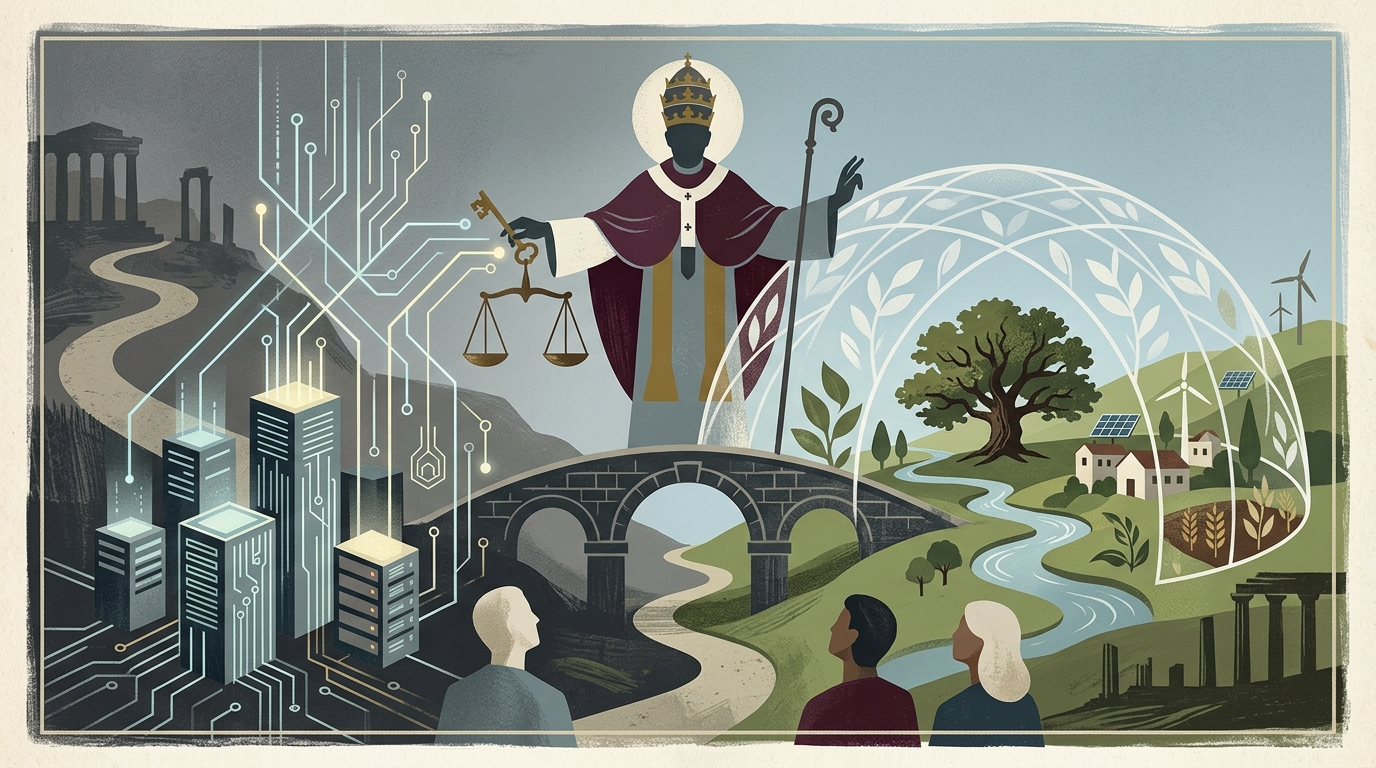
In the hallowed halls of the Vatican, where centuries of tradition meet the existential challenges of the future, Pope Leo has issued a statement destined to reshape the global discourse on technology. Against a backdrop of an escalating climate crisis and the unbridled expansion of data centers, the Pontiff made it clear that Artificial Intelligence (AI) can no longer be evaluated solely on its efficiency, but primarily on its ecological footprint. This intervention, highlighted by 'The Invading Sea', emphasizes the need for an 'integral ecology' that weaves digital progress into the protection of our 'Common Home'.
The Digital Thirst and the Cost of Intelligence
For Pope Leo, Artificial Intelligence is not an ethereal entity residing in the 'cloud,' but a deeply material process with tangible consequences for the environment. Training large language models requires vast amounts of electricity and millions of liters of water to cool servers. The Pontiff stressed that the pursuit of technological supremacy must not come at the expense of natural resources that belong to everyone, especially future generations. "Every algorithm written, every model trained, leaves a scar on the earth if it is not accompanied by moral responsibility," he remarked.
This approach is not merely a moral exhortation but a call for concrete regulatory frameworks. Pope Leo proposes the establishment of parameters that would compel tech companies to be transparent about their resource consumption. The concept of 'algor-ethics', which the Vatican has been systematically promoting, is now expanding to include 'environmental justice.' This means AI must be designed in a way that contributes to solving climate change rather than exacerbating it.
From Anthropocentric to Planet-centric Technology
One of the most compelling points of the Pope's address was the critique of the unbridled anthropocentrism of modern technology. While AI is often marketed as a tool to enhance human productivity, Pope Leo argued that this perspective is limited. True progress, according to him, lies in our ability to create systems that recognize the interdependence of all life forms. AI must become a 'guardian of creation,' assisting in biodiversity monitoring, natural disaster prediction, and the optimization of renewable energy sources.
- The urgent need for transparency in data center energy consumption.
- Prioritizing the development of AI that serves environmental restoration.
- Protecting vulnerable communities most affected by climate change and technological inequality.
- Creating a global code of ethics binding states and multinationals.
The Pope did not fail to mention the danger of 'digital colonialism.' Much of the data center infrastructure and the hardware powering AI in the developed world depends on the mining of rare earth minerals in developing nations, often with devastating consequences for the local environment and human rights. The ethics of AI, therefore, are inextricably linked to social justice and the responsible stewardship of the land.
The Convergence of Science and Faith
This move by the Vatican comes at a time when the global community is searching for guidelines for AI governance. Pope Leo's voice serves as a bridge between the scientific community and broader society, adding a spiritual dimension to a technical issue. As noted by 'The Invading Sea', religion can provide the moral 'brake' missing from rapid technological development. Protecting against the 'invading sea'—a metaphor for rising sea levels due to climate change—requires an AI that is not only smart but wise.
"Technology is a gift from God, but it must be used to cultivate the Garden of Eden, not to turn it into a desert for the sake of profit." — Pope Leo
In closing, the Pontiff called on Silicon Valley leaders and policymakers not to fear limitations. On the contrary, he argued that ethical boundaries are what will allow AI to reach its full potential by serving the common good. The challenge for 2026 and beyond is clear: can we create an intelligence that respects the limits of our planet? The answer to this question will determine not only the future of technology but the future of life on Earth itself.