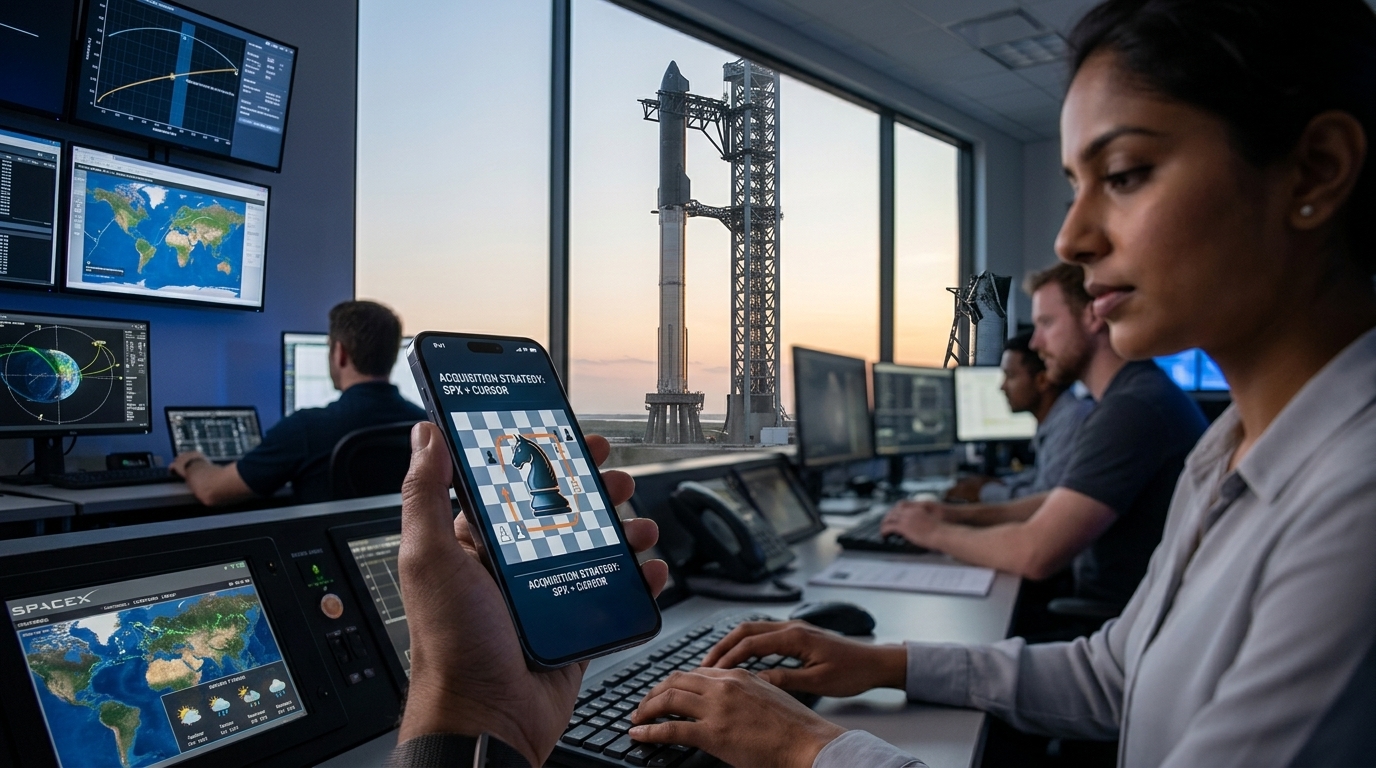
The recent news that SpaceX, the undisputed leader of the private aerospace industry, has acquired Cursor for a staggering $60 billion has sent shockwaves through global markets. This move, occurring just days after Elon Musk’s company’s highly anticipated Initial Public Offering (IPO), is far more than a mere business transaction. It is a statement of intent that shifts SpaceX's center of gravity from pure mechanical engineering toward a hybrid model of "software-centric" aerospace dominance.
The Strategy Behind the Valuation
For many Wall Street analysts, the $60 billion price tag for an AI-powered code development platform seems excessive. However, when examining Musk’s broader ecosystem, the logic becomes clearer. Cursor is not just a simple code editor; it is a tool that accelerates software authorship through AI, allowing developer teams to produce code at speeds previously deemed impossible. In the case of SpaceX, where software controls everything—from the landing of Falcon rockets to the management of the Starlink constellation—development speed is everything.
SpaceX is now utilizing the capital raised from its IPO to fully vertically integrate its production chain. By controlling the tool used to write its software, the company drastically reduces the time from conceptualization to field implementation. What we are witnessing is the application of Musk's "First Principles" approach to computing: if software is the bottleneck, you must own the tool that eliminates that bottleneck.
Synergy with xAI and the Future of Starship
A critical element often overlooked is the connection with xAI, Musk’s other artificial intelligence venture. Integrating xAI’s models within the Cursor environment could create a closed-loop system of "self-improving" code. Imagine a scenario where Starship encounters an issue during flight. Cursor's AI system could, theoretically, suggest and test flight code corrections in real-time, offering an unprecedented level of safety and adaptability.
Furthermore, this acquisition deals a significant blow to SpaceX’s competitors, such as Blue Origin and United Launch Alliance. While traditional aerospace players rely on external software vendors and slow bureaucratic processes, SpaceX is transforming into a software company that happens to build rockets. Cursor provides SpaceX with the advantage of "digital agility," making it immune to the delays that plague the industry.
Economic Implications and the New IPO Reality
The timing of the acquisition is particularly fascinating. By using its shares as currency post-IPO, SpaceX proved that its market capitalization is not just a figure on paper but a tool for aggressive expansion. The market responded positively, viewing Cursor as the "force multiplier" that will allow SpaceX to dominate not only Low Earth Orbit but also the enterprise AI tools market.
However, skeptical voices remain. The concentration of so much power—from satellites and rockets to AI development tools—in the hands of a single individual raises questions about competition and security. If Cursor becomes the standard for developing critical infrastructure, SpaceX will hold the "keys" to a vast portion of the global technological infrastructure. In conclusion, the acquisition of Cursor is the first act in a new chapter where AI is not merely auxiliary but the very engine of space exploration.