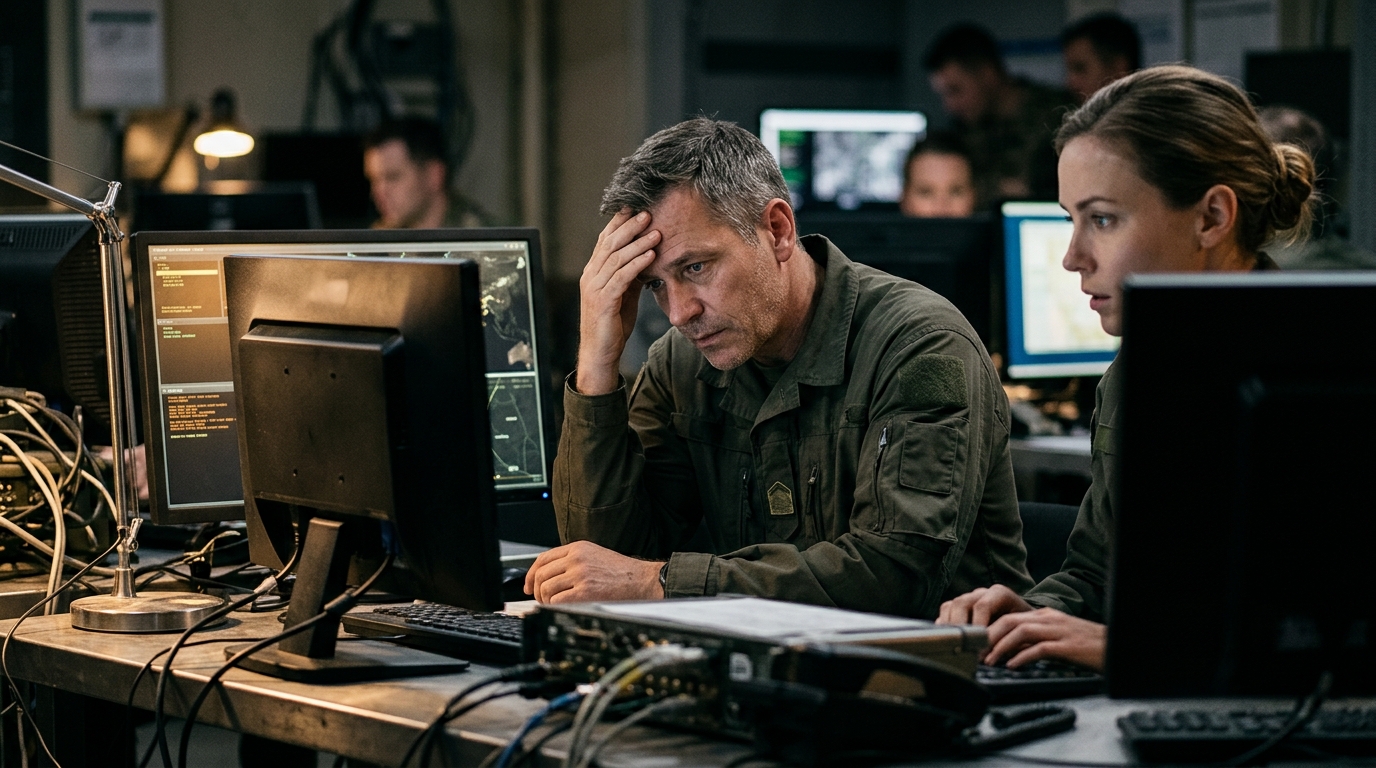
At the dawn of 2026, the promise of "surgical precision" through Artificial Intelligence (AI) on the battlefield appears to be collapsing under the weight of reality. The recent tragedy in the Minab region is not merely an isolated military error, but a painful milestone in the history of algorithmic warfare. When detection and targeting systems operate at nanosecond speeds, the human capacity for verification—the "meaningful human control" required by international treaties—becomes a dangerous illusion.
The Speed Paradox and the Collapse of the OODA Loop
In military planning, the OODA loop (Observe-Orient-Decide-Act) is the holy grail of operational effectiveness. AI promises to compress this loop, allowing forces to react faster than the adversary. However, in the case of Minab, we witnessed the paradox of this speed: the system processed data from multiple sources (drones, satellites, signals intelligence) and arrived at a targeting decision within seconds. The human operator, faced with a deluge of information, had neither the time nor the tools to challenge the algorithm's "recommendation."
Processing speed has now surpassed the biological capacity of the brain to perceive context. In Minab, a gathering of civilians was misinterpreted as a military mobilization due to "noise" in the data. The AI functioned perfectly according to its code, but failed catastrophically to understand the humanitarian reality on the ground.
Automation Bias and the Accountability Gap
One of the most disturbing phenomena highlighted is "automation bias." Military analysts tend to place blind trust in computer suggestions, viewing them as more objective than human judgment. In the Minab tragedy, warning signs were ignored because the algorithm reported a "high confidence level."
- The lack of transparency in "black box" AI decisions makes retrospective accountability nearly impossible.
- Commanders are being relegated to mere "rubber-stampers" for decisions already made by software.
- The legal framework remains in limbo: Who is to blame? The programmer, the commander, or the system itself?
"We cannot allow the right to life and death to be delegated to lines of code that possess no moral compass," states a key UN report on autonomous weapons systems.
The Need for a New International Security Architecture
The Minab tragedy must serve as the catalyst for a global agreement to limit military AI. It is no longer enough to have a human "in-the-loop" if that human lacks the practical ability to override the system's decision. We must redefine "meaningful human judgment" as a prerequisite for any kinetic military action.
Furthermore, the international community must consider imposing "speed brakes" on algorithmic decisions in populated areas. Technology must serve the protection of civilians, not sacrifice it on the altar of operational tempo. If limits are not set now, the next "Minab" will not be an accident, but the inevitable normalcy of a world governed by unchecked mathematical models.
Conclusion: Ethics as an Operational Imperative
Military effectiveness cannot be divorced from moral legitimacy. The use of AI in warfare promises to reduce friendly casualties but risks dramatically increasing "collateral damage" due to the impossibility of verification. The Minab tragedy teaches us that technological superiority is hollow if it leads to the loss of our humanity. The challenge for 2026 and beyond is to ensure that the speed of the machine never leaves behind the slow, but essential, process of human conscience.