In an era where the music industry finds itself at a critical crossroads, the voices of traditional creators are gaining a new, almost prophetic weight. David Ellefson, the iconic bassist and co-founder of Megadeth, recently expressed his strong dissatisfaction with the rise of Artificial Intelligence (AI) in the arts. In an interview shared by Blabbermouth.net, Ellefson did not mince words: "My problem with artificial intelligence is it's not that intelligent and it's artificial." This seemingly simple statement carries a profound philosophical and ethical reflection that now concerns the entire cultural fabric of 2026.
The Illusion of Creation
For an artist who built his career on sweat, technical prowess, and the raw energy of live performances, the idea of an algorithmic composition feels like sacrilege. Ellefson argues that AI does not "create" in the traditional sense of the word. Instead, it recycles. The machine learning process is based on analyzing millions of existing tracks, identifying patterns, and producing a result that is statistically likely to sound "correct." However, in art, being "correct" isn't always the goal. Innovation often stems from mistakes, dissonance, and human frailty – elements that an algorithm is programmed to avoid or smooth out.
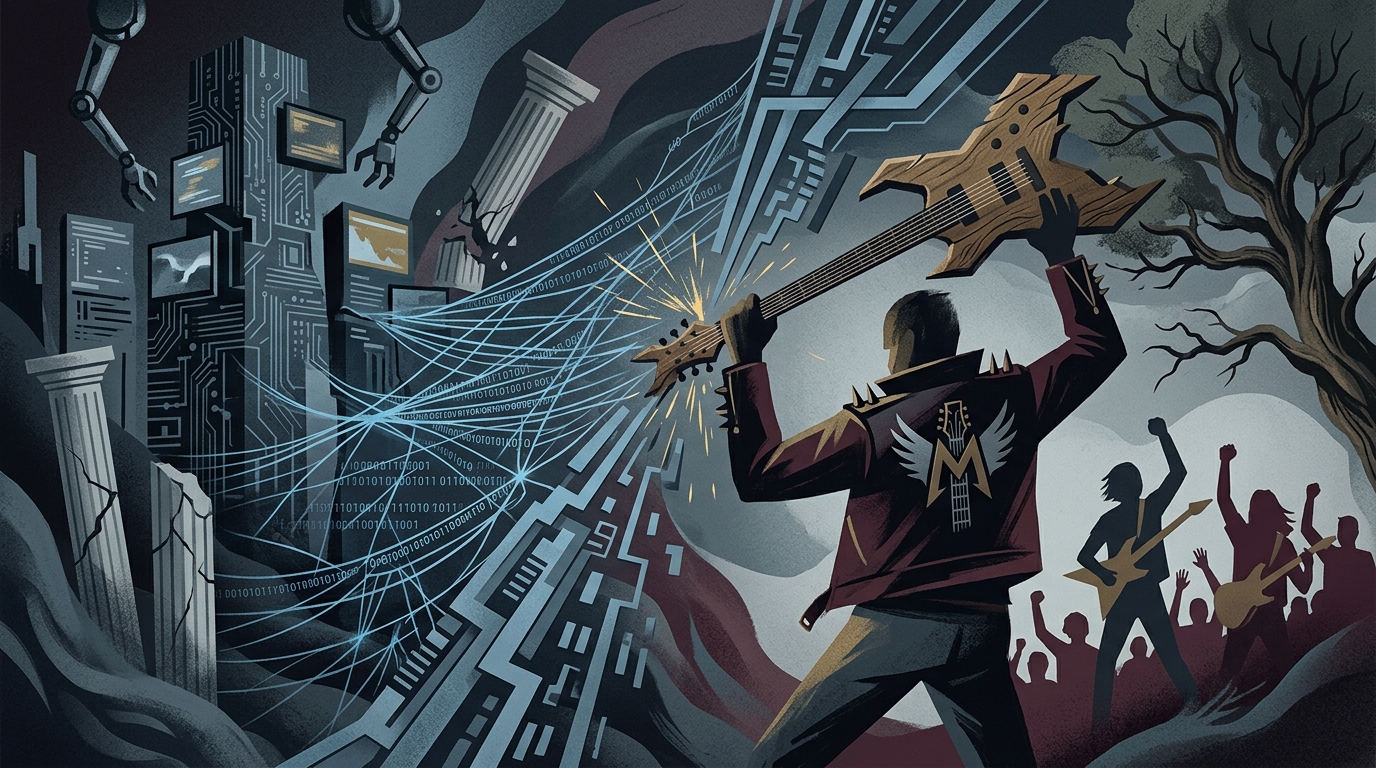
Ellefson points out that the "intelligence" of these systems is actually a sophisticated form of mimicry. There is no consciousness behind the notes, no pain, joy, or political rage. In heavy metal, a genre that thrives on authenticity and resistance to the establishment, the invasion of AI is seen by many as the ultimate corporate dilution. When a machine writes a riff, it doesn't do so because it has something to say to the world, but because its parameters dictate it.
Ethical Dilemmas and Intellectual Property
Beyond the aesthetic aspect, Ellefson touches upon the burning issue of ethics. The training of AI models often occurs without the consent of the artists whose work is used as "fuel" for the algorithms. This represents a form of digital plundering, where decades of intellectual property are turned into data for the production of cheap, disposable content. Ellefson, having lived through the shifts from vinyl to CD and from Napster to streaming, views AI as the final phase of the devaluation of musical worth.
- The lack of emotional depth in algorithmic compositions.
- The violation of creators' rights through unauthorized model training.
- The homogenization of sound, as AI tends toward the "average."
- The risk of replacing session musicians with digital substitutes.
The question Ellefson poses is whether we want a world where art is merely "content" to be consumed, or if it remains a sacred communication between humans. The musician's use of the term "artificial" underscores the alienation the creator feels from the machine's product. For Ellefson, intelligence requires experience, and experience requires biology.
The Future of Live Music
Perhaps the only "lifeline" for artists like Ellefson is the live experience. While AI can create a perfect copy of a recording, it cannot replicate the electrified atmosphere of a concert, the connection with the audience, and the unpredictable nature of a live performance. Ellefson emphasizes that music is a social activity, a ritual that requires physical presence. The "artificial" nature of AI makes it incapable of participating in this ritual in a meaningful way.
In conclusion, Ellefson's critique is not merely the grumbling of a scene veteran. It is a warning about the loss of the human essence in a world that prioritizes speed and profit over quality and truth. The battle for the "soul" of music has just begun, and artists who insist on authenticity will be the leaders of this new resistance.