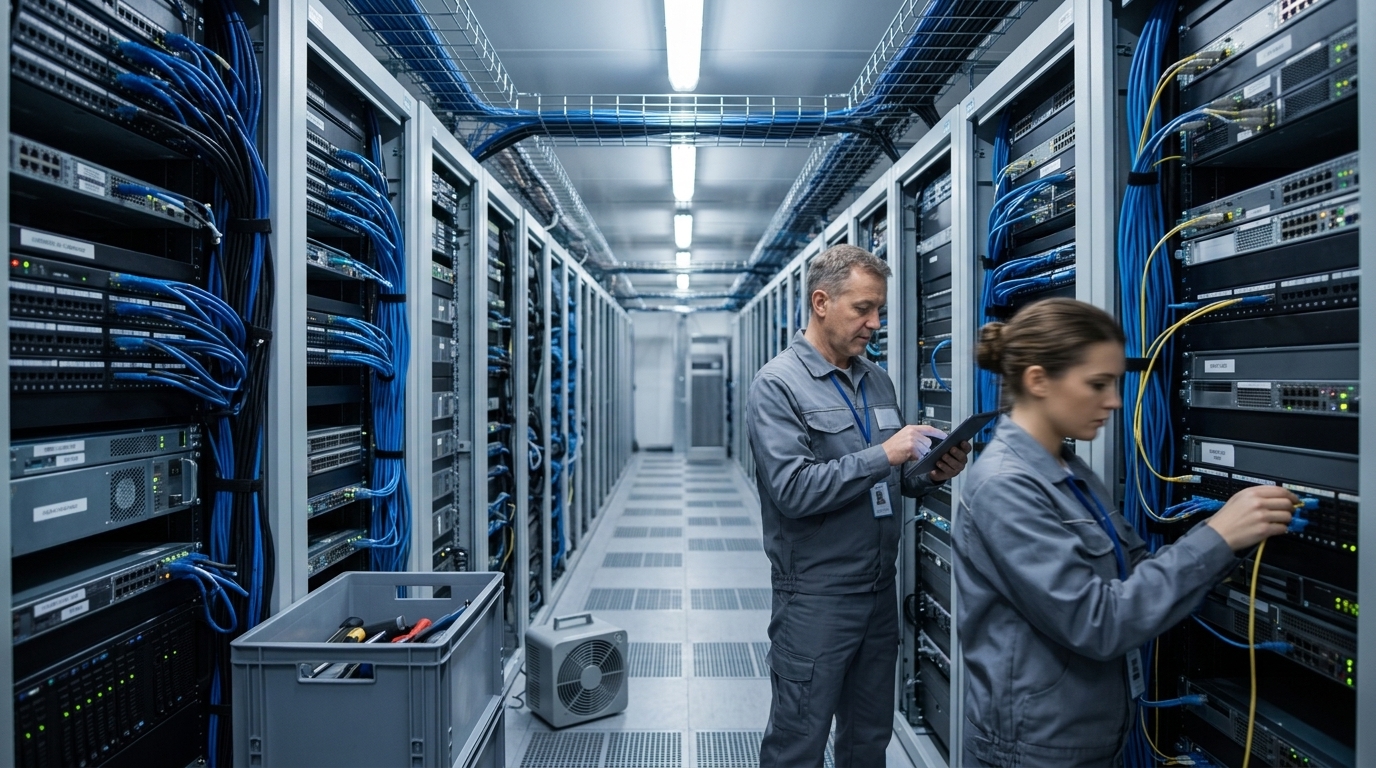
The promise of the "Cloud" has always been one of immateriality. We have been taught to think of our data as something floating in the ether, detached from physical reality. However, the Artificial Intelligence (AI) revolution requires something very tangible: massive facilities, miles of cabling, and, most importantly, giant cooling systems. For residents in areas ranging from Arizona in the US to Dublin and Britain, this "immaterial" technology has acquired a very specific and painful sound.
The Unceasing Hum of Progress
The problem stems from the need for servers to stay cool. As AI models like GPT-4 require exponentially more computing power, processors generate heat that could melt components within seconds. The solution involves industrial fans and cooling towers operating 24 hours a day, seven days a week. For those living within a few hundred meters, this translates into a constant, low-frequency hum that penetrates walls and windows.
"It's like having a jet engine preparing for takeoff in your backyard, but it never actually takes off," a resident told Fortune, describing daily life next to a major tech company's data center.
The health impacts are significant. Studies have shown that long-term exposure to low-frequency noise can cause chronic insomnia, increased stress, hypertension, and cardiovascular issues. Residents complain that their quality of life has been completely degraded, with many unable to use their gardens or even sleep without earplugs.
Resources in Crisis: Water and Energy
Noise is just the tip of the iceberg. Data centers are environmental giants with an insatiable thirst. To cool their systems, they consume millions of liters of potable water, often in regions already plagued by drought. The conflict between the needs of local agriculture and the demands of Big Tech is becoming increasingly intense. Furthermore, the pressure on the electrical grid is immense. In some cases, the construction of new homes has been frozen because data centers absorb all available electrical capacity in the area.
- Water Consumption: An average data center can consume as much as a city of 30,000 residents.
- Energy Footprint: AI is expected to double the energy consumption of data centers globally by 2026.
- Property Devaluation: Homes around noisy facilities lose up to 20% of their market value.
The Regulatory Gap and Corporate Responsibility
The paradox is that many of these facilities operate within legal noise limits. Existing regulations are often based on outdated standards that do not account for the specific nature of constant low-frequency sounds. Companies, for their part, promise "noise mitigation measures" and "green investments," but residents feel these moves are mostly promotional (greenwashing) rather than substantial.
Legal action seems to be the only path for many communities. In the US, class-action lawsuits are underway, demanding the installation of more expensive but quieter cooling systems or the relocation of facilities away from residential zones. Artificial Intelligence may promise a bright future for humanity, but if that future is built on the exhaustion of local communities, the moral and social cost may prove unbearable.
Conclusion
The growth of AI cannot continue in a vacuum of responsibility. The need for a stricter regulatory framework that protects the right to silence and access to basic resources is imperative. The "Cloud" must finally land in reality and respect the people living in the shadow of its infrastructure.