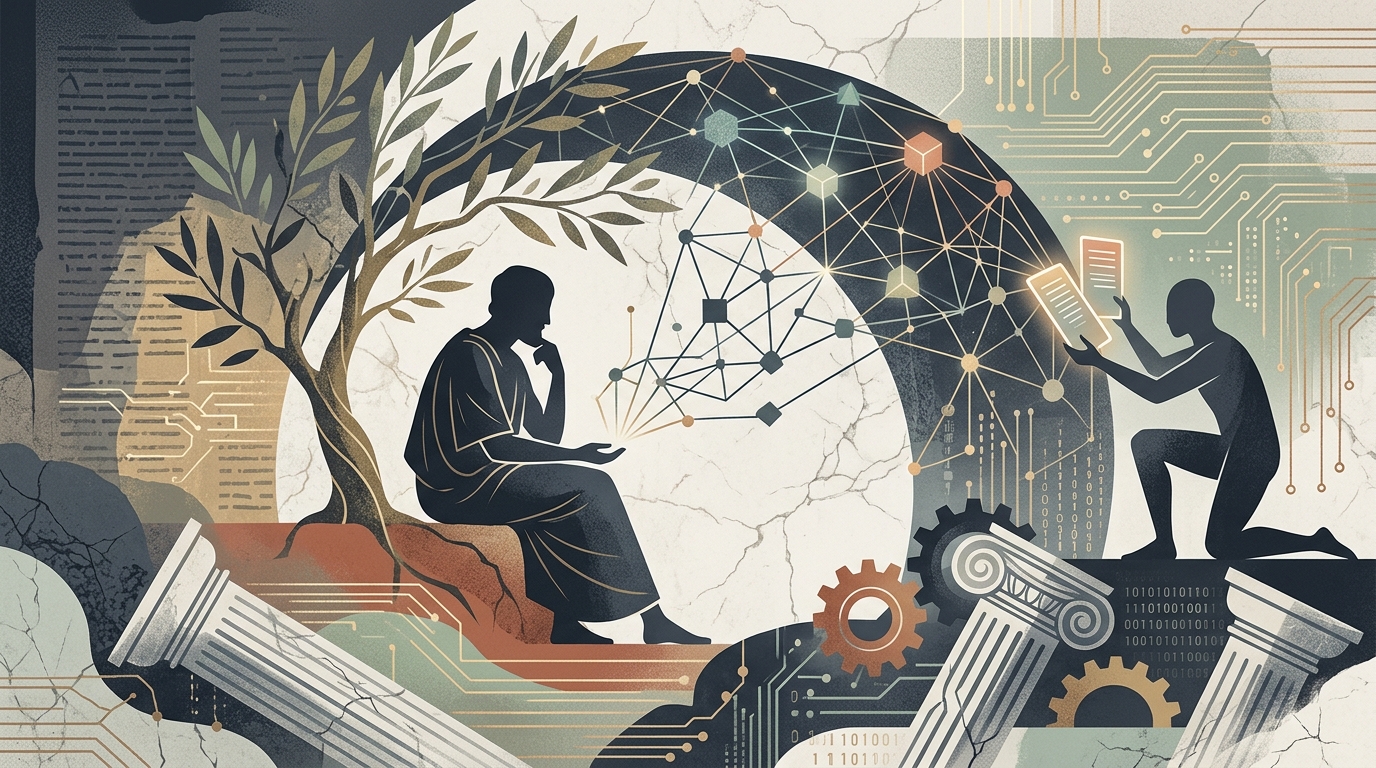
In an era where Artificial Intelligence (AI) is rapidly reshaping our social and economic landscape, returning to the roots of Western thought feels more necessary than ever. Angie Hobbs, Professor of the Public Understanding of Philosophy at the University of Sheffield, draws a compelling parallel: how would Aristotle, the founder of logic and ethics, view the emergence of algorithms that appear to "think"?
According to Hobbs, Aristotle’s stance would likely be a blend of scientific enthusiasm and ethical vigilance. The philosopher who believed that *eudaimonia* (human flourishing) is the ultimate goal of life would see in AI the fulfillment of an ancient promise: the automation of drudgery, allowing humans to devote themselves to politics, art, and contemplation.
The Prophecy of the Self-Moving Loom
In the first book of his *Politics*, Aristotle formulated a thought that seems prophetic today. He wrote that if tools could perform their work on their own—if the loom could weave without hands and the plectrum could play the lyre by itself—then master-craftsmen would no longer need assistants, and masters would no longer need slaves. This "Aristotelian utopia" of automation lies at the heart of modern AI optimism.
However, Hobbs highlights a crucial distinction: for Aristotle, a tool remains a tool. AI, no matter how sophisticated, lacks *proairesis*—the capacity for conscious moral choice based on values. The danger Hobbs identifies is not a robot uprising, but our own voluntary surrender of agency. If we allow algorithms to dictate what is just, what is beautiful, or what is true, we risk becoming slaves to our own creations.
Phronesis vs. Algorithmic Logic
A central point of Hobbs’ analysis concerns the concept of *Phronesis* (practical wisdom). Aristotle argued that ethics is not a set of rules or mathematical formulas, but a skill acquired through experience and engagement with reality. AI operates on statistical probabilities and historical data. It can simulate logic, but it cannot exercise *epieikeia* (equity)—the ability to deviate from a strict law when specific circumstances demand a more humane touch.
"Aristotle would be concerned about the atrophy of our own moral muscles," Hobbs notes. Just as an athlete who stops training loses their strength, a human who delegates their judgment to a chatbot risks losing the capacity for critical thinking. Depending on AI for writing, making legal decisions, or even managing relationships creates an intellectual lethargy that opposes the Aristotelian *energeia*—the active exercise of human faculties.
The Golden Mean in the Digital Age
The solution, following the Aristotelian approach suggested by Hobbs, lies in the "Golden Mean." We must neither reject technology out of fear (deficiency) nor surrender blindly to it (excess). The virtuous use of AI is that which enhances human creativity without replacing it.
In this context, education takes on a primary role. Instead of teaching children how to get ready-made answers, we must teach them how to ask the right questions and how to evaluate the ethical dimensions of the output. Aristotle would call us to be the "architects" of our technology, ensuring that the algorithm serves the "common good" and political virtue, rather than mere efficiency or profit.
"Technology must be the servant of our flourishing, not the jailer of our thoughts," Hobbs concludes, reminding us that freedom is not the absence of effort, but the ability to define our own destiny.