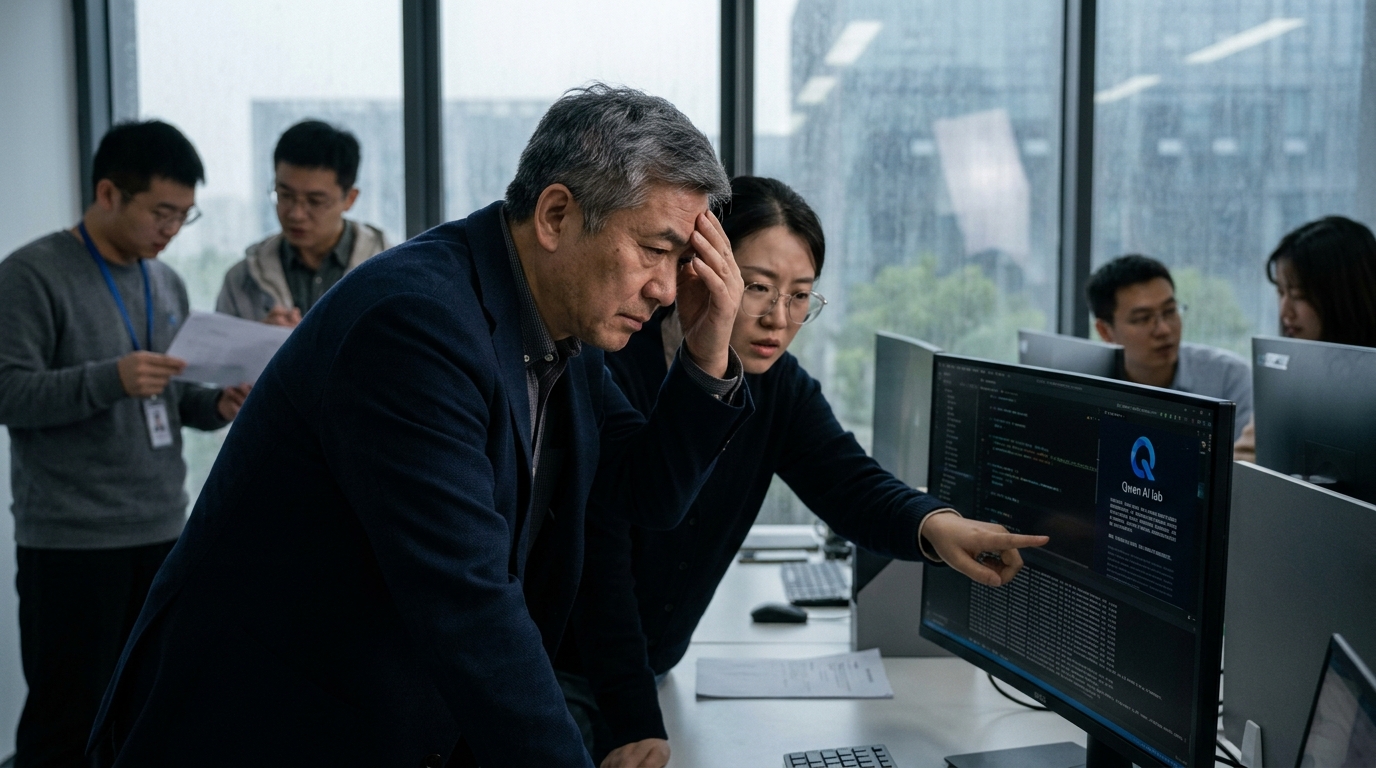
The global artificial intelligence landscape was shaken to its core as Alibaba Group Holding (BABA) witnessed a staggering 11.5% drop in its share price during a single trading session. The catalyst for this dramatic sell-off was a series of grave allegations leveled by the US-based AI safety firm Anthropic against Alibaba’s Qwen AI Lab. The accusations center on the alleged misuse of intellectual property (IP), claiming that the Chinese tech giant utilized proprietary data and architectural insights from Anthropic’s Claude models to accelerate the development of its own Large Language Models (LLMs).
The Nature of the Allegations and Market Reaction
According to sources close to Anthropic, the Qwen model exhibited specific behavioral patterns and response heuristics that strongly suggest it was trained directly on outputs from Claude—a practice often referred to as unauthorized 'model distillation.' Even more concerning are hints that Alibaba may have gained access to non-public training sets. The news triggered a wave of panic across the New York and Hong Kong stock exchanges, as investors braced for potential legal ramifications and a further intensification of the technological 'Cold War' between Washington and Beijing.
Alibaba, which has been aggressively pivoting toward AI leadership following its massive corporate restructuring, now sees the reputation of Qwen—once hailed as the most formidable Asian rival to GPT-4—under severe scrutiny. The 11.5% plunge reflects the market's acute sensitivity to ethical breaches and IP theft, particularly when they involve strategic adversaries of Western tech dominance.
The Technical Debate: Distillation vs. Theft
In the high-stakes world of AI, the boundary between 'inspiration' and 'theft' is increasingly blurred. Many developers use synthetic data generated by frontier models to fine-tune smaller, more efficient ones. However, Anthropic’s terms of service, much like those of OpenAI, strictly forbid the use of their model outputs to create competing commercial products. If Alibaba indeed used Claude to 'teach' Qwen how to reason, it represents a fundamental violation of commercial agreements and industry ethics.
Industry analysts have long noted that Qwen AI Lab produced remarkably high benchmark scores in a suspiciously short timeframe, often outperforming established Western models. Anthropic claims to have identified 'digital fingerprints'—unique markers in the model's logic—that prove the integration of their proprietary methodology. Alibaba has countered these claims, asserting that Qwen was built from the ground up using original research and open-source datasets, dismissing the allegations as 'baseless attempts to stifle Chinese innovation.'
Geopolitical and Economic Consequences
This dispute is far more than a corporate spat; it is a battle for the soul of the next industrial revolution. The US government is reportedly monitoring the situation, as it could justify further export controls on high-end chips and restrictive measures on Chinese firms' access to US cloud computing infrastructure. For Alibaba, the timing is particularly detrimental. After years of navigating Beijing’s domestic regulatory crackdowns, the company desperately needed a clean victory in AI to win back international institutional investors.
- The loss of billions in market capitalization hampers Alibaba's ability to fund future R&D initiatives.
- The potential for being blacklisted from international AI research collaborations is now a tangible threat.
- Institutional giants like BlackRock and Vanguard may reconsider their risk exposure to Chinese tech equities in light of these IP risks.
AI Ethics: A Global Imperative
The incident underscores a massive void in international AI governance. How do we protect an algorithm that learns from other algorithms? If information is accessible online, where does fair use end and intellectual property begin? Anthropic, founded on the principles of 'AI safety and alignment,' seems intent on drawing a hard line in the sand. Their stance could force the entire industry to adopt more transparent and verifiable training protocols.
"Artificial intelligence cannot be built on stolen foundations. Innovation requires integrity; otherwise, the entire ecosystem will collapse under the weight of litigation," a senior Anthropic representative stated.
In conclusion, Alibaba stands at a pivotal crossroads. If it fails to provide a transparent audit of its training data, it risks becoming a pariah in the global AI community. The 11.5% stock drop might just be the opening chapter of a long, arduous legal and geopolitical struggle that will define the distribution of technological power in the 21st century.