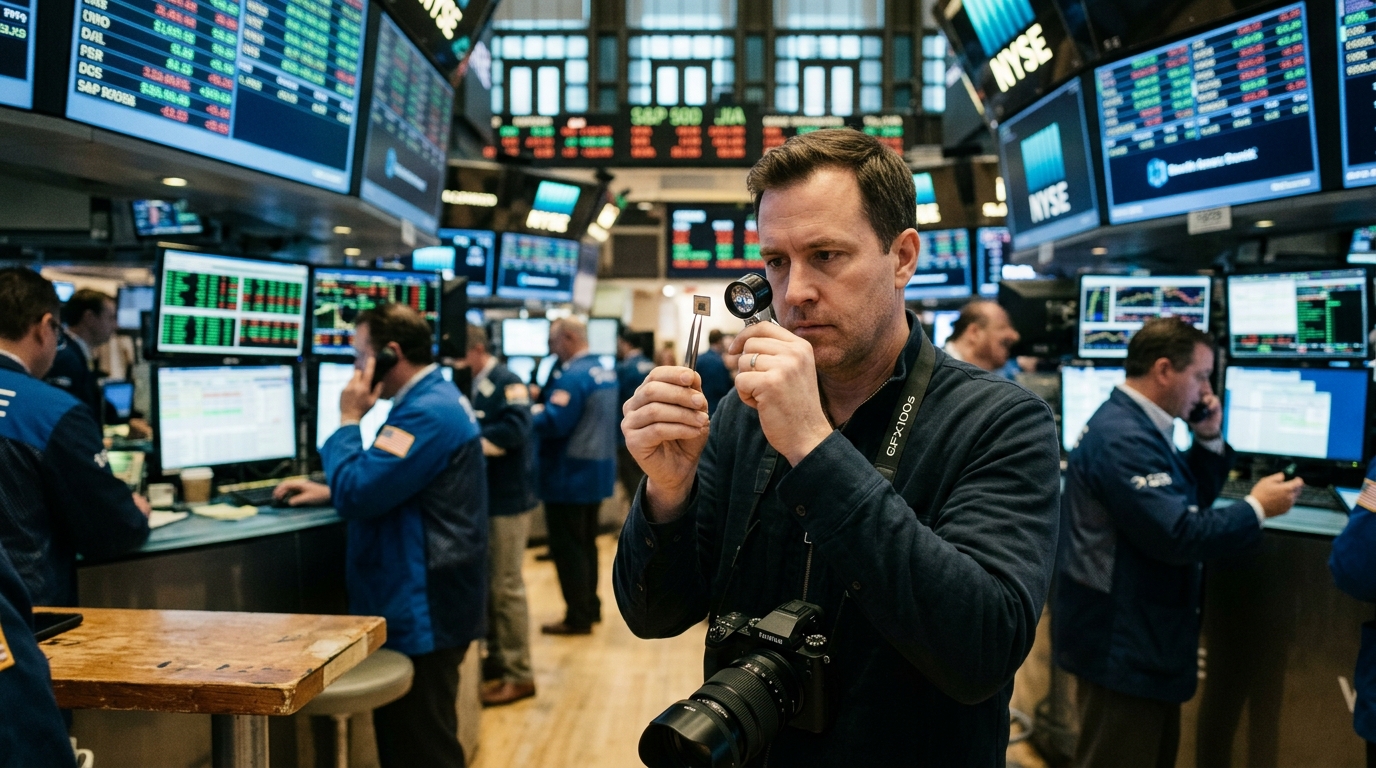
As we move through the second half of 2026, the frenzy that began with the emergence of Large Language Models (LLMs) has shifted from "what AI can do" to "how we will power it." Wall Street, always alert to the next big trend, has turned its gaze away from chatbot applications and toward the bowels of data centers. There, the next big bet isn't a new line of code, but a physical object, often smaller than a grain of rice: advanced semiconductors, High Bandwidth Memory (HBM) units, and silicon interconnects.
The Physics of Profitability: Why Size Matters
The era when Wall Street was impressed simply by an algorithm's ability to write poetry has passed. Today, analysts at Goldman Sachs and Morgan Stanley study the charts of TSMC and SK Hynix with the same dedication they once applied to bank balance sheets. The need for ever-increasing computational power has led to a race to shrink transistors to levels that touch the limits of quantum physics.
The components the market is referring to—such as the tiny capacitors and data transfer buses in new GPU architectures—are what allow the training of models with trillions of parameters. Without these microscopic engineering marvels, artificial intelligence would remain a theoretical exercise. Wall Street has understood that the real value lies in the "picks and shovels" of the digital gold mine, and these tools are getting smaller, yet disproportionately more expensive.
The Dominance of HBM Memory and the Chiplet Ecosystem
One of the key pillars of this new investment narrative is High Bandwidth Memory (HBM). As processors get faster, the main bottleneck is the speed at which data is transferred from memory to the processor. The chosen solution is stacking memory layers on top of each other, creating a structure that, while tiny, offers massive speeds. Companies like Micron and Samsung are fighting for dominance in this field, with their stocks showing volatility reminiscent of crypto, precisely because of the criticality of these components.
Simultaneously, "chiplet" technology—where a processor is no longer a single piece of silicon but an assembly of smaller, specialized units—allows manufacturers to push past the limits of Moore's Law. This shift to modular architecture means that Wall Street is no longer just investing in a single chip maker, but in the entire supply chain: from chemical and photolithography suppliers (like ASML) to companies specializing in advanced packaging.
Geopolitics and Energy Efficiency
It's not just about profits; it's about power. The miniaturization of these components has made their production the most critical geopolitical issue of the decade. Dependence on Taiwan and the efforts of the US and the EU to bring production back to their soil through billions in subsidies have turned silicon "grains of rice" into national assets. Investors now factor geopolitical risk into tech valuations more than ever before.
Furthermore, there is the issue of energy. As data centers consume an increasing percentage of global electricity, Wall Street is betting on components that offer the best performance-per-watt ratio. The tiny components that manage power within the chips (Power Management ICs) have become the unsung heroes of the market. A company's ability to reduce heat and consumption at the micro-scale translates directly into billions in savings for cloud giants like Microsoft and Amazon.
Conclusion: Small is the New Big
Wall Street has a proverbial ability to seek the substance behind the hype. While the general public is concerned with whether AI will replace writers or artists, "smart money" is funding the hardware revolution. The grain of rice described by the market is not just a metaphor for size, but for the fundamental importance of small things in building large empires. In the AI world of 2026, dominance is not judged by words, but by nanometers.