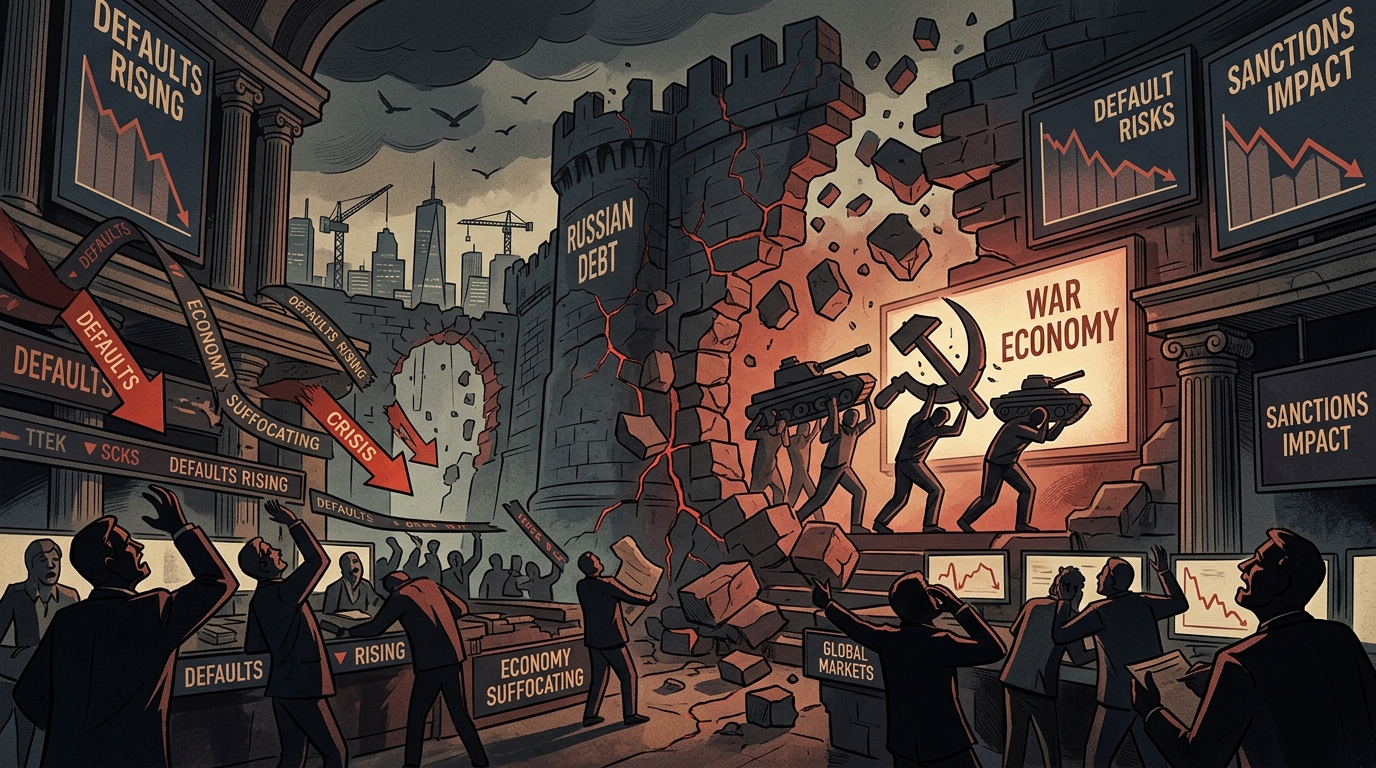
The image of the "fortress economy" that the Kremlin has meticulously crafted over the last four years is beginning to shatter in a spectacular fashion. As of May 2026, data emerging from sources like Izvestia and analyzed by international financial institutions reveal a grim reality: the Russian corporate bond market is in a state of freefall. Vladimir Putin’s strategic choice to sacrifice macroeconomic stability for the sake of military dominance in Ukraine has pushed 25% of the bond market to the edge of default.
The Anatomy of a Foretold Collapse
The numbers do not lie, and the trend is exponential. In 2024, there were 11 technical defaults recorded. In 2025, this number more than doubled to 24. However, the first quarter of 2026 has been the most alarming of all, with 11 cases of debt service failure already recorded in just three months. This means the rate of defaults has nearly quadrupled compared to the start of the crisis.
The cause of this bleeding is multi-faceted, but at its heart lies the suffocating monetary policy of the Central Bank of Russia (CBR). To curb skyrocketing inflation fueled by massive military spending, the bank has maintained interest rates at levels that make borrowing prohibitive for non-military enterprises. Russian companies, locked out of international capital markets due to sanctions, relied on the domestic bond market to refinance their debt. Now, with rates "burning" through balance sheets, refinancing is impossible, leading to a vicious cycle of non-payment.
The Bunker Mentality and the Shelter Economy
While the country's economic foundation erodes, reports from Moscow describe a President increasingly detached from economic reality. Vladimir Putin, now frequently referred to as the "bunker dweller," appears to have outsourced economic management to technocrats who are mandated to serve the front lines exclusively. The "war economy" has cannibalized the workforce, raw materials, and capital, leaving the private sector to starve.
- 25% of corporate bonds are now considered "high risk" or in pre-default status.
- Labor shortages due to mobilization have sent production costs soaring.
- State subsidies are directed solely toward the defense industry, leaving sectors like construction and retail exposed.
The irony is that Russia still reports GDP growth in its statistics, but this is a "hollow" growth. When you produce tanks that are destroyed at the front within days, you add to the GDP but subtract from the national wealth. This dissonance is what is causing the bond market collapse: investors see that companies not producing weapons have no future in the current system.
Long-term Consequences: A Lost Decade
The unfolding debt crisis is not merely a technical issue of financial markets. It is the prelude to a deep structural decomposition. The devaluation of the bond market means that for years to come, Russian entrepreneurship will lack access to working capital. Innovation has stalled, infrastructure is aging, and dependence on China for the import of even the most basic technological components has become absolute.
"Russia is not just facing an economic downturn, but an industrial regression that will take generations to reverse," analysts note.
In conclusion, Putin's obsession with war has created an economic time bomb. The defaults we see today are just the tip of the iceberg. If a quarter of the bond market collapses, the banks holding these bonds will face massive holes in their balance sheets, potentially leading to a systemic banking crisis that even petrodollars will not be able to stop.