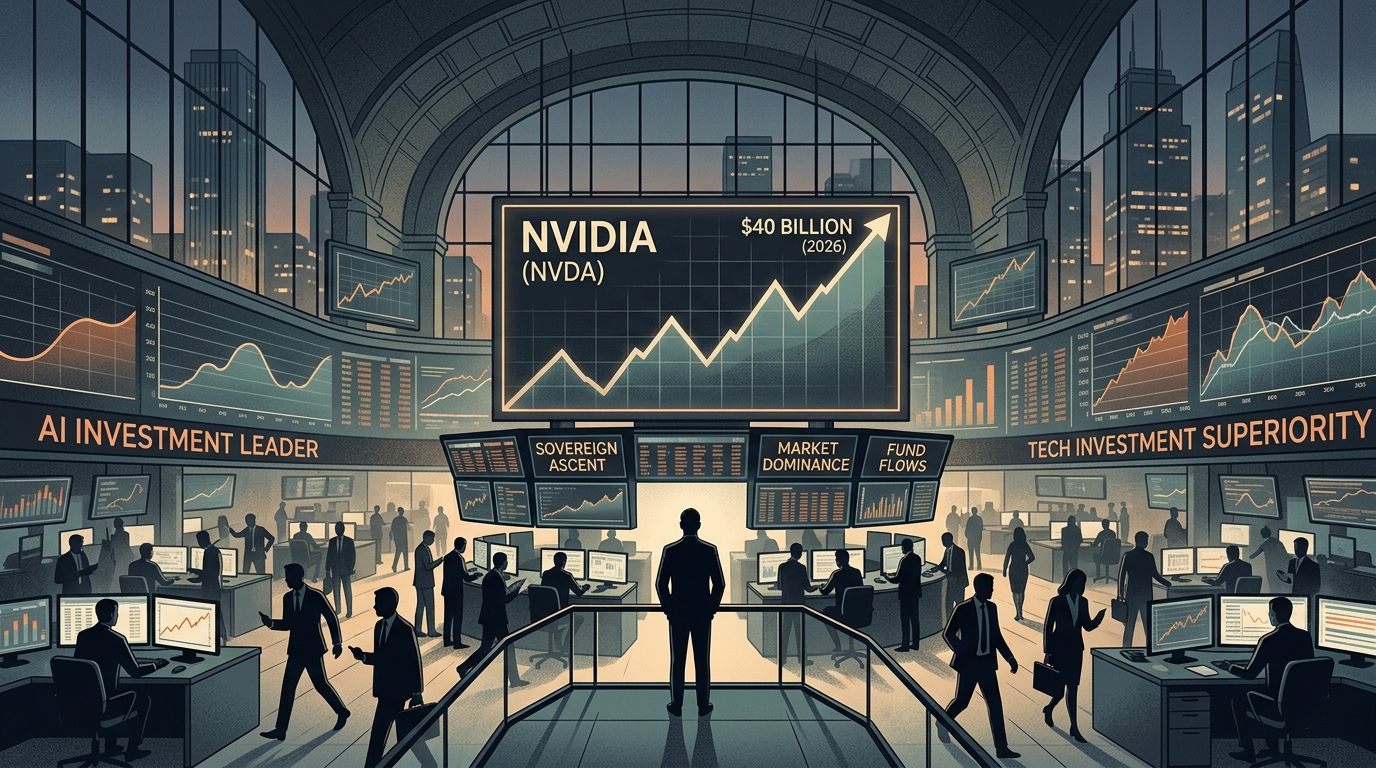
As of May 2026, Nvidia is no longer viewed merely as a manufacturer of graphics processors or AI chips. With the announcement that its investment portfolio in startups and strategic infrastructure has surpassed the $40 billion milestone, the Santa Clara giant has transformed into the de facto central banker of the global AI ecosystem. This development marks a historic shift in the balance of power in Silicon Valley, where ownership of hardware is now coupled with absolute control over capital flows.
The 'Circular AI Economy' Strategy
Nvidia's ascent to the top of the investment pyramid was no accident. The company implemented what many analysts call the "circular technology economy." By funding companies such as Mistral, Anthropic, and CoreWeave, Nvidia doesn't just secure stakes in future market leaders; it ensures these companies remain tethered to its architecture. These investments often come with agreements for preferential access to the latest Blackwell and Rubin processors, creating a closed loop where capital returns to Nvidia in the form of orders.
In 2026, this strategy has paid off beyond all expectations. Nvidia participates in more than 150 funding rounds annually, operating more like an aggressive Venture Capital fund than an industrial manufacturer. This vertical integration allows it to influence the technical specifications of the entire industry, making its CUDA software the undisputed standard for every new AI application.
Sovereign AI: The Geopolitical Dimension
One of the most intriguing aspects of Nvidia's investment activity in 2026 is its support for "Sovereign AI." The company has channeled billions into national infrastructure projects in countries like Saudi Arabia, the UAE, India, and France. By helping governments build their own domestic data centers, Nvidia has become an indispensable partner for the national security of these states.
This approach has a dual objective. First, it diversifies the company's revenue away from dependence on US Big Tech (Microsoft, Google, Meta). Second, it creates a geopolitical buffer against regulators. When a single company is responsible for the digital infrastructure of ten different nations, breaking it up or restricting it through antitrust laws becomes an extremely complex and dangerous process for international stability.
Backlash and the Shadow of Monopoly
However, this dominance does not come without pushback. The European Commission and the US FTC have intensified investigations into whether Nvidia is using its investment power to exclude competitors like AMD and Intel. Critics argue that startups receiving funding from Nvidia are "forced" to ignore alternative hardware solutions, even if they are more efficient for specific tasks.
Furthermore, there is the fear of a "semiconductor bubble." With Nvidia pumping $40 billion into the market, AI company valuations have skyrocketed to levels many consider unsustainable. If the demand for AI services wanes, the resulting domino effect could drag down the entire tech sector, given that Nvidia is now the connective tissue of the global digital economy.
Conclusion: Jensen Huang’s World
As we head into the second half of 2026, the question is no longer whether Nvidia will remain a leader, but who can challenge it. With a cash reserve reminiscent of a central bank and an investment strategy spanning from rare earth mining to generative AI software, Jensen Huang has built more than a company. He has built an empire that funds the very future it promises to construct. The challenge for competitors and regulators will be to ensure that this future does not belong exclusively to one player.