The global economic stage is at one of its most critical junctures in recent years, as escalating tensions between Iran and Israel bring the nightmare of an energy crisis back to the forefront. In April 2026, markets are not merely facing a temporary fluctuation but a structural threat that could derail central bank plans for interest rate cuts. However, in this volatile cocktail of geopolitical risk, a new factor is acting as a 'counterweight': Artificial Intelligence (AI).
The Oil Threat and the Ghost of Inflation
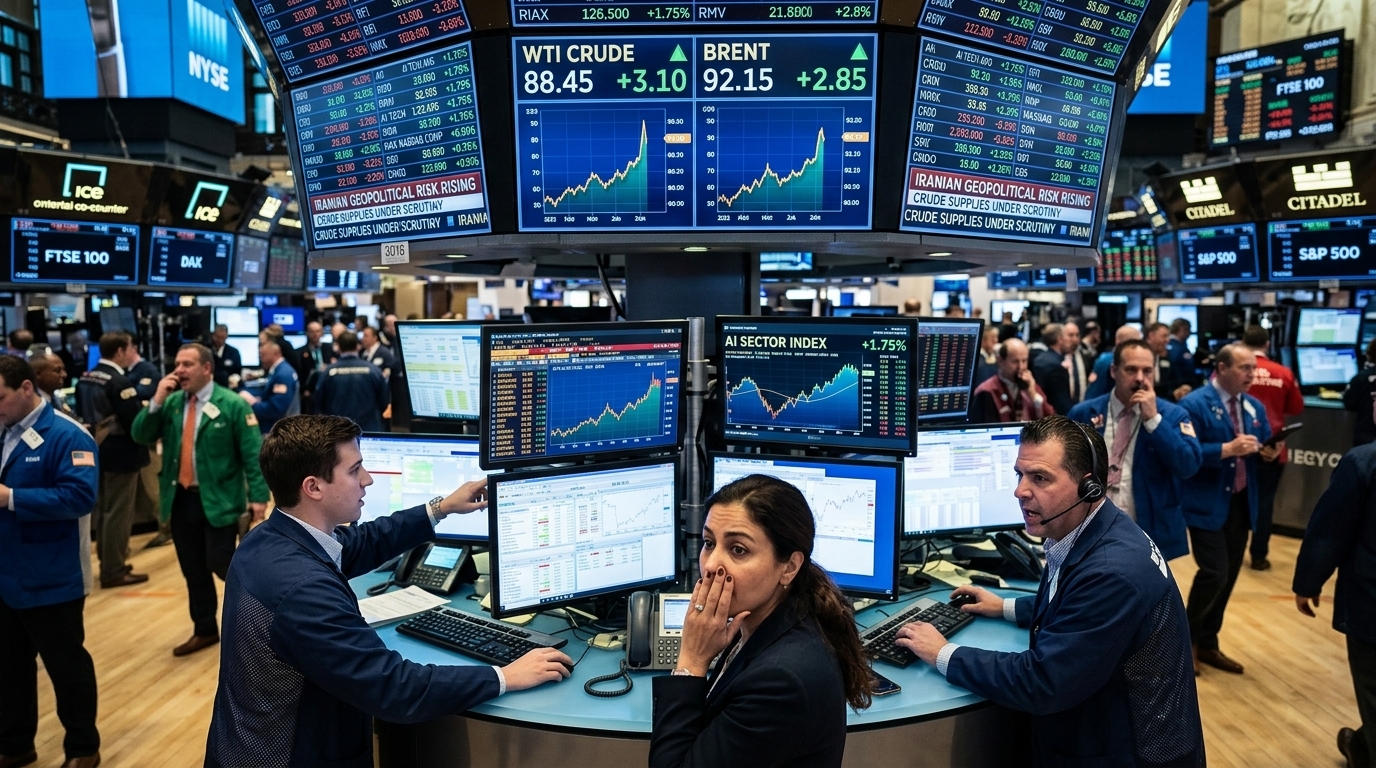
Wall Street and City of London analysts are watching developments in the Persian Gulf with bated breath. The possibility of a shipping disruption in the Strait of Hormuz—through which one-fifth of global oil consumption passes—has already driven Brent forecasts to $90 per barrel, with some extreme scenarios even suggesting triple digits. This increase is not just a problem for drivers at gas stations; it is a direct fuel for inflation.
If oil stabilizes above $90, the European Central Bank and the Fed will find themselves in a precarious position. The 'last mile' of the fight against inflation is proving to be the most difficult, as energy costs ripple through the entire supply chain. Markets, which until recently were pricing in aggressive rate cuts within 2026, are now forced to recalibrate, causing jitters across stock indices.
AI as an Investment Safe Haven
Despite the geopolitical storm, the technology sector, specifically companies leading the AI revolution, is showing remarkable resilience. This is no longer a mere speculative bubble but a fundamental shift in how value is generated. Artificial Intelligence acts as a counterweight to inflationary pressures in two primary ways:
- Productivity Gains: Businesses are integrating AI agents that reduce operational costs, offsetting the rise in energy prices.
- Resource Efficiency: Advanced AI models are now used to optimize supply chains and forecast demand, reducing waste in an era of expensive raw materials.
The 'Magnificent Seven' of tech continue to attract capital, as investors believe that innovation-based profitability is less vulnerable to oil fluctuations compared to traditional industrial sectors.
The Role of AI in Risk Management
A less visible but extremely significant aspect is the use of AI by financial institutions themselves to manage geopolitical risk. Algorithms now analyze millions of data points in real-time—from satellite images of tankers to official statements on social media—allowing fund managers to react in milliseconds. This 'digital shielding' has, so far, prevented a total market panic, keeping volatility at manageable levels.
"The market no longer just fears oil; it fears uncertainty. AI is the only tool we have to transform that uncertainty into calculable risk," says a senior analyst at Goldman Sachs.
Conclusion: A Dual Reality
We are in an era where the old economy of fossil fuels is colliding with the new economy of information. The tension with Iran serves as a reminder of the fragility of physical infrastructure, while the rise of AI highlights the power of intangible infrastructure. The bet for the remainder of 2026 is whether technological progress can run faster than geopolitical destabilization. For nations like Greece, which are directly dependent on energy imports but are striving to position themselves on the AI map, this balance is more than academic; it is a matter of national economic survival.