Friday, June 19, 2026, will be remembered as a watershed moment for India's technology ecosystem. Stock indices in Mumbai and Bengaluru turned deep red as investors reacted with alarm to Accenture Plc’s latest earnings guidance. The Dublin-based giant, often considered a bellwether for the global IT services industry, delivered a sobering message: global enterprises are tightening their belts, and the outsourcing sector is facing its most significant challenge in two decades.
The 'Accenture Effect' and the Indian Market
Why does an announcement from a company headquartered in Ireland cause such a tremor in India? The answer lies in the shared DNA of their client bases. Accenture competes directly with Indian giants like Tata Consultancy Services (TCS), Infosys, and Wipro for the same high-stakes contracts from Fortune 500 companies. When Accenture signals that its clients are deferring 'discretionary spending' on digital transformation, it is an omen that Indian firms will soon face a similar drought in new deal signings.
Following the news, shares of Infosys plummeted by 5.4%, while TCS and HCL Technologies saw their valuations drop by 4.2% and 3.8%, respectively. This selloff is not an isolated incident; it compounds a disastrous year for the sector, which has shed nearly 30% of its market capitalization in 2026 alone. The post-pandemic optimism that fueled a hiring frenzy and record valuations has evaporated, replaced by a harsh new economic reality.
The AI Threat: Moving from Arbitrage to Automation
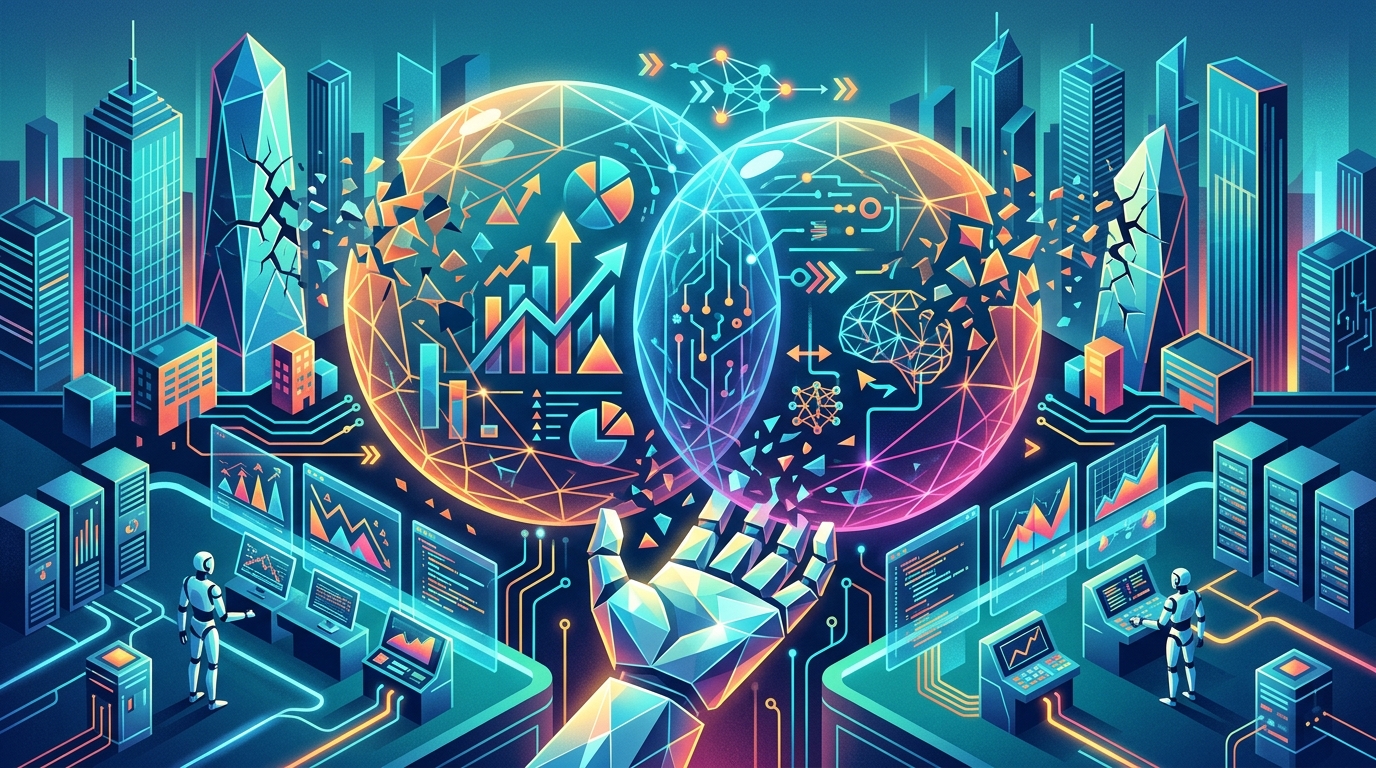
Beyond macroeconomic headwinds and high interest rates, the 'elephant in the room' is Generative Artificial Intelligence (GenAI). For decades, the Indian IT model was built on labor arbitrage—providing high-quality, low-cost human capital for coding, testing, and maintenance. In 2026, AI can perform many of these tasks in a fraction of the time and at a near-zero marginal cost.
Analysts point out that while enterprises haven't stopped spending on technology, they are fundamentally changing *how* they spend. Instead of hiring armies of junior developers, they are looking for AI-driven solutions that require far fewer human hours. Accenture warned that while its AI-related bookings are growing, they are not yet sufficient to offset the decline in traditional IT service contracts. This creates a 'revenue gap' that Indian firms are struggling to bridge.
"We are not just in a cyclical downturn. We are witnessing a structural shift where value is moving from man-hours to software intelligence," said a senior market analyst based in Mumbai.
Geopolitical and Macroeconomic Uncertainty
The situation is further complicated by a volatile global landscape. With major elections across key markets and ongoing uncertainty regarding central bank policies, CEOs are opting to preserve liquidity rather than commit to multi-year digital overhaul contracts. India, which exports the vast majority of its IT services to the US and Europe, is uniquely vulnerable to any slowdown in these economies.
Furthermore, rising domestic costs and wage pressures within India have squeezed the profit margins that once made these companies investor favorites. The days of effortless double-digit growth appear to be over. Companies are now forced to reinvent themselves as 'AI-first' organizations—a transition that requires significant capital expenditure and, more importantly, a radical shift in corporate culture and talent management.
Outlook: A Necessary Reckoning?
Despite the grim headlines, some industry veterans argue that this crisis will serve as a necessary 'cleansing' of the market. Firms that successfully integrate AI into their core offerings and provide high-level strategic consulting—rather than just body shopping—will likely emerge stronger. However, for the immediate future, the path remains steep. The tumble of Indian software stocks is a stark reminder that in the age of AI, no business model is invincible, regardless of its past glory. Investors will likely remain cautious until there is clear evidence that the Indian IT sector can lead the next digital revolution rather than being disrupted by it.