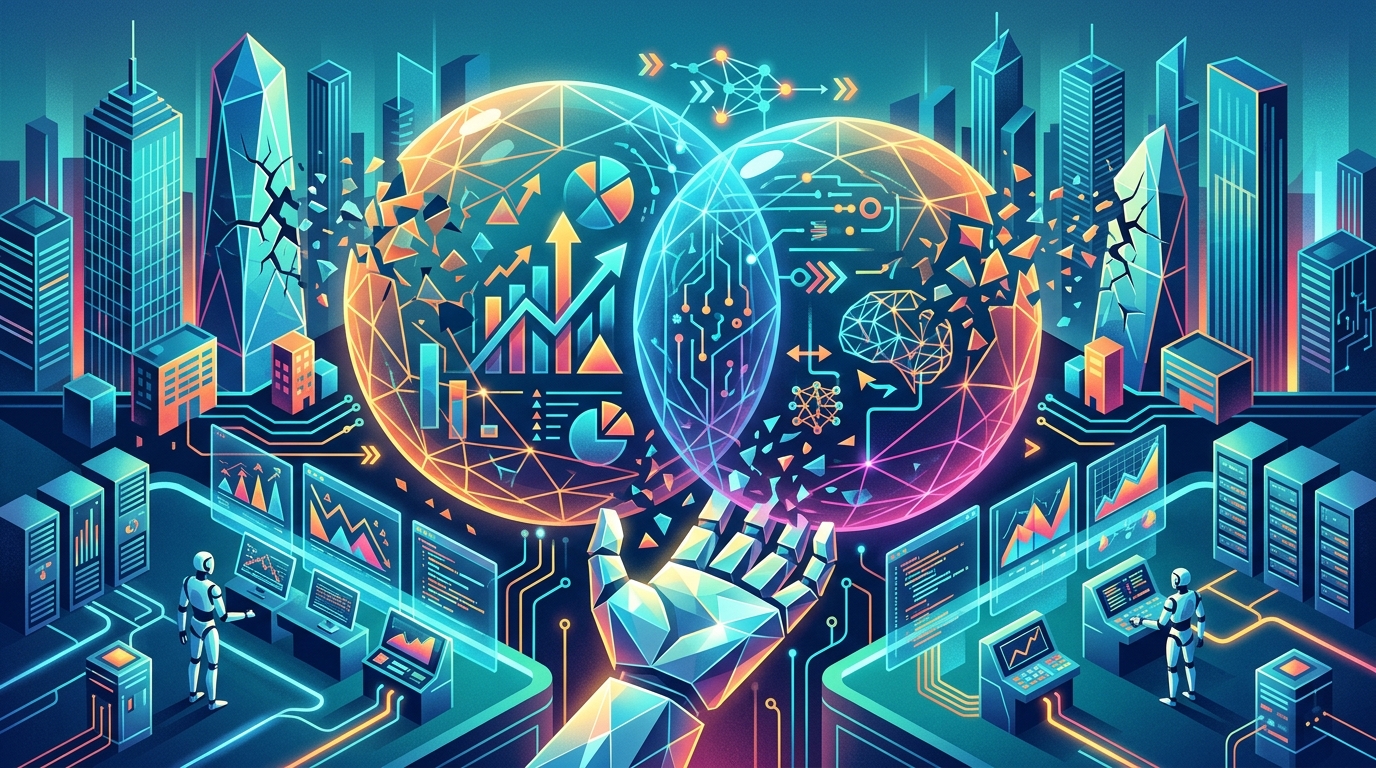
As we navigate the first half of 2026, the global discourse on Artificial Intelligence (AI) has shifted from the unbridled optimism of its early years to a profound, almost existential concern regarding the structure of the world economy. The International Monetary Fund (IMF), in its latest and most comprehensive report, does not mince words: AI is not merely a productivity tool, but a catalyst that could fracture the social contract unless immediate and coordinated intervention occurs.
IMF Managing Director Kristalina Georgieva pointed out that nearly 40% of global employment is exposed to the impacts of AI. In advanced economies, this figure rises to a staggering 60%. The key difference from previous technological revolutions—such as the steam engine or the internet—is the speed and depth of penetration. While industrial automation replaced manual labor, AI is now targeting the core of cognitive labor, affecting everyone from lawyers and financial analysts to software developers and administrative executives.
The Great Disruption: Who is at Risk?
According to the IMF analysis, the labor market is bifurcating into two distinct speeds. On one side are workers who can leverage AI to augment their productivity, likely leading to higher wages and more creative roles. On the other side lies a vast segment of the workforce whose skills are becoming obsolete. AI is no longer just 'assisting'; in many cases, it is fully replacing entire workflows through autonomous 'AI Agents'.
Of particular concern is the impact on young professionals. Entry-level positions, which have traditionally served as the training ground for career advancement, are being rapidly automated. This creates a structural vacuum: how will the leaders of tomorrow gain the necessary foundational experience if their first jobs have been taken over by algorithms?
- Wage stagnation in sectors with high automation potential.
- A widening gap between high-skilled and low-skilled labor.
- Long-term unemployment risks for older workers who find retraining challenging.
Geopolitical Inequalities and the Digital Divide
The IMF highlights that AI threatens to widen the gap not just between individuals, but between nations. Advanced economies possess the digital infrastructure and capital to reap the rewards of AI integration. In contrast, developing nations, which often rely on labor-cost advantages, risk losing their competitive edge. Without significant investment in digital literacy and infrastructure, the Global South could find itself in a state of permanent economic dependency.
"Artificial Intelligence could lead to an unprecedented concentration of wealth and power if governments do not redesign social safety nets," the report warns.
The IMF's recommendations include the potential implementation of 'AI taxes' or a comprehensive revision of capital taxation to fund universal basic income programs or massive reskilling initiatives. However, implementing such measures requires a level of international cooperation that seems increasingly difficult in today's polarized geopolitical climate.
The Economic Shift: Capital vs. Labor
From a purely economic standpoint, we are witnessing a historic shift from labor-intensive growth to capital-intensive growth. In 2026, the value of a company is increasingly tied to its proprietary models and compute power rather than its headcount. This creates a 'winner-takes-most' dynamic that challenges traditional antitrust laws and social welfare models.
For service-oriented economies, the challenge is double-edged. While AI can drastically reduce operational costs and improve service delivery, the displacement of middle-class service jobs could lead to a significant drop in consumer spending power, creating a feedback loop that could stifle growth. The IMF urges a proactive stance: governments must move beyond reactive policies and begin anticipating the labor shifts of the next decade today.
In conclusion, the IMF's warning is not a prophecy of doom but a call to action. The technology is here, and its effects are already being felt across all sectors. The question is no longer whether AI will transform work, but whether we, as a global society, are prepared to distribute the fruits of this transformation equitably.