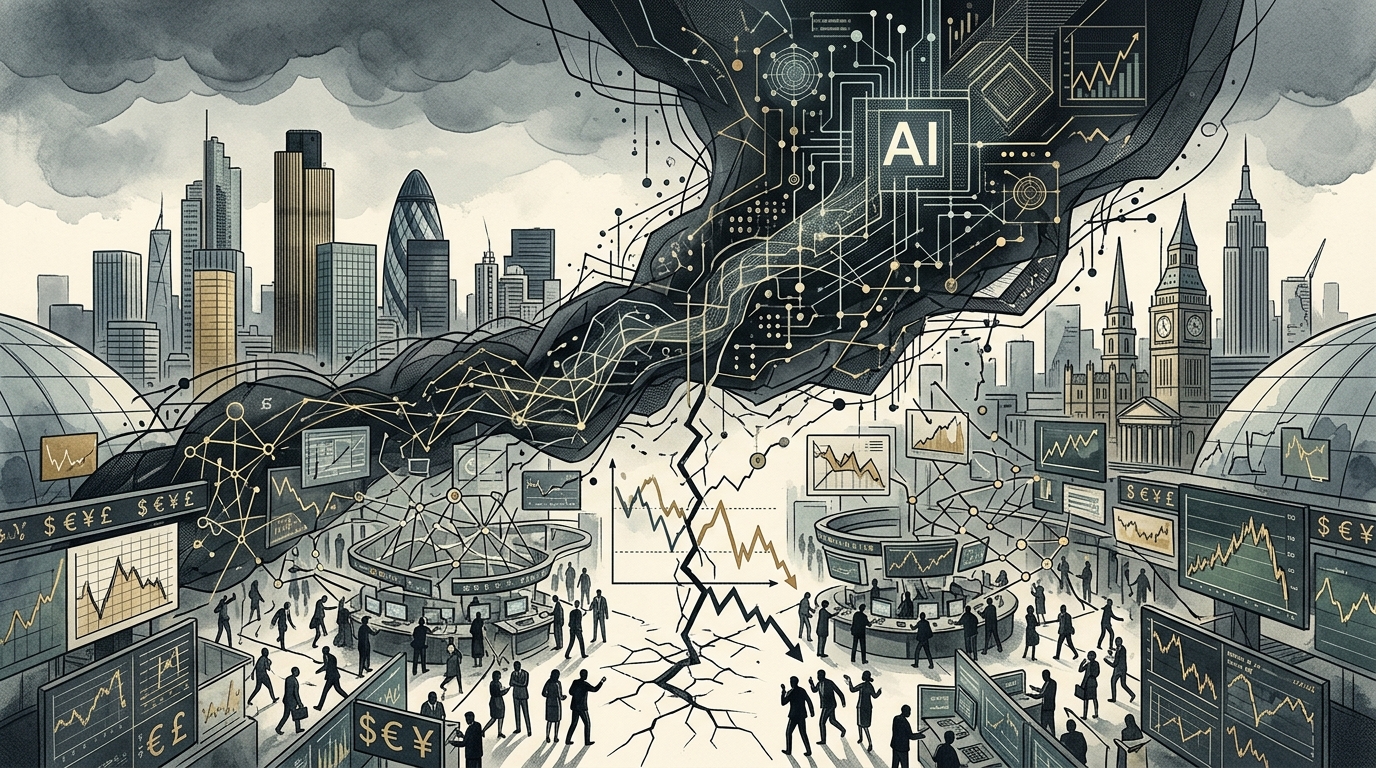
The history of financial crises teaches us that instability is often born in the blind spots of innovation. Today, the International Monetary Fund (IMF) is turning its spotlight on one such spot: the rapid and often unchecked integration of Artificial Intelligence (AI) into the global financial system. In a recent, extensive report that sent ripples through Wall Street and central banking circles, the Fund warns that AI is not merely an efficiency tool, but a potential source of systemic risk that could trigger the next great crisis.
The 'Monoculture' of Algorithms and Herding Behavior
One of the primary fears expressed by the IMF concerns the concentration of power among a few technology providers. As banks and investment firms rush to adopt models like those from Anthropic or OpenAI for decision-making, a dangerous uniformity is emerging. If a large number of financial institutions rely on the same underlying model for risk assessment or trade execution, any flaw or 'hallucination' in the algorithm can lead to simultaneous, massive market movements.
This 'algorithmic herding' can amplify volatility and lead to flash crashes. The IMF points out that the lack of diversity in decision-making undermines the resilience of the system. When all players 'think' using the same code, market corrections are no longer gradual; they become violent and universal. The systemic fragility increases when the 'plumbing' of finance depends on a handful of proprietary black boxes.
Cybersecurity: The New Generation of Threats
The report places significant emphasis on the escalation of cyber threats. AI provides malicious actors—ranging from individual hackers to state-sponsored entities—with tools to create highly convincing phishing attacks, automate the discovery of vulnerabilities in banking networks, and conduct 'data poisoning' attacks. In the latter case, attackers manipulate the training data of an AI model, forcing it to make incorrect decisions that benefit the intruder or paralyze the system.
The IMF highlights that the speed at which offensive AI is evolving is outpacing the defensive capabilities of many financial organizations. The possibility of a coordinated attack on payment infrastructures or transaction clearing systems is now a nightmare scenario that demands international cooperation and billions in investments toward 'defensive AI'. The digital perimeter is no longer a wall, but a shifting battlefield of algorithms.
The 'Black Box' and the Transparency Deficit
An additional layer of concern involves the opacity of deep learning models. Often, even the creators of these models cannot fully explain why an AI arrived at a specific decision. In the banking sector, this creates serious legal and ethical issues, especially regarding loan approvals or risk management. The IMF warns that if regulators cannot audit the logic behind algorithmic decisions, it is impossible to predict where the next crack in the system might appear.
The lack of 'explainability' means that during a period of market stress, humans might not be able to intervene effectively because they don't understand the AI's logic in real-time. This decoupling of human oversight from automated execution is a recipe for disaster in high-stakes financial environments. The IMF suggests that the 'black box' problem is not just a technical hurdle, but a fundamental regulatory challenge.
The report concludes with a call to action: central banks must incorporate AI into their stress-testing scenarios and enforce stricter data governance standards. While technology offers immense opportunities for cost reduction and financial inclusion, without the proper safeguards, the 'invisible hand' of the market risks being replaced by an 'invisible code' that no one fully controls.