The Greek energy market is undergoing a structural realignment that, according to recent data and government sources, places the country in a "higher energy tier" within the European Union. The transition from a lignite-based system to a model dominated by Renewable Energy Sources (RES) and natural gas as a bridge fuel is beginning to yield results in terms of macroeconomic indicators and export capacity. However, the debate over whether this ascent translates into tangible relief for households and businesses remains at the heart of political discourse.
The Surge of RES and Decarbonization
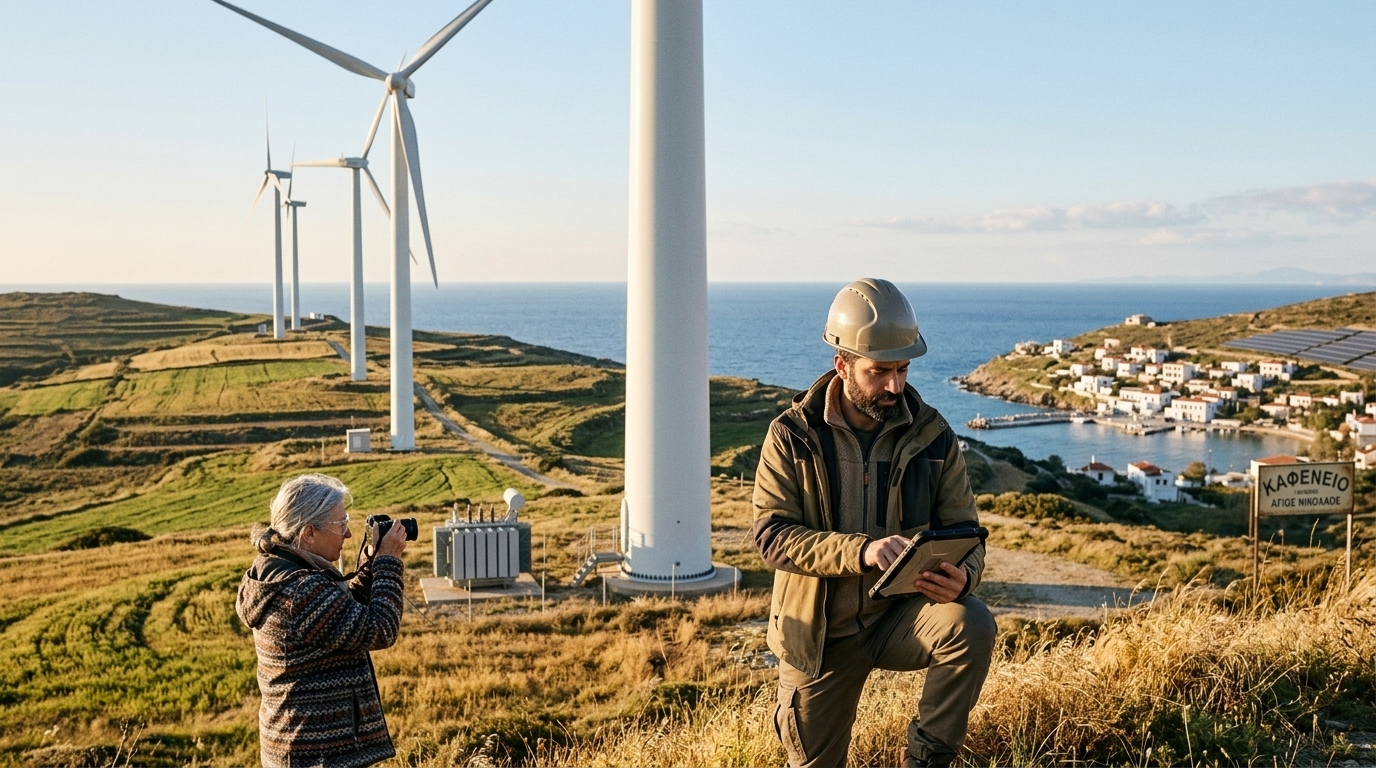
Greece has achieved one of the fastest rates of decarbonization in Europe. The strategic decision to decommission old, polluting units of the Public Power Corporation (PPC) while simultaneously promoting wind and solar farms has radically altered the energy mix. In 2025 and the early months of 2026, historical highs were recorded in the participation of RES in power generation, often exceeding 50% of total demand on a monthly basis. This development is not merely environmental; it is profoundly economic, as it reduces the need to purchase CO2 emission rights, which heavily burdened production costs in the past.
However, the penetration of RES brings the challenge of volatility. The "duck curve," where production peaks at noon when demand is low, necessitates investments in energy storage systems. The government has prioritized large-scale pumped hydro and battery projects to ensure that green energy is not wasted during peak production hours but is instead used when wholesale market prices rise.
Greece as a SE European Export Hub
One of the most striking developments of the last two years is Greece’s transformation from a net importer to a significant exporter of electricity. Through interconnections with Bulgaria, North Macedonia, Albania, and Italy, the country channels its surplus green production to neighboring markets. This strengthens the trade balance and positions Athens as a power player on the Balkan energy map. The strategic importance of the Vertical Corridor and new electrical interconnections (such as the Great Sea Interconnector to Cyprus and Israel) underscores the country's ambition to become the region's "green battery."
These exports also act as a balancing factor for prices. When domestic demand is low and RES production is high, exports allow producers to maintain viability, while Greece imports cheaper energy from the North when conditions demand it. This Market Coupling is the pillar of the European Target Model, which Greece is implementing with increasing success.
The Reality of Prices: Wholesale vs. Retail
Despite the optimism of government officials, Greece's position in the EU price rankings remains a complex issue. In the wholesale market, Greece often records prices lower than the European average, especially during periods of high sunshine. However, the retail price reaching the end consumer is burdened by regulated charges, taxes, and the cost of distribution (HEDNO) and transmission (IPTO) networks, which require massive investments for modernization.
Furthermore, the Greek energy exchange is characterized by less depth compared to Central European markets, making it more susceptible to sharp fluctuations (volatility). The government argues that retail prices in Greece, after subsidies and special tariffs, remain competitive. Nevertheless, comparisons with countries like Spain or Portugal, which have similar climates but different market structures, show that there is still room for improvement, particularly in protecting energy-vulnerable households.
Challenges and the Future of Energy Costs
The great challenge for 2026 and beyond is stabilizing prices at levels that will allow Greek industry to remain competitive. High energy costs act as a deterrent to the growth of the secondary sector. The promotion of Power Purchase Agreements (PPAs) between RES producers and industries is a solution being heavily pushed, allowing businesses to "lock in" low prices for long periods, independent of stock market fluctuations.
In conclusion, Greece is indeed moving toward a higher energy tier. Its geopolitical position, the rapid development of RES, and international interconnections grant it a role that transcends its borders. The challenge now is to ensure that the benefits of this transition permeate throughout society, reducing energy costs in a permanent and fair manner, away from the need for emergency state interventions and subsidies.