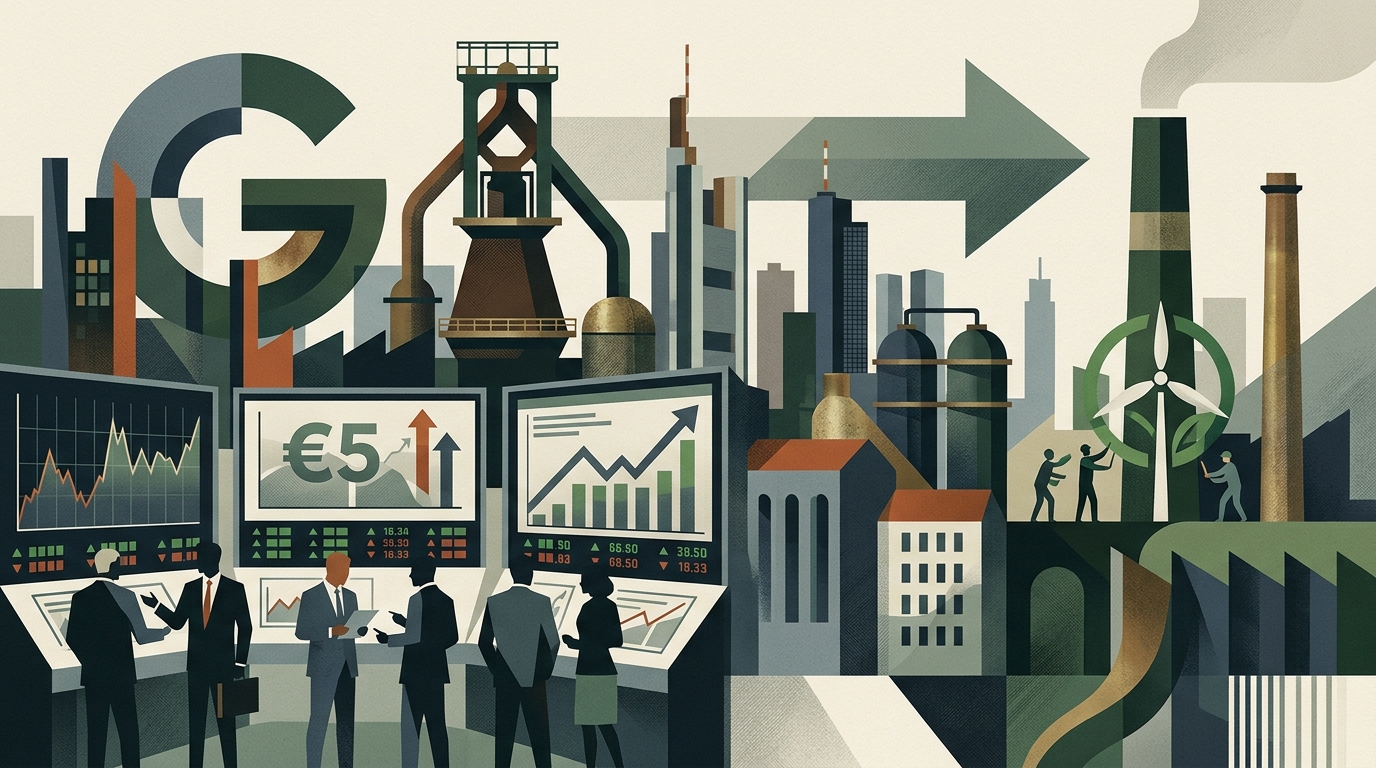
In a move described as an "existential necessity" for the engine of the European economy, Berlin has announced the activation of an ambitious €5 billion subsidy program. The goal is to support Germany's heavy industry—from steel and cement to chemicals—on its path toward decarbonization. The program, based on the "Climate Protection Contracts" mechanism, is Germany's direct response to the aggressive subsidy policies of the US (Inflation Reduction Act) and China's dominance in green technologies.
The Mechanism of Carbon Contracts for Difference (CCfD)
The heart of this initiative lies in the "Carbon Contracts for Difference" mechanism. This is an innovative financial structure where the state commits to covering the additional costs incurred by using clean technologies (such as green hydrogen) compared to traditional fossil-fuel-based methods. If the price of carbon in the EU Emissions Trading System (ETS) rises enough to make green technology competitive, companies will return the difference to the state. This creates a safety net for the long-term investments required to transform massive industrial plants.
The German government, under pressure from high energy prices following the invasion of Ukraine, realizes that deindustrialization is no longer a theoretical scenario but a visible threat. Major industrial units have already begun moving production outside Europe, seeking cheaper energy and more favorable regulatory frameworks. The €5 billion is merely the first installment of a total commitment that could reach tens of billions in the coming years.
Geopolitical Competition and the Shadow of the USA
Berlin's move does not happen in a vacuum. Washington, through the Inflation Reduction Act (IRA), offers massive tax breaks and subsidies for green investments, attracting European giants. Simultaneously, China continues to flood the global market with cheap low-carbon products, backed by state funds. Germany, traditionally the guardian of free-trade rules, is now forced to adopt a more interventionist industrial policy to survive.
- Protecting jobs in energy-intensive sectors.
- Accelerating the transition to climate neutrality by 2045.
- Maintaining technological leadership in manufacturing and engineering.
- Reducing dependence on imported fossil fuels.
However, critics of the program point out the risks. Having the state "pick winners" can lead to market distortions and a waste of resources if the chosen technologies do not prove sustainable in the long run. Furthermore, Germany's constitutional "debt brake" (Schuldenbremse) limits the room for maneuver, creating internal political friction within the governing coalition.
The Infrastructure and Energy Cost Challenge
Beyond direct subsidies, the success of this "green offensive" depends on the speed of infrastructure development. Without an extensive hydrogen transport network and without a sufficient supply of cheap renewable electricity, the €5 billion will be little more than a "bandage" on a deep wound. Industrialists warn that electricity prices in Germany remain prohibitive compared to the US or China, making even subsidized investments only marginally profitable.
"This is not just about climate policy; it is about the very survival of Germany as an industrial nation," stated a senior executive from the Federation of German Industries (BDI).
In conclusion, Germany is attempting a difficult experiment: to turn the climate crisis into an opportunity for industrial renaissance. If the €5 billion gamble pays off, it will serve as a model for the entire European Union. If it fails, Europe risks becoming a "museum of industrial history," while the rest of the world marches forward into the green era.