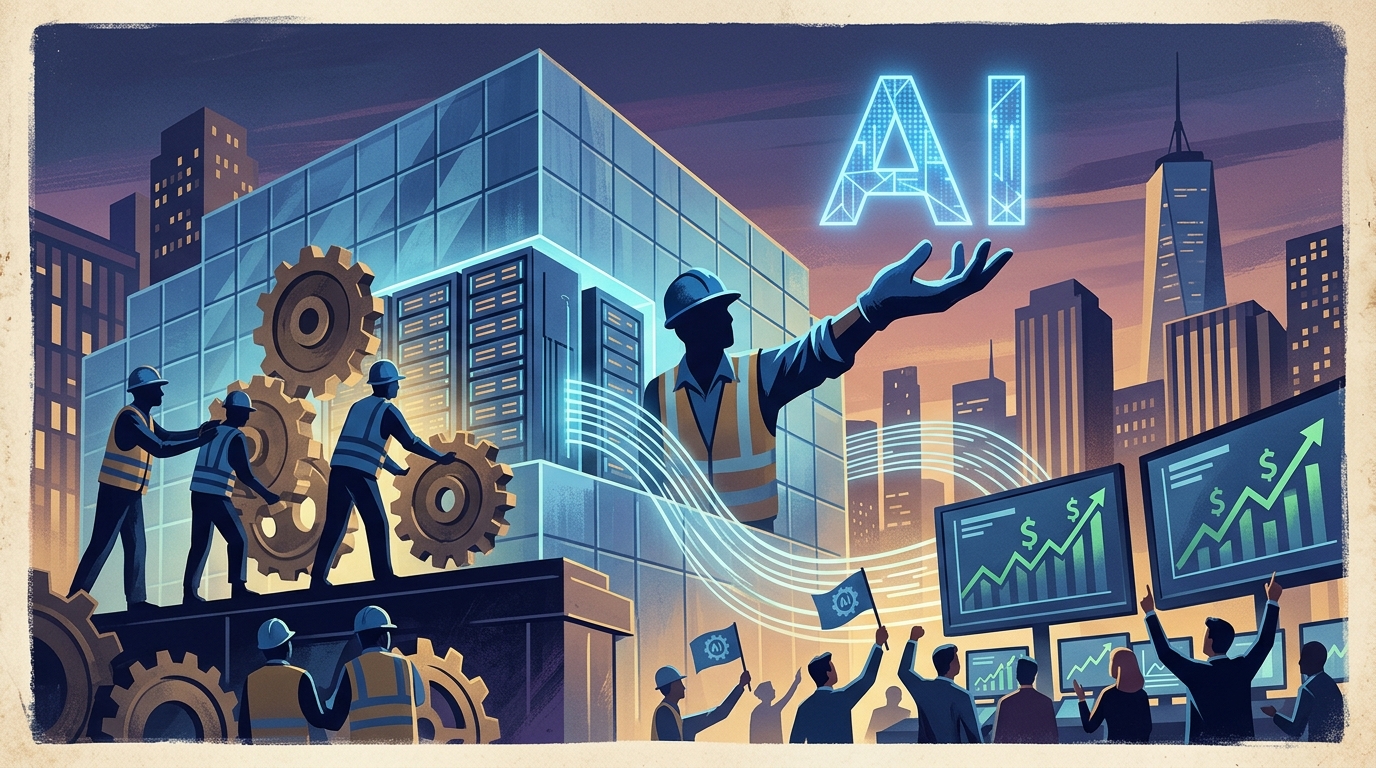
The global race for Artificial Intelligence (AI) dominance is not merely being fought in coding labs and Silicon Valley boardrooms. It is being waged, with increasing intensity, in the mud and steel skeletons of construction sites worldwide. As the demand for raw computing power skyrockets, tech giants—Google, Microsoft, Amazon, and Meta—are facing a common hurdle: fierce local opposition to the construction of massive data centers. However, they have discovered an unexpected and remarkably potent ally: blue-collar labor unions.
The Infrastructure Clash and Local Resistance
For years, data centers were viewed as "clean" investments. But the sheer scale of the AI era has shifted the paradigm. These facilities now require gargantuan amounts of electricity, often straining local power grids to their breaking points, and consume millions of gallons of water for cooling server racks. In many communities, from Northern Virginia to Dublin and Frankfurt, residents are pushing back, citing noise pollution, visual blight, and, most critically, the environmental footprint.
This is where the union factor comes into play. Tech companies have realized that the abstract promise of "digital progress" is no longer enough to appease an angry mayor or a local environmental group. They need political cover and grassroots support. By forming alliances with trade unions—representing carpenters, electricians, and ironworkers—they transform a controversial tech project into a "jobs project." When a union leader stands before a city council to support a data center, the narrative shifts instantly. It is no longer about a faceless multinational corporation; it is about the livelihoods of local workers.
Economic Incentives and the Politics of Construction
Building a state-of-the-art AI data center costs billions of dollars. While the operational phase requires a relatively small permanent staff—often just a few hundred technicians—the construction phase can employ thousands of workers for several years. For unions, these projects are gold mines. They provide steady, high-paying work with benefits at a time when traditional manufacturing is in flux.
This alliance also carries profound political weight. In the United States, for instance, the Biden administration has placed union empowerment at the heart of its economic agenda. Tech giants, frequently targeted by regulators over antitrust concerns, are using these partnerships to earn political capital in Washington. They present themselves as the backbone of a new American industrialism that doesn't just produce code, but also builds robust, physical infrastructure.
The Sustainability Paradox and the Path Ahead
However, this marriage of convenience is not without its contradictions. Environmental advocates warn that the rapid expansion of data centers is undermining global climate goals. The massive energy demand often forces utilities to delay the retirement of coal or natural gas plants. Unions, naturally, tend to prioritize immediate employment over stringent environmental mandates, creating a unified front that activists find difficult to penetrate.
Furthermore, there is the question of long-term job sustainability. What happens once the initial AI infrastructure boom subsides? Tech companies are betting that the need for upgrades and new facilities will be perpetual. But for local communities, the risk remains: being left with massive, energy-hungry monoliths that contribute little to the local economy once the cranes are gone.
"We aren't just building shells; we are building the brain of the next industrial revolution, and we want our workers to hold the keys," a union representative in Ohio recently remarked.
In conclusion, Big Tech has learned a vital lesson from the industrial titans of the past: political power flows from the ground up. By using blue-collar labor as a strategic shield, technology companies are navigating obstacles that once seemed insurmountable. The battle for data centers proves that even in the age of AI, the future is still built with concrete, sweat, and shrewd alliances.