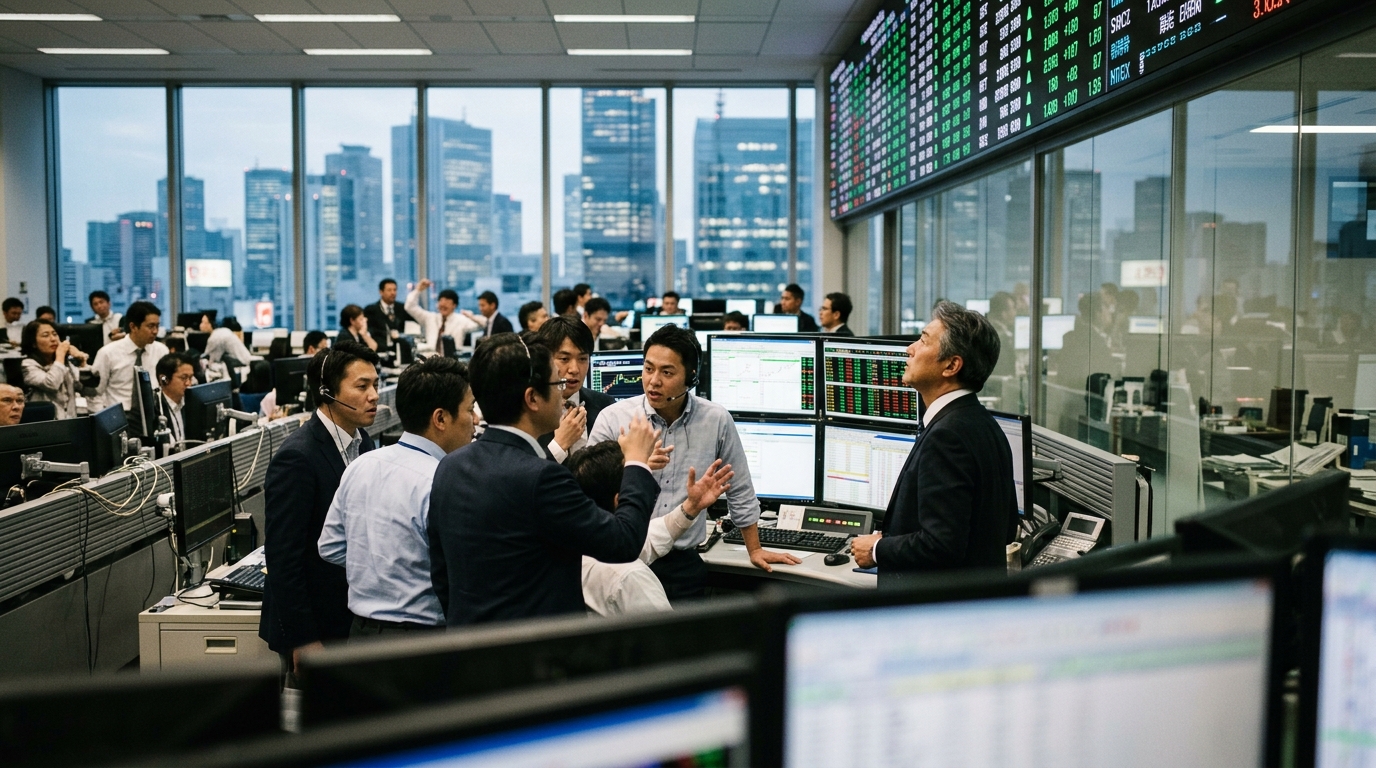
In the spring of 2026, Asian financial markets are displaying a phenomenon that can only be described as "geopolitical schizophrenia." On one side, indices in Taipei and Seoul are shattering records, fueled by an insatiable global demand for semiconductors that power Artificial Intelligence (AI). On the other, military drills in the Taiwan Strait and escalating tensions in the South China Sea create a backdrop that, in any other era, would have triggered a massive capital flight.
This phenomenon, which analysts are calling "The Great Asian Divide," highlights a new reality: the promise of AI is so potent that it is successfully drowning out the drums of war. Investors appear to be betting that global reliance on TSMC and Samsung is so absolute that no power would dare disrupt their production, effectively turning technological supremacy into a unique form of "digital shield."
Semiconductor Dominance and the Risk Decoupling
The AI surge is no longer just a technological trend; it is the primary engine of economic divergence in the Asia-Pacific region. While China struggles with a persistent real estate crisis and internal deflationary pressures, its high-tech-focused neighbors are thriving. Taiwan, despite constant threats from Beijing, has seen its stock market rally by 25% since the beginning of the year, with TSMC leading the charge.
This decoupling between geopolitical risk and investment behavior is unprecedented. Institutional investors, instead of seeking safe havens in gold or US Treasuries, are pouring liquidity into companies like SK Hynix and Tokyo Electron. The logic is cynical yet clear: if war breaks out in Taiwan, the global economy will collapse regardless, so why not capitalize on AI gains while peace lasts?
The Chinese Paradox and the "Chip Curtain"
On the other side of the divide sits China. Despite Beijing's efforts to achieve technological self-sufficiency, US export restrictions on advanced chips have erected a "Chip Curtain" across the IT sector. Chinese tech giants like Alibaba and Tencent are failing to keep pace with the global AI rally, as their access to the necessary hardware remains severely restricted.
This creates an asymmetric market. Japan and South Korea have fully aligned themselves with the US-led supply chain, reaping massive financial rewards while simultaneously increasing their exposure to Washington's policy shifts. Asia is no longer a monolithic emerging market; it is a battlefield where economic success depends on who holds the keys to the most sophisticated algorithms and the processors that run them.
A Fragile Balance for the Future
How long can this euphoria last? Future historians may look back at 2026 as the year of the great delusion. The belief that economic interdependence prevents conflict has been debunked repeatedly throughout history. However, in the age of AI, interdependence is deeper than ever. It is not just about trade in goods; it is about the very "intelligence" of modern states.
Investors are now forced to navigate an environment where corporate fundamentals are exceptional, but geopolitical risk is flashing red. The "AI at any cost" strategy dominates the narrative, but history teaches us that when markets ignore political reality for too long, the eventual correction tends to be violent and unpredictable.