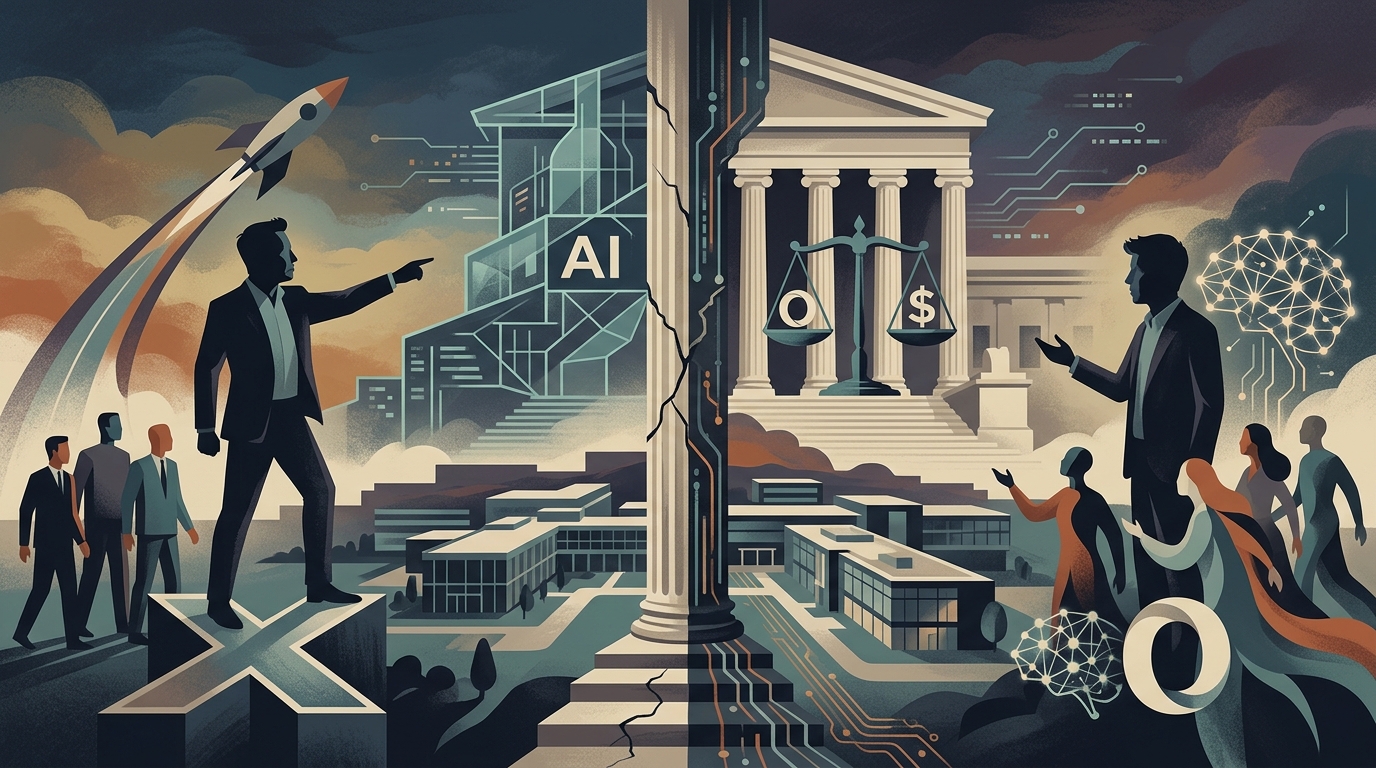
Today, Monday, April 27, 2026, the global tech spotlight shifts to a San Francisco courtroom. The long-simmering conflict between Elon Musk and Sam Altman, CEO of OpenAI, has moved into its most critical phase. This is far from a mere personal feud between two billionaires; it is a legal collision that could redefine how Artificial Intelligence is developed, governed, and distributed in the 21st century.
The "Betrayed" Mission and the Founding Agreement
The core of Musk’s lawsuit lies in the allegation that OpenAI has dangerously veered away from its original mission: creating Artificial General Intelligence (AGI) for the benefit of humanity, free from profit-driven pressures. Musk, who was a primary donor during the organization's founding in 2015, claims there was a "Founding Agreement" stipulating that OpenAI would remain a non-profit and its code would be open to the public.
According to Musk’s legal team, OpenAI's transition into a "capped-profit" entity and its intimate partnership with Microsoft constitute a flagrant breach of this contract. "OpenAI has been transformed into a closed-source de facto subsidiary of the largest technology company in the world: Microsoft," the lawsuit states. Musk is asking the court to compel OpenAI to make its research public and to prohibit Microsoft from profiting from GPT-4 or future AGI-level models.
OpenAI’s Defense and the Reality of Survival
On the other side, Sam Altman and OpenAI’s legal counsel categorically reject these claims. Their primary line of defense is that a formal, signed "Founding Agreement" as described by Musk never existed. Instead, they argue that Musk himself acknowledged as early as 2018 that developing AGI would require billions of dollars in compute power—resources that could never be secured through donations alone.
OpenAI is expected to present internal emails showing that Musk once proposed merging OpenAI with Tesla or taking full control himself to compete with Google. "It is ironic," say sources close to the company, "that the man who once sought total control is now posing as a champion of open-source, all while building his own for-profit AI venture, xAI."
Implications for the Tech Ecosystem
This trial is expected to last weeks and unearth discovery documents revealing the inner workings of the world’s most influential AI firm. Analysts highlight three critical points of impact:
- The Definition of AGI: If the court accepts that current technology (like GPT-4 or the recently teased GPT-5) approaches or constitutes AGI, it could trigger clauses that exclude Microsoft from using it, causing a massive disruption on Wall Street.
- The Open-Source Model: A ruling in Musk’s favor could force companies toward greater transparency, though critics fear this might provide an advantage to geopolitical rivals like China.
- The Integrity of Non-Profit Structures: The case questions whether an organization can start as a charity and pivot into a global commercial titan without legal repercussions.
As both parties enter the courtroom, the stakes are not just billions of dollars, but the custody of the keys to a technology promising to alter human history. The verdict will set a precedent for every future startup that promises to save the world while simultaneously seeking to dominate it.