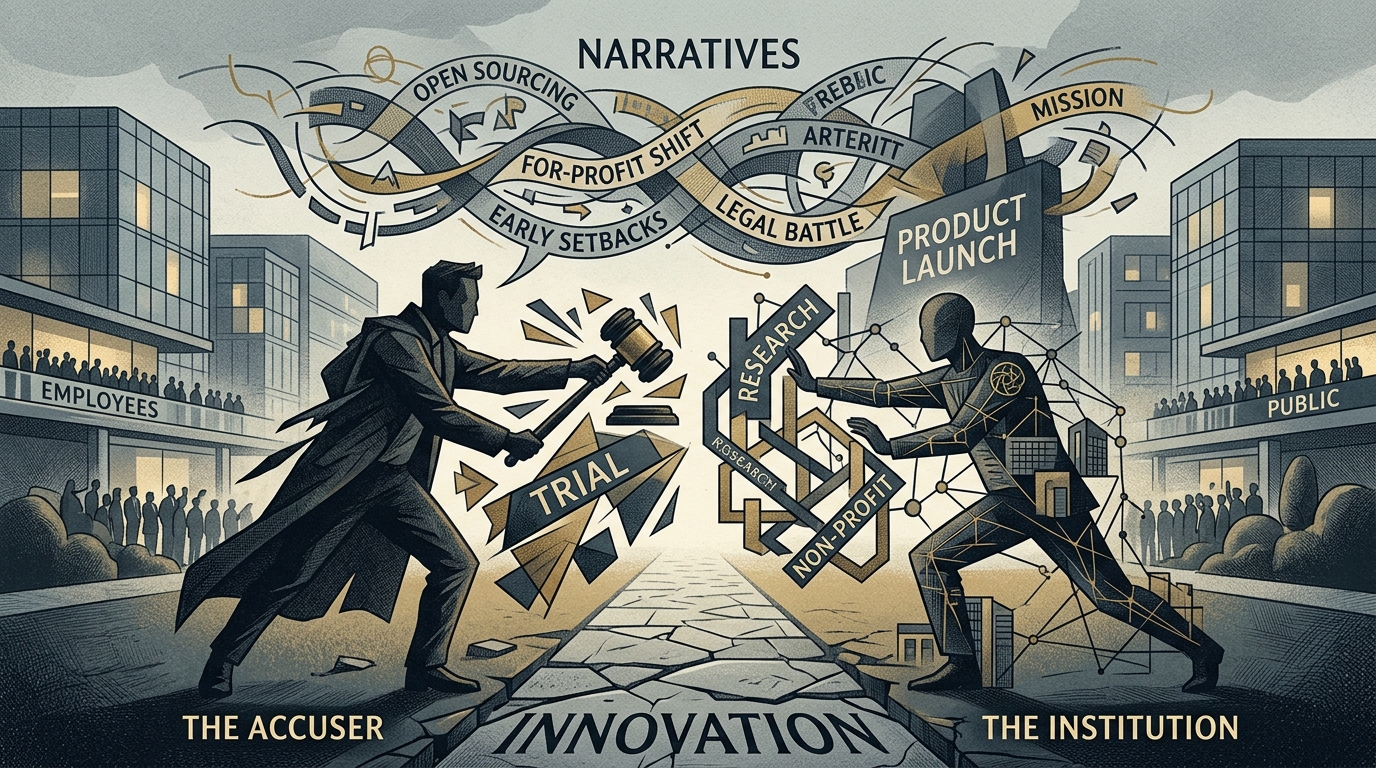
The courtroom in San Francisco became the epicenter of the global tech world this week as the highly anticipated trial of Elon Musk against OpenAI and its CEO, Sam Altman, commenced. What Musk sought to present to the jury as a simple tale of betrayal—a founder abandoned and a philanthropic mission sacrificed at the altar of profit—quickly began to complicate under the weight of legal technicalities and revelatory past communications.
The 'Founding Agreement' That Never Was
The core of Musk’s lawsuit rests on the allegation that OpenAI breached a 'founding agreement' to remain a non-profit organization developing artificial intelligence for the benefit of humanity, keeping its code open-source. However, during the first week of proceedings, OpenAI’s lawyers repeatedly emphasized that no signed document exists that constitutes such a contract. The defense argued that mission statements and emails from 2015 do not amount to a legally binding contract, but rather a philosophical direction that had to adapt to the harsh economic realities of AI development.
Musk’s strategy relies on the concept of 'promissory estoppel,' claiming he donated tens of millions of dollars based on promises made by Altman and Brockman. Yet, OpenAI hit back by presenting evidence showing that Musk was aware of, and in some cases supported, the transition to a for-profit model to attract capital, provided he maintained control.
The Email Trap and Tesla’s Shadow
The most challenging moment for Musk during the first week was the release of internal messages from 2018. In these, Musk appears to suggest that OpenAI’s only hope of competing with Google was to be absorbed by Tesla and used as a 'cash cow' for his car company. This revelation undermines the narrative of the 'pure idealist' fighting against commercialization. OpenAI’s lawyers argued that Musk’s ire stems not from the loss of open access to technology, but from the fact that OpenAI succeeded spectacularly without him at the helm.
- Emails show Musk suggested merging OpenAI with Tesla as early as 2018.
- The defense focuses on Musk halting funding when his demand for total control was rejected.
- Microsoft, while not a direct defendant, sits at the center as the 'for-profit demon' in Musk's view.
The Conflict Over AGI and Microsoft
Another critical point of the trial is the definition of Artificial General Intelligence (AGI). OpenAI’s agreement with Microsoft stipulates that the latter has rights to OpenAI’s technology until AGI is achieved. Musk claims that GPT-4 (and its successors) already constitutes a form of AGI, and therefore OpenAI is 'hiding' this progress to protect Microsoft’s commercial interests. OpenAI, on the other hand, maintains that AGI remains a future goal and that current technology is merely a sophisticated word-prediction tool.
"Justice cannot be based on memories and promises made at dinners, but on written commitments that stand the test of time," stated OpenAI's lead counsel during the opening arguments.
As the trial progresses, the stakes are not just about damages or access to code, but the future of AI governance. If Musk succeeds in convincing the jury, he could force OpenAI to open-source its models, which would cause an earthquake in the market and jeopardize the partnership with Microsoft. However, after the first week, the path for the billionaire appears much steeper than anticipated.