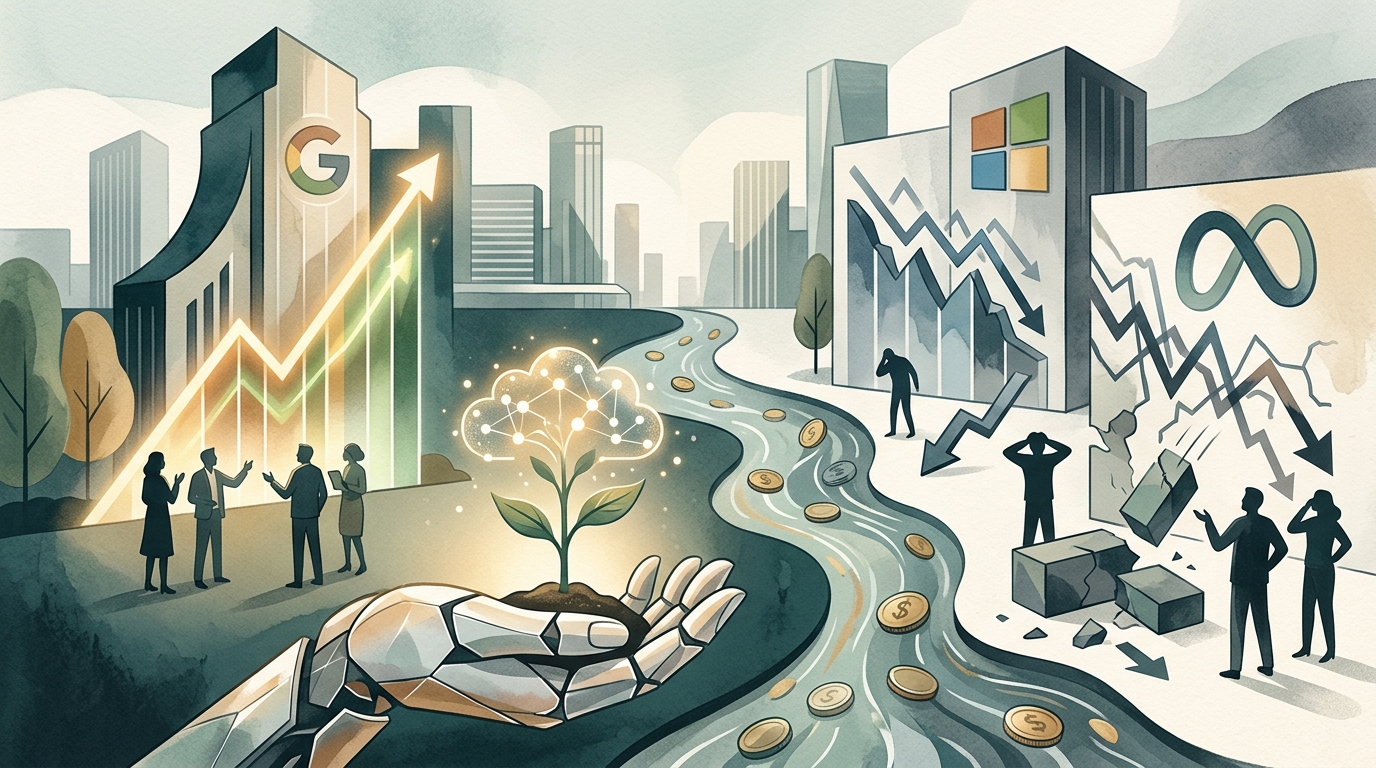
The era of the "blank check" for Artificial Intelligence is coming to an end. As we move through the second quarter of 2026, the financial reports from Microsoft, Meta, and Alphabet (Google) reveal a stark reality: building the future of AI is costing significantly more than initially projected, and Wall Street’s patience is wearing thin. While all three giants announced massive hikes in capital expenditures (CAPEX), only Google managed to convince shareholders that these billions are already translating into tangible growth.
The Semiconductor Crisis and the Cost of Memory
The primary driver of spending is no longer just the acquisition of Nvidia’s GPUs, but the acute shortage of High Bandwidth Memory (HBM) chips. Prices for these components have skyrocketed as demand for training next-generation models, such as Llama 5 and GPT-5, far outstrips supply. Meta announced it is raising its annual spending ceiling to $40 billion, while Microsoft is nearing the $50 billion mark, sparking concerns about margin erosion.
The situation is further complicated by the fact that Asian supply chains remain under immense pressure. The shortage of HBM4, essential for the efficient operation of modern data centers, has created a "bidding war" among Big Tech firms. Those with the deepest pockets secure the necessary infrastructure, but the "buy now, figure it out later" strategy is no longer charming analysts. They see operating expenses ballooning without a corresponding explosive rise in AI service revenues for end-users.
The Google Exception: Infrastructure’s Revenge
Why did Google get rewarded while others were punished? The answer lies in vertical integration. Alphabet, Google’s parent company, has invested for years in its own processors (TPUs), allowing it to mitigate the costs imposed by Nvidia and memory suppliers. Furthermore, recent financial results showed that Google Cloud achieved record operating profits, proving that enterprises are already paying for access to Gemini models.
- Google reported a 28% increase in Cloud revenue, beating expectations.
- Integration of AI into Search (SGE) did not lead to a drop in ad revenue, as many feared.
- The company announced its first-ever dividend, reassuring investors that cash flow remains robust despite AI investments.
"Google is no longer just selling a promise; it is selling compute power and results," says a leading analyst at Morgan Stanley.
Microsoft and Meta: The Scale Challenge
In contrast, Microsoft found itself in a defensive position. Despite its close relationship with OpenAI, the need for massive investment in physical infrastructure (data centers) has begun to squeeze Azure’s profit margins. Investors worry that Microsoft has become a "hostage" to its own capital, forced to spend astronomical sums just to maintain market share against aggressive competitors. Meta, on the other hand, continues to pour billions into Mark Zuckerberg’s vision of an AI-powered social ecosystem, but the link between this spending and immediate ad revenue growth remains opaque.
The risk for Meta is a repeat of the Metaverse scenario: massive spending on a technology that might take a decade to bear fruit. In today’s high-interest-rate environment, the market does not have the luxury of waiting that long. The pressure for monetization is now the dominant demand from the street.
Conclusion: Sorting the Winners
The current juncture marks a shift from the "era of discovery" to the "era of efficiency." The companies that will survive and dominate are not necessarily those with the most sophisticated linguistic models, but those that can control their infrastructure costs. Google appears to have the lead in this area, thanks to its ownership of both the hardware and the software stack. For the rest, the path to AI profitability remains paved with billions of dollars in expensive chips and questionable margins. The question remains whether the global economy can absorb the cost of this digital revolution without triggering a new Silicon Valley bubble.