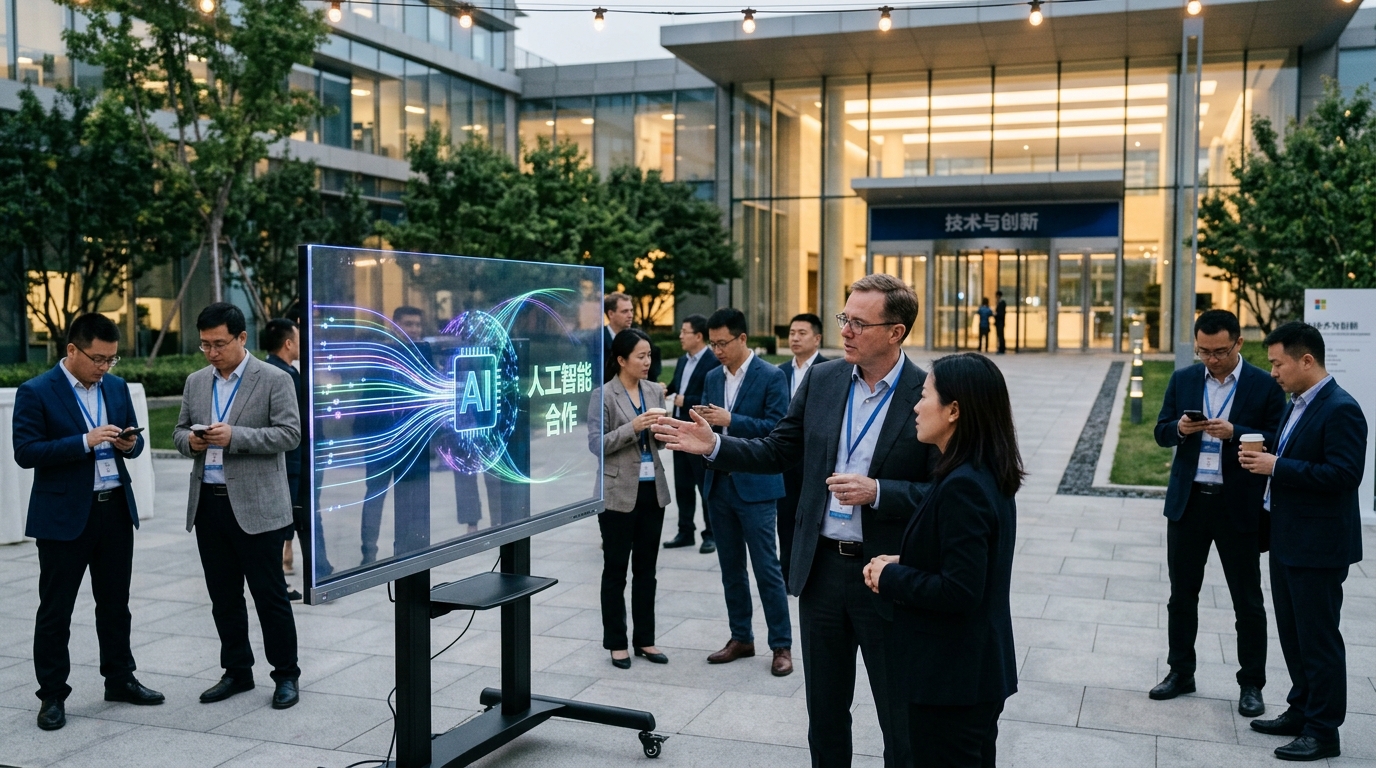
In the intricate chess game of global technological dominance, Microsoft appears to be executing a checkmate move that few predicted with such precision. While diplomatic relations between Washington and Beijing often resemble a glacier, the American software giant has found a 'back door' to introduce the world's most advanced artificial intelligence technology into the heart of China. This strategy is not based on the direct presence of ChatGPT—which remains officially unavailable in the country—but on the Azure OpenAI service, which allows Chinese enterprises to integrate GPT-4 and DALL-E models into their own applications.
The Azure Bridge and the ByteDance Case
The revelation that ByteDance, the parent company of TikTok, has been using OpenAI models via Microsoft Azure to develop its own large language models (LLMs) caused a stir in the market. Although ByteDance claims this usage is limited and within terms of service, the fact highlights a fundamental truth: the Chinese tech scene, despite its rapid progress, still craves the architectural superiority of models born in San Francisco. Microsoft, acting as a trusted intermediary, provides the necessary cloud infrastructure that complies with local regulations while simultaneously offering access to tools that Chinese developers consider essential to remain competitive.
This partnership creates a paradox. On one hand, the US imposes strict restrictions on the export of high-end semiconductors (such as Nvidia's chips) to China to slow the development of Chinese AI. On the other, an American company like Microsoft 'exports' the intelligence of these chips via the cloud. Microsoft argues that its approach is entirely legal, as data is processed on servers that adhere to international standards, allowing the company to dominate a market where Google and Meta struggle to even gain a foothold.
Competition and the 'War of a Hundred Models'
China is not a passive observer. Beijing has launched a national effort to achieve 'technological self-reliance.' Companies like Baidu with its Ernie model, Alibaba with Tongyi Qianwen, and Tencent with Hunyuan, have entered a race to match the performance of GPT-4. However, Microsoft's dominance in China is threatened not only by local innovation but also by the Cyberspace Administration of China (CAC), which demands strict control over AI-generated content to ensure it aligns with 'socialist values.'
Microsoft's advantage lies in its hybrid nature. It possesses the scale of a global player and decades of local experience in China through its research centers (Microsoft Research Asia). This deep-rooted presence allows it to navigate the clashing interests of the two superpowers. Chinese startups prefer Azure OpenAI because it allows them to 'buy' time: instead of training models from scratch with limited GPU resources, they use Microsoft's ready-made APIs to build services targeting the massive domestic market.
Geopolitical Risk and the Future Outlook
Microsoft's strategy is not without risks. In Washington, critics argue that providing access to advanced AI models to Chinese companies could eventually undermine US national security. There is a fear that the expertise gained through using OpenAI's models could be used to train military applications or surveillance systems. If the US government decides to close this 'cloud window,' Microsoft could face massive financial losses and a rupture in its relations with Beijing.
In conclusion, Microsoft has managed to turn artificial intelligence into a diplomatic and economic tool of unparalleled power. In China, AI is not just code; it is the new battlefield for influence. The company's ability to balance innovation and compliance will determine whether OpenAI remains the de facto standard of intelligence in a world increasingly divided into digital camps. The battle for China is only the beginning of a broader conflict over who will control the 'operating system' of the future.