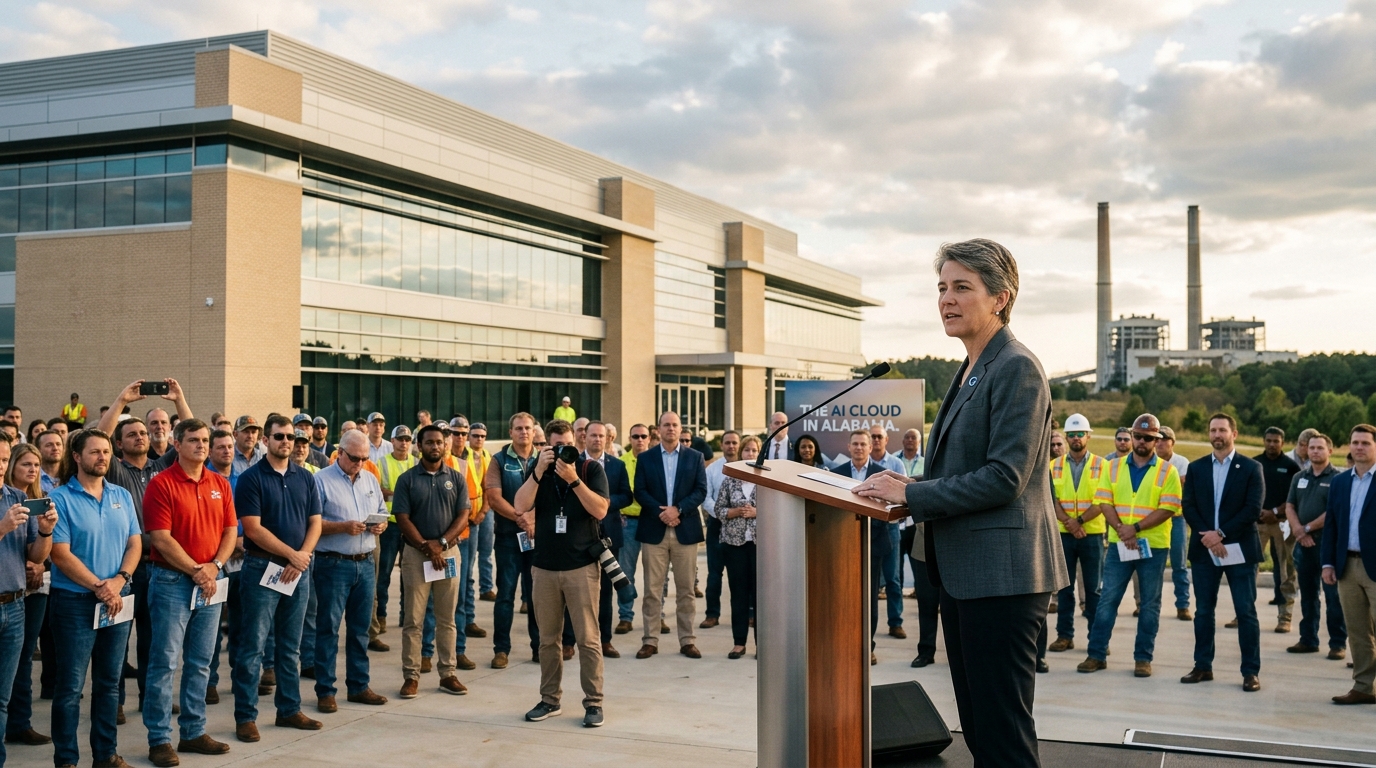
In a move that underscores the rapid shift of the global economy from traditional industries to digital dominance, Google has announced a new $1.5 billion investment to expand its data center campus in Jackson County, Alabama. This investment, set to be deployed throughout 2026 and 2027, builds upon the company’s existing presence in the state, bringing its total commitment to levels that are transformative for the local economy.
The location in Jackson County is no coincidence. Google’s data center is housed on the site of the former Widows Creek fossil fuel power plant, once a symbol of the coal era. Today, this very site is being transformed into the "brain" of artificial intelligence, housing thousands of servers that power services like Gemini, Google Search, and Google Cloud. The transition from coal to cloud serves as a powerful metaphor for the evolution of American energy and technology.
The Strategic Importance of AI Infrastructure
As the demand for artificial intelligence (AI) services skyrockets, the need for physical infrastructure—so-called data centers—becomes more critical than ever. Google, competing with giants like Microsoft and Amazon, is investing billions to ensure it has the necessary computational power. The expansion in Alabama is not just about data storage; it is about training the next generation of AI models that will reshape medicine, education, and global productivity.
According to company executives, the new facilities will incorporate the most advanced cooling and energy efficiency technologies to minimize their environmental footprint. Alabama offers a unique combination of available land, access to utility grids, and a favorable regulatory environment that allows for the rapid implementation of such massive projects.
Community Support and Education
Beyond the walls of the data center, Google seeks to solidify its presence through community support programs. The company announced a series of grants to local schools and educational institutions, focusing on fostering STEM (Science, Technology, Engineering, Mathematics) skills. The goal is to prepare Alabama’s workforce for the jobs of the future, which will not be limited to server maintenance but will span the entire spectrum of the digital economy.
- Funding for robotics programs in public schools.
- Scholarships for computer science studies at local colleges.
- Partnerships with local organizations to provide free Wi-Fi in public spaces.
This "soft power" approach is essential for tech giants to be accepted by local communities, especially in areas previously hit by deindustrialization. Google does not want to be seen as an outside invader, but as a partner investing in the region's prosperity.
The Energy Challenge
One of the most thorny issues accompanying the expansion of data centers is their massive energy consumption. Running thousands of processors 24/7 requires stable and abundant electricity. Google has a global commitment to operate on carbon-free energy by 2030, and Alabama is a crucial testing ground for this promise.
The partnership with the Tennessee Valley Authority (TVA) is pivotal. Google is working to source energy from renewable sources, such as solar farms, to power its facilities. However, criticism remains: can the green transition keep pace with the explosive growth in consumption required by AI? The answer to this question will determine not only Google’s future in Alabama but also the sustainability of the entire tech industry.
“Our investment in Alabama is an investment in the future of innovation. By transforming old industrial infrastructure into modern technology hubs, we are creating opportunities that will last for generations,” a company spokesperson stated.
In conclusion, Google’s move in Alabama sends a clear message: the geography of technology is shifting. Silicon Valley is no longer the only player. Regions with a rich industrial history, like the American South, are emerging as critical pillars of the new digital era, provided they can balance growth with social and environmental responsibility.