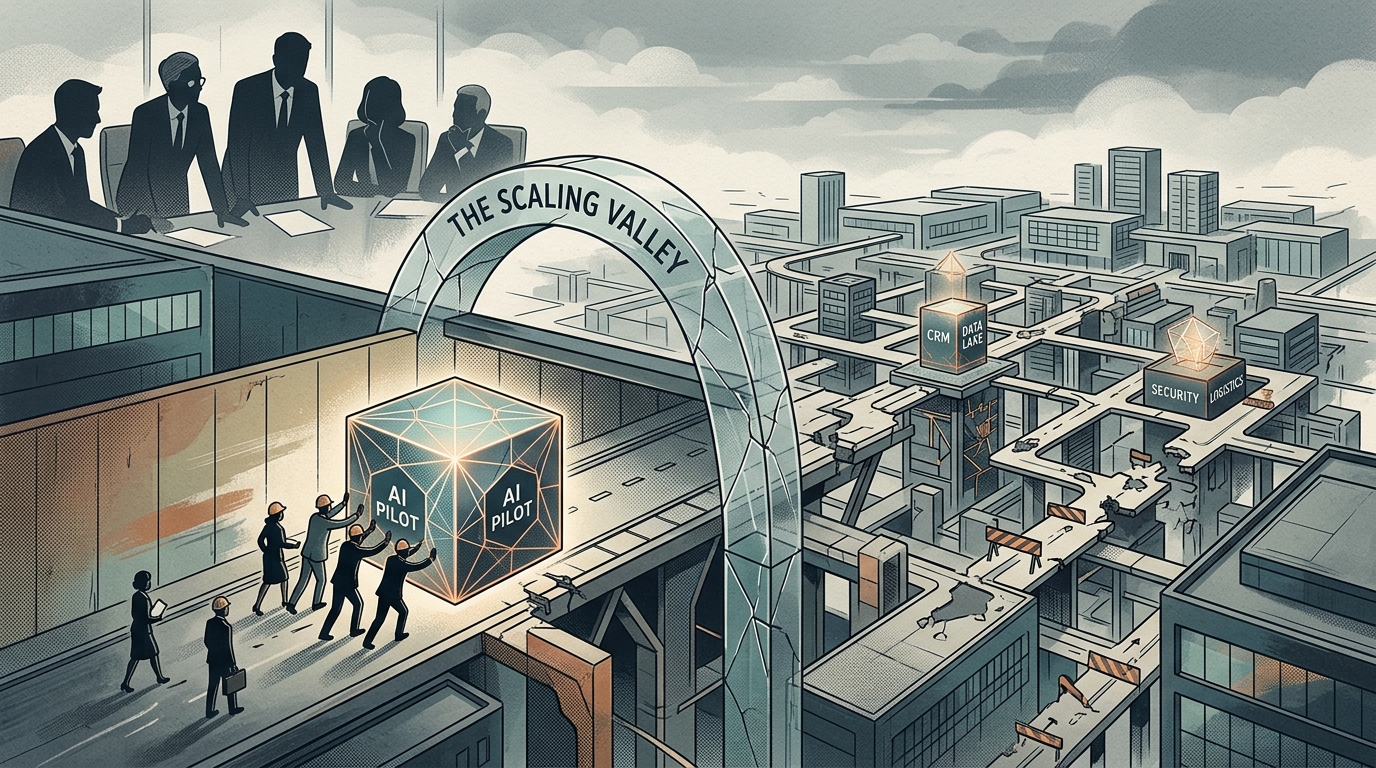
As we navigate the midpoint of 2026, the initial euphoria surrounding Generative AI has matured into a sobering reality: the challenge of scaling. While most large enterprises have successfully launched dozens, if not hundreds, of pilot projects (PoCs), only a fraction have made the jump into full-scale production. In a recent roundtable hosted by Fortune, executives from Salesforce, Amgen, and Thomson Reuters dissected the phenomenon analysts call "Pilot Purgatory"—the state where AI projects fail to graduate from experimentation to enterprise-wide utility.
The Infrastructure Barrier and the Data Illusion
The primary reason for scaling failure isn't the AI model itself, but the scaffolding surrounding it. As industry leaders point out, building a flashy demo is relatively easy; building a system that operates reliably with real-time data across a global organization is an entirely different beast. Many companies discovered too late that their data remains trapped in silos, often inconsistent, and frequently inaccessible to modern AI architectures.
At Amgen, for instance, applying AI to biopharmaceutical research requires a level of precision that cannot tolerate "hallucinations." Scaling here isn't just about speed; it's about ensuring the AI can navigate the immense complexity of biological data without compromising scientific integrity. The journey from a controlled lab environment to actual drug manufacturing requires a robust data architecture that most firms are still struggling to construct.
Cultural Resistance and the Trust Deficit
Beyond the technical hurdles, AI scaling often hits a human wall. Thomson Reuters, an organization built on the pillars of trust and precision in legal and tax information, emphasizes that employee adoption is the ultimate gatekeeper. If users do not trust the AI’s output, or if they perceive the technology as an existential threat to their roles, scaling will fail regardless of the code’s elegance.
By 2026, "change management" has emerged as a more critical skill set than machine learning engineering. Successful companies are those investing heavily in upskilling their workforce and establishing transparent governance frameworks. AI cannot scale in an environment of fear; it requires a culture of human-machine collaboration where the AI is viewed as a "copilot" or an augmentative tool rather than a replacement for human judgment.
From Chatbots to Autonomous Agents
A significant trend discussed is the shift from passive chatbots that merely answer queries to "autonomous agents." Salesforce, through platforms like Agentforce, is pushing the narrative that true scaling occurs when AI can execute tasks—such as closing a sales lead or resolving a complex customer service issue—autonomously within defined safety guardrails.
This transition requires a fundamental rethink of ROI (Return on Investment). Organizations can no longer measure success solely through "time saved." They must evaluate how AI impacts top-line growth, customer retention, and product innovation. Scaling happens when AI becomes an integral part of the growth strategy rather than just a cost-cutting measure hidden in the IT budget.
The Cost of Governance and Compliance
Finally, the regulatory landscape—with the EU AI Act now in full effect in 2026—adds a layer of complexity to scaling. Moving a pilot project to production means it must comply with stringent rules regarding data privacy, ethics, and transparency. Many projects stall in the legal department because they weren't designed with "compliance by design" principles. Market leaders agree: responsible AI is not a hindrance but a prerequisite for sustainable scaling. Without the trust of regulators and the public, no AI project can survive the transition to the real world.