The news that DeepSeek, the Chinese AI lab that sent shockwaves through Silicon Valley with its hyper-efficient models, is now developing its own hardware marks a pivotal moment in the global tech war. This is not merely a cost-cutting exercise; it is an existential necessity born from a landscape of tightening geopolitical restrictions and technological protectionism.
From Software Algorithms to Silicon Reality
DeepSeek has evolved beyond being just another player in the Large Language Model (LLM) space. With the release of DeepSeek-V3 and R1, it demonstrated that high-tier performance—comparable to GPT-4—could be achieved with a fraction of the traditional computational budget. However, reliance on NVIDIA’s GPUs remains the Achilles' heel for any Chinese AI firm. Export controls imposed by the U.S. government have throttled access to cutting-edge chips like the H100 and Blackwell, forcing the Chinese industry to innovate under duress.
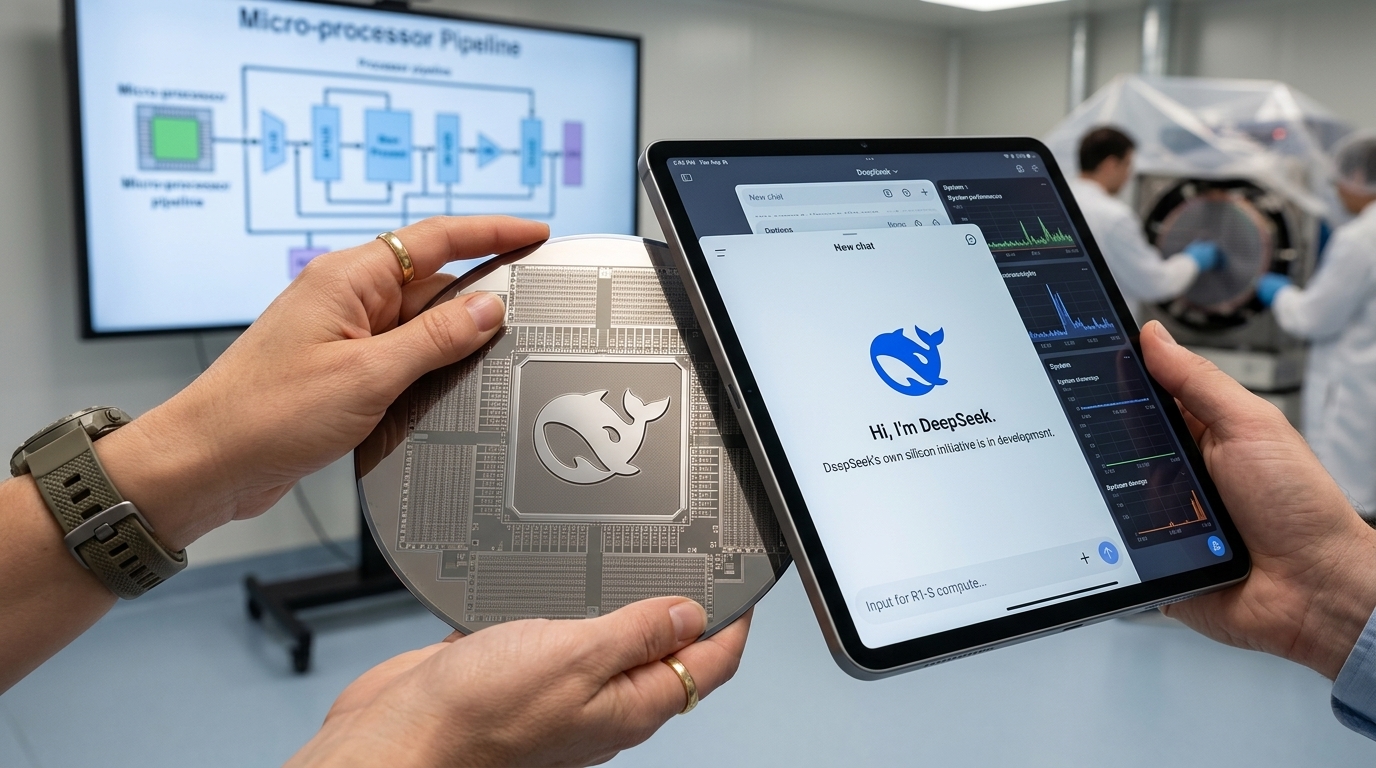
DeepSeek’s decision to design its own chip focuses primarily on inference—the process where a trained model generates responses to user prompts. While training requires massive raw power, inference is what dictates long-term profitability and operational scale. By developing a chip optimized specifically for the Mixture-of-Experts (MoE) architecture that DeepSeek champions, the company can achieve unprecedented levels of throughput and efficiency.
The Geopolitical Chessboard and the 'Silicon Curtain'
This move must be viewed within the context of China’s broader strategy for "technological self-reliance." As Washington tightens the noose around semiconductor supply chains, Beijing is responding with massive subsidies and the encouragement of vertical integration. DeepSeek, though a private entity, aligns perfectly with China’s urgent need to break the NVIDIA monopoly.
The critical question remains: manufacturing. Even if DeepSeek designs a superior chip, who will build it? With TSMC effectively barred from serving high-end Chinese AI interests due to U.S. sanctions, the domestic SMIC (Semiconductor Manufacturing International Corporation) is the only realistic partner. Despite challenges in 7nm and 5nm lithography, China has proven it can produce functional, if less yield-efficient, silicon compared to its Taiwanese counterparts.
Economic Efficiency and the Death of General-Purpose Compute
The trend toward Application-Specific Integrated Circuits (ASICs) is not new—Google has its TPUs, and Amazon has Trainium. However, DeepSeek is introducing a tighter feedback loop: the chip is being designed in tandem with the algorithm. This "co-design" approach allows for the removal of redundant features found in general-purpose GPUs, which are built to handle everything from video games to molecular modeling.
For DeepSeek, a dedicated inference chip translates to:
- Reduced Energy Consumption: The single largest operating expense for modern data centers.
- Lower Latency: Faster response times for end-users, essential for real-time AI agents.
- Sanction Resilience: Owning the intellectual property of the silicon reduces the risk of sudden supply chain decapitation.
By tailoring the hardware to the specific mathematical operations of their models, DeepSeek is essentially building a specialized engine for a specialized vehicle, rather than trying to make a tank fly.
Conclusion: A New Paradigm in AI Competition
DeepSeek is not just trying to survive; it is attempting to rewrite the rules of the industry. If they succeed in pairing world-class algorithms with proprietary hardware, they could offer AI services at price points that Western competitors—burdened by the "NVIDIA tax"—will find impossible to match. The battle for AI supremacy is no longer fought solely in the lines of code, but in the microscopic etchings of silicon wafers. The world is watching to see if this vertical integration will allow a Chinese underdog to outpace the giants of the West.