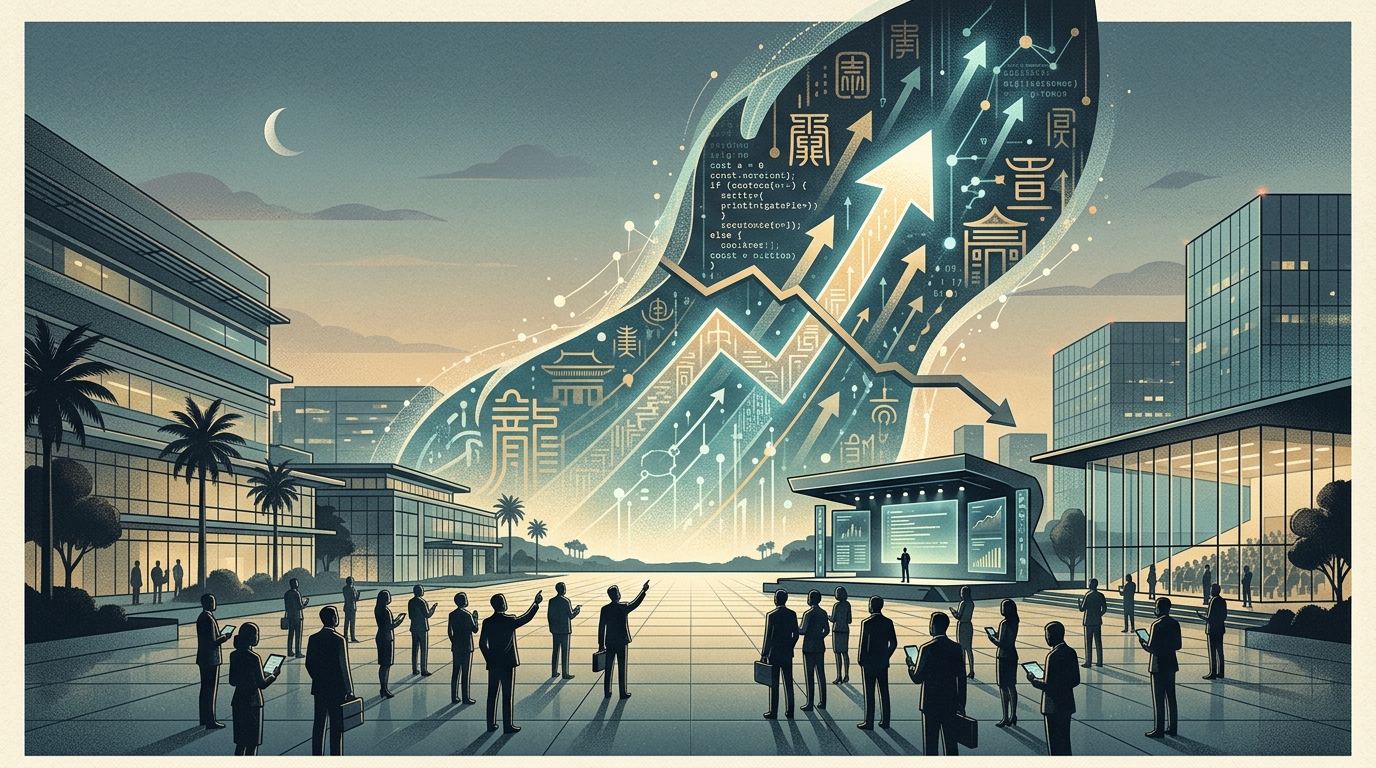
In a move that amounts to a declaration of total economic warfare in the Artificial Intelligence sector, Chinese AI lab DeepSeek has announced that its recent 75% discount on API services is now permanent. This decision is far from a mere marketing stunt; it is a calculated strategic maneuver that prices the company's output tokens at least 34 times lower than OpenAI’s flagship GPT-5.5 model. As we progress through May 2026, the AI landscape is shifting from a race for raw intelligence to a grueling battle for economic viability and infrastructure scale.
The Architecture of Disruption: How DeepSeek Achieved the Impossible
DeepSeek’s ability to offer such aggressive pricing without compromising output quality stems from its architectural ingenuity. By leveraging a Mixture-of-Experts (MoE) framework alongside Multi-head Latent Attention (MLA), the company has drastically slashed the computational overhead during inference. While Western competitors have largely focused on scaling parameter counts to achieve higher reasoning capabilities, DeepSeek has prioritized efficiency per watt and per dollar.
Specifically, DeepSeek’s pricing for its V3 model and subsequent iterations has stabilized at levels that make AI integration into daily applications nearly negligible in cost. For enterprises processing billions of tokens daily, the price delta between GPT-5.5 and DeepSeek translates into millions of dollars in annual savings. This puts immense pressure on OpenAI and Anthropic, who must now justify their premium pricing through significantly superior reasoning capabilities or more integrated ecosystems.
Geopolitical Implications and the Western Response
This move cannot be viewed in isolation from the broader geopolitical context. DeepSeek, headquartered in Hangzhou, represents China’s spearhead in the quest to dominate global AI infrastructure. By offering a solution that is "good enough" for the vast majority of tasks at an ultra-low price point, the company aims to become the default standard for developers in the Global South and Europe, where budgets are often tighter than in Silicon Valley.
- Democratization or Dependency? Low pricing allows startups to build products that were previously economically unviable, but it also creates a dependency on Chinese infrastructure.
- The Margin Trap: American firms, under pressure from investors for profitability, find it difficult to follow this race to the bottom in pricing.
- Open Source Commitment: DeepSeek continues to support the open-source community, building significant goodwill among global developers.
OpenAI, for its part, appears to be doubling down on "super-intelligence." GPT-5.5 is not marketed as a cheap utility but as a digital scientist capable of autonomous discovery. However, for 80% of business tasks—such as document summarization, routine coding, and customer support—this level of intelligence may be a luxury many are unwilling to pay for when a 34x cheaper alternative exists.
The Future of the Token Economy
As we head toward the latter half of 2026, the concept of the "token" as a commodity is becoming a reality. DeepSeek’s move signals the end of the era where access to frontier-level language models was a privilege of the well-funded.
"Intelligence is becoming like electricity: we don't care where it's generated, as long as it's cheap and reliable,"market analysts observe.
In conclusion, DeepSeek's permanent discount forces the entire industry to rethink its business models. If OpenAI and Google cannot reduce their operational costs through hardware innovations or more efficient algorithms, they risk being sidelined into a niche market of high-end users, leaving the mass market to Chinese dominance. The token wars have entered their most volatile phase yet.