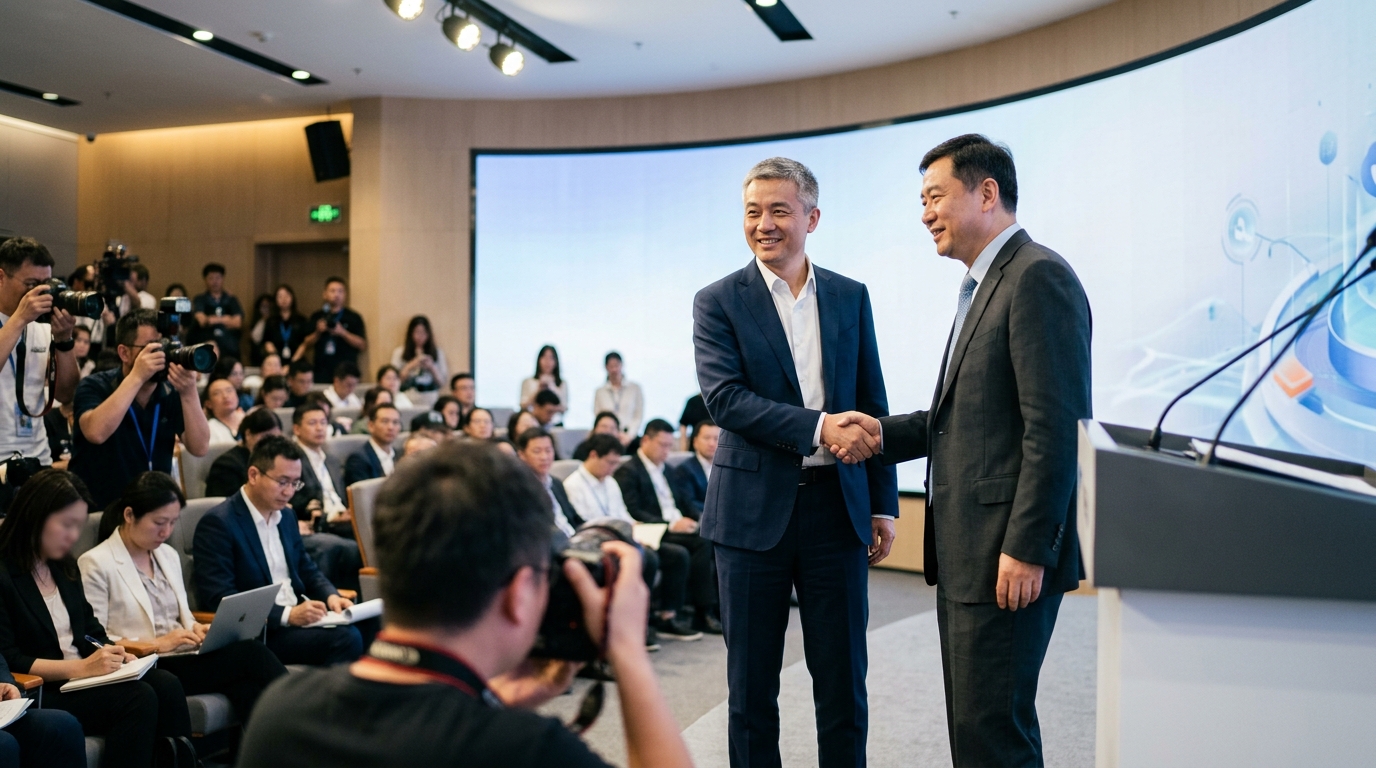
In a move that reshapes the balance of power on the global technological map, DeepSeek, one of China's most dynamic AI startups, has announced the full optimization of its models for Huawei's processor architecture. This development is not merely a corporate partnership but a strategic response to the ongoing pressure and restrictions imposed by the United States on China's access to advanced semiconductors, such as those from Nvidia.
DeepSeek, which has already made waves in the global community with the efficiency of its models (like DeepSeek-V3), is proving that software can be tailored to meet the needs of domestic hardware, bypassing the traditional advantage of Nvidia's CUDA ecosystem. This "vertical integration" of Chinese technology represents Beijing's holy grail in its quest for technological sovereignty.
The Strategy of Convergence: Software and Hardware on a National Mission
For years, the greatest hurdle for Chinese AI companies was not a lack of algorithmic intelligence but a reliance on Western hardware. Huawei's Ascend processors, specifically the 910B model, are now considered the most serious competitors to Nvidia's chips in the Chinese market. However, hardware alone is not enough; it requires software capable of exploiting every cycle of the processor.
DeepSeek has managed to develop libraries and kernels specifically designed for Huawei's Da Vinci architecture. This means that the training of Large Language Models (LLMs) can now be conducted at speeds and costs approaching Western standards using exclusively Chinese resources. This collaboration breaks the cycle of dependence, allowing Beijing to continue AI development even under a regime of total exclusion from international supply chains.
Responding to US Sanctions and the 'Silicon Wall'
US restrictions on high-performance chip exports were aimed at slowing Chinese progress in AI, fearing China's military and economic superiority. However, the history of technology has shown that pressure often breeds innovation. The case of DeepSeek and Huawei is the most striking example of this theory.
Instead of attempting to acquire illegal chips through third countries, Chinese giants are now investing heavily in optimizing code for existing domestic hardware. DeepSeek's use of techniques like Mixture-of-Experts (MoE) allows for the creation of powerful models that require less computational power, making them ideal for the current level of Chinese semiconductors. This "smart" approach offsets the gap in chip manufacturing precision (nanometers) compared to TSMC or Intel.
Geopolitical Implications and the Bifurcation of the Internet
This move heralds a deeper split in the global technology sector. We may soon see two parallel AI ecosystems: one based on Nvidia, OpenAI, and Google in the West, and one based on Huawei, DeepSeek, and Baidu in the East. This "Bifurcated AI" will have enormous consequences for system compatibility, cybersecurity, and global technology governance.
Furthermore, DeepSeek's success on Huawei hardware sends a message to other developing economies that fear technological dependence on the US. China now offers an alternative, complete "package" (chips plus software) that can be exported to countries in the Global South, strengthening its influence through "AI Diplomacy."
"Technological autonomy is no longer an option for China, but a necessity for survival. The DeepSeek-Huawei partnership is proof that software can defeat sanctions."
In conclusion, DeepSeek did not just present a new model; it presented a new doctrine. The era when China was the West's "assembler" is gone forever. Today, Beijing is building its own foundations, and the alliance between top software minds and hardware giants is the tip of the spear in this new digital age.