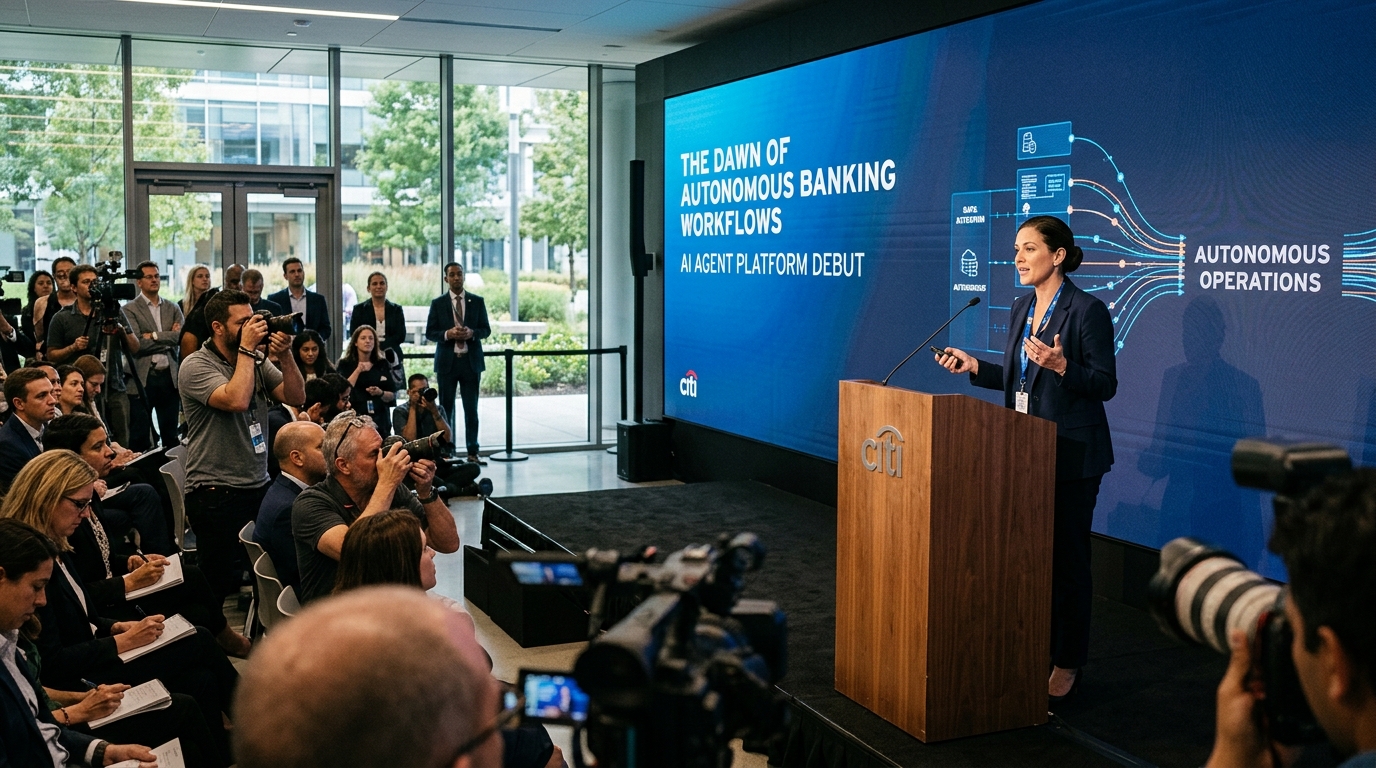
In a move that signals a fundamental shift in the operational fabric of global financial institutions, Citigroup (Citi) has announced the launch of a sophisticated platform designed to integrate Artificial Intelligence agents (AI Agents) into everyday banking workflows. This development transcends the simple chatbots seen in recent years, introducing systems capable of executing complex, multi-step processes with minimal human intervention.
From Assistance to Autonomy: The Rise of AI Agents
Citi's new platform is not merely an upgrade to existing Generative AI tools. While previous models focused on generating text or analyzing data upon request, AI agents possess the ability to 'reason' in sequences, make decisions within predefined parameters, and interact with other software systems to complete a project. In the banking sector, this translates to the automation of processes such as compliance checks, risk management, and credit limit analysis.
According to bank executives, the platform allows employees to create specialized agents that can navigate internal data silos, synthesize reports, and recommend actions. The distinction lies in the 'agentic' nature of the system: instead of a user asking a question and receiving an answer, the agent takes responsibility for an entire workflow.
Transforming the Wall Street Workforce
The introduction of these technologies inevitably raises questions about the future of jobs in the banking sector. Citi, like other giants such as JPMorgan Chase and Goldman Sachs, maintains that the goal is 'augmentation' rather than replacement. However, market analysis suggests that entry-level positions, which rely heavily on data processing and the drafting of standardized documents, are on the front lines of this transformation.
- Efficiency: Reducing the processing time for bureaucratic procedures from days to minutes.
- Accuracy: Minimizing human error in repetitive audit and verification tasks.
- Focus: Freeing up banking professionals to focus on strategy and high-touch client relationships.
"We don't view AI as a substitute for human judgment, but as a power multiplier that allows our people to focus on what they do best: high-level decision-making," state sources close to Citi's management.
Regulatory Frameworks and Ethical Risks
Adopting autonomous agents in a highly regulated environment like banking is not without its challenges. Regulators in the US and EU are closely monitoring how banks ensure the transparency of decisions made by AI. The phenomenon of 'hallucinations' in AI models remains a real risk, especially when dealing with financial transactions worth billions of dollars.
Citi has invested significantly in 'guardrails,' ensuring that every action taken by an AI Agent is traceable and subject to human approval before finalization. AI 'explainability' has become a central pillar of the bank's strategy, as it must prove to authorities that its systems do not operate as 'black boxes.'
The Big Picture: The Race for Technological Supremacy
Citi's move is part of a broader AI 'arms race' on Wall Street. JPMorgan Chase has already developed its own ChatGPT-like system, IndexGPT, while Morgan Stanley uses AI to support its wealth management advisors. Citi's differentiation lies in its focus on 'agentic' architecture, which is considered the next frontier in technological evolution.
In conclusion, Citi's platform is a bold statement about the future of banking. The transition from a bank that 'uses technology' to a bank that 'operates via AI agents' is now underway, reshaping not only profit margins but the very essence of financial labor in the 21st century.