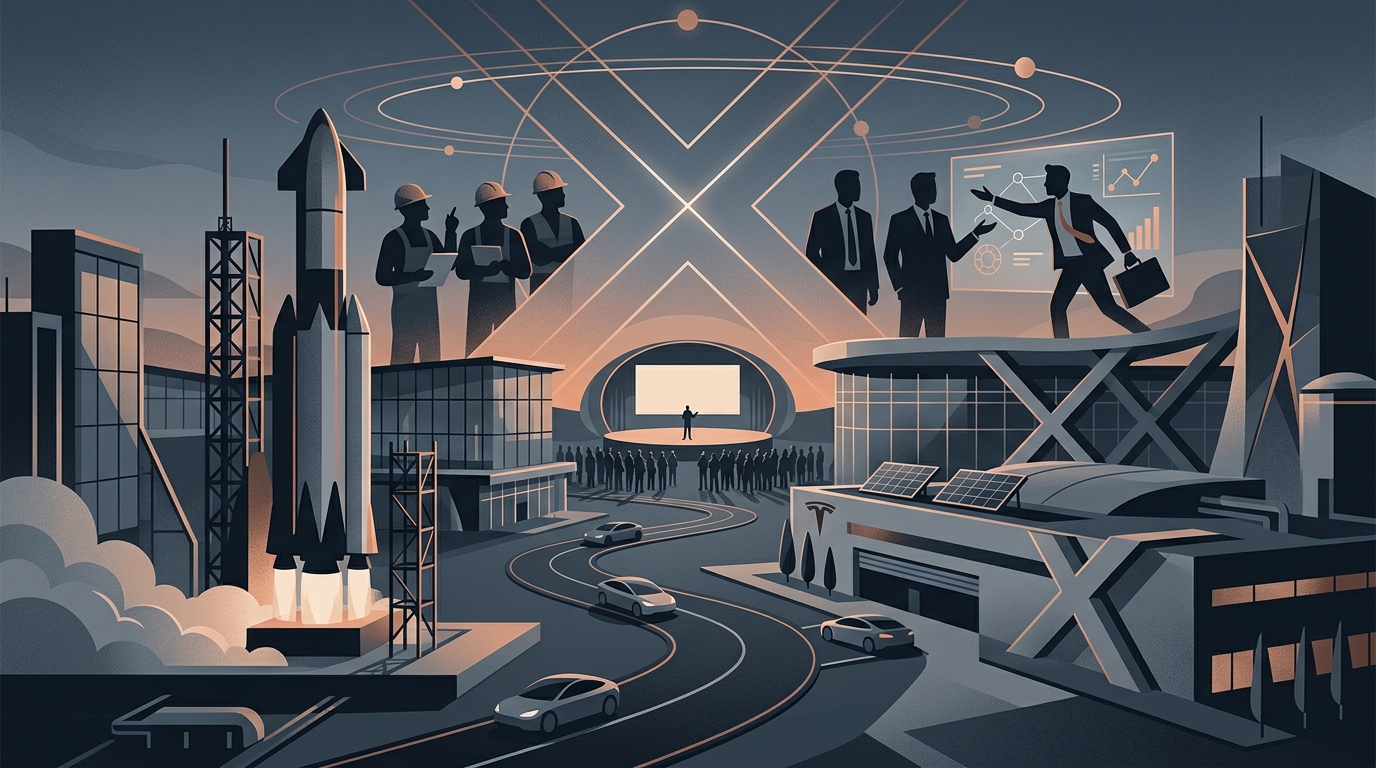
In the corridors of Wall Street and the labs of Silicon Valley, an idea that once seemed like science fiction is beginning to take on the characteristics of a financial reality: the merger of Tesla and SpaceX. As we move through June 2026, Elon Musk appears to be considering consolidating his numerous business activities under a single umbrella, possibly "X Holdings." However, as a recent analysis by Bloomberg points out, this venture is not merely a bureaucratic process, but a minefield of conflicts of interest and legal challenges.
The Strategic Rationale and the Vision of Synergy
The core argument in favor of a merger is rooted in the concept of "technological convergence." Tesla is no longer just a car company; it is an artificial intelligence, robotics (Optimus), and energy storage firm. On the other hand, SpaceX dominates the orbits with Starlink and is preparing for the full commercial exploitation of Starship. Musk's supporters argue that sharing resources—from materials science to Dojo's computing power—could create an industrial giant unprecedented in history.
Imagine a future where Tesla vehicles communicate exclusively through the Starlink network, or where Tesla's battery technology powers colonies on Mars. For Musk, the boundaries between his companies have always been blurred. He frequently borrows engineers from one company to solve problems in another. A formal merger would legitimize this practice, allowing for the seamless transfer of capital and talent.
The Thorn of Corporate Governance
But this is where the problems begin. Tesla is a public company with thousands of shareholders and a board of directors that has a fiduciary duty to protect their interests. SpaceX remains private, with a valuation that has skyrocketed thanks to government contracts and a monopoly on launches. A merger would require an extremely complex valuation: How do you price a private space company to "sell" it to the shareholders of a public car company?
Critics, such as Bloomberg's Liam Denning, warn that such a move could be seen as a way for Musk to use Tesla's cash to fund SpaceX's expensive Martian ambitions. There is also the 2016 SolarCity precedent, an acquisition many saw as a "bailout" of a failing company owned by Musk's relatives using Tesla's money. Although Musk won the legal battles over SolarCity, the scale of a potential Tesla-SpaceX deal is orders of magnitude larger, making the risk to minority shareholders immense.
Starlink: The Deal's Catalyst
Many analysts believe the "key" to any consolidation is Starlink. The satellite internet service is now generating significant cash flows and is considered the most "mature" part of SpaceX for an IPO. A potential strategy would be to spin off Starlink and merge it with Tesla, leaving the riskier rocket business as a private entity. This would give Tesla access to a new revenue stream and justify its high market valuation as a connectivity provider.
However, regulatory pressure in 2026 is more intense than ever. The SEC (U.S. Securities and Exchange Commission) is closely monitoring Musk's every move, especially after his controversial past statements. Any merger attempt would face grueling scrutiny over whether the acquisition price is fair or if it is merely a mechanism for transferring wealth to the founder.
Conclusion: A High-Stakes Gamble
Consolidating Musk's companies would be the ultimate test for modern capitalism. On one hand, we have the vision of a man who wants to accelerate the evolution of the species, disregarding traditional structures. On the other, we have market rules designed to prevent the arbitrariness of the powerful. If Musk manages to convince investors that SpaceX and Tesla are two sides of the same coin, he will have created the first true "interplanetary enterprise." If he fails, he risks dragging both his creations into a vortex of litigation and financial instability.