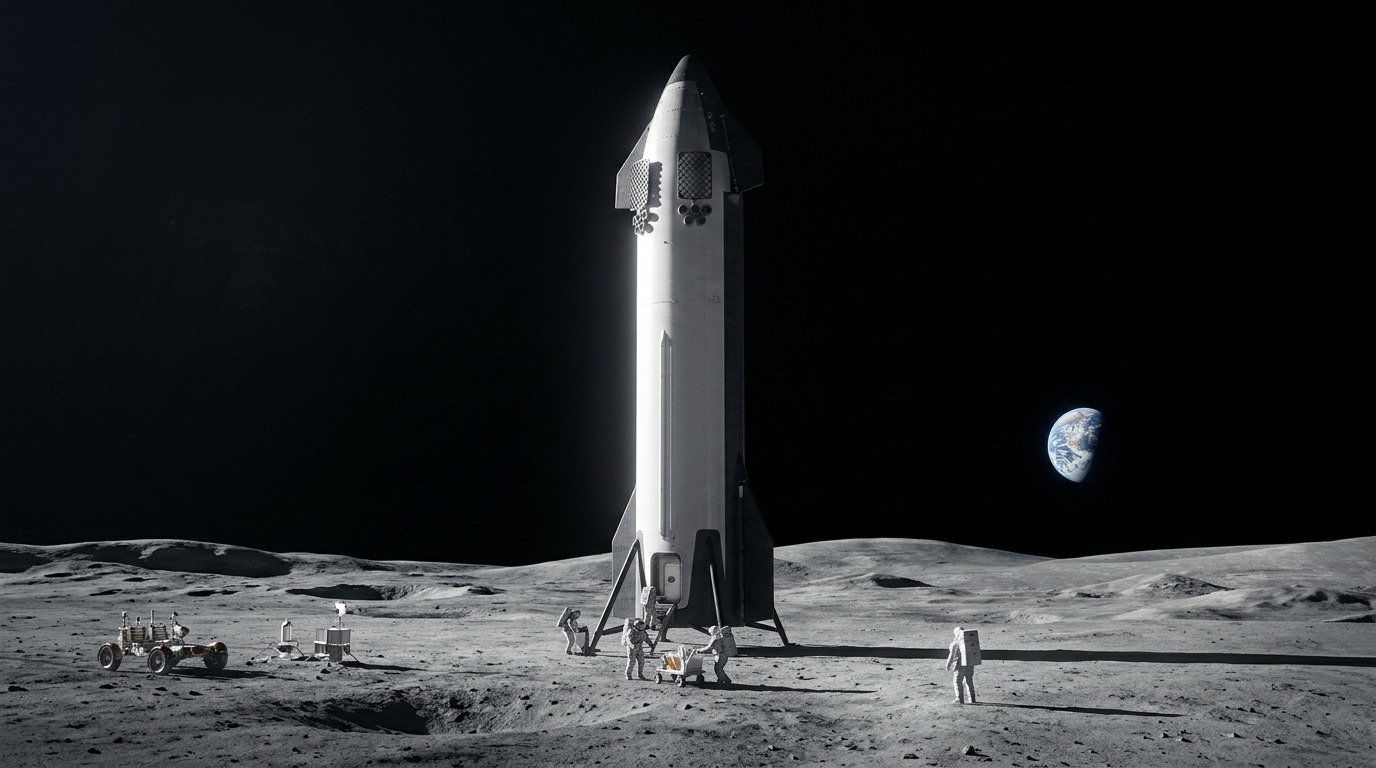
May 30, 2026, will likely be remembered as a dark day for Blue Origin, and a moment of sobering clarity for American space strategy. The recent explosion during testing of the New Glenn rocket and the Blue Moon lunar lander did more than just destroy billions of dollars in hardware; it shattered the illusion of competition within NASA’s Artemis program. With Jeff Bezos’s Blue Origin effectively sidelined for the critical Artemis III mission, NASA now finds itself in the uncomfortable position of being entirely dependent on a single provider: Elon Musk’s SpaceX.
The Collapse of the 'Dual-Provider' Strategy
For years, NASA leadership has insisted that the return to the Moon must rely on at least two distinct landing systems. The logic was sound: competition drives down costs, and redundancy ensures that one company's failure doesn't derail the entire national program. However, the reality of 2026 is proving otherwise. Blue Origin, despite massive internal investment and political backing, appears to be lagging desperately behind in terms of operational readiness.
The explosion at the test site points to deep-seated engineering hurdles with the New Glenn, the heavy-lift rocket intended to challenge SpaceX’s Starship. Without a functional launch vehicle and a reliable lunar lander, Blue Origin cannot guarantee astronaut safety. Faced with the ticking clock of a geopolitical space race against China, NASA has no choice but to pivot its full weight toward SpaceX. This creates a "monopoly of necessity" that bears little resemblance to the free-market competition envisioned by Congress.
SpaceX’s Dominance and the IPO Shadow
As Blue Origin licks its wounds, SpaceX is on a trajectory that seems unstoppable. Starship has already completed multiple successful orbital tests, and its production continues at an industrial scale. The news of Bezos’s setback coincided with intensifying rumors that Musk is preparing a blockbuster Initial Public Offering (IPO) for SpaceX or its Starlink subsidiary within the next year.
The timing is no coincidence. SpaceX is no longer merely a NASA contractor; it is the de facto operator of American space infrastructure. An IPO at this stage could raise capital that would make the company more financially potent than many national space agencies. However, analysts warn: concentrating such immense power in the hands of a private individual—one who often pursues his own idiosyncratic foreign policy—poses a risk to U.S. national interests. If Musk decides his priorities diverge from NASA’s, Washington will have no Plan B.
The Political and Economic Toll of Delay
The Blue Origin failure also carries heavy budgetary implications for NASA. Maintaining the Artemis program requires billions in annual funding, and every delay increases the overhead costs of legacy infrastructure. Furthermore, political support for lunar exploration is fragile. If Artemis III is pushed toward the end of the decade due to lack of competition, critics in Congress will undoubtedly seize the opportunity to call for budget cuts.
On the other hand, SpaceX’s dominance allows for an economy of scale never before seen in aerospace. The use of fully reusable rockets has slashed the cost per kilogram to levels that make a lunar economy theoretically viable. The question remains: is NASA willing to hand over the keys to the Moon to a private corporation in exchange for speed and efficiency? The Blue Origin explosion just made that question unavoidable.
- Blue Origin’s failure significantly increases Musk’s leverage over the U.S. government.
- China is closely monitoring Artemis delays, hoping to secure the lunar south pole first.
- A potential SpaceX IPO could fundamentally reshape the high-tech investment landscape.
Ultimately, the race for the Moon is no longer a contest between nations, but a clash between bureaucratic caution and entrepreneurial velocity. Blue Origin tried to play by NASA’s traditional rules and stumbled. SpaceX rewrote the rules, and now, it appears to be the only player left on the field.