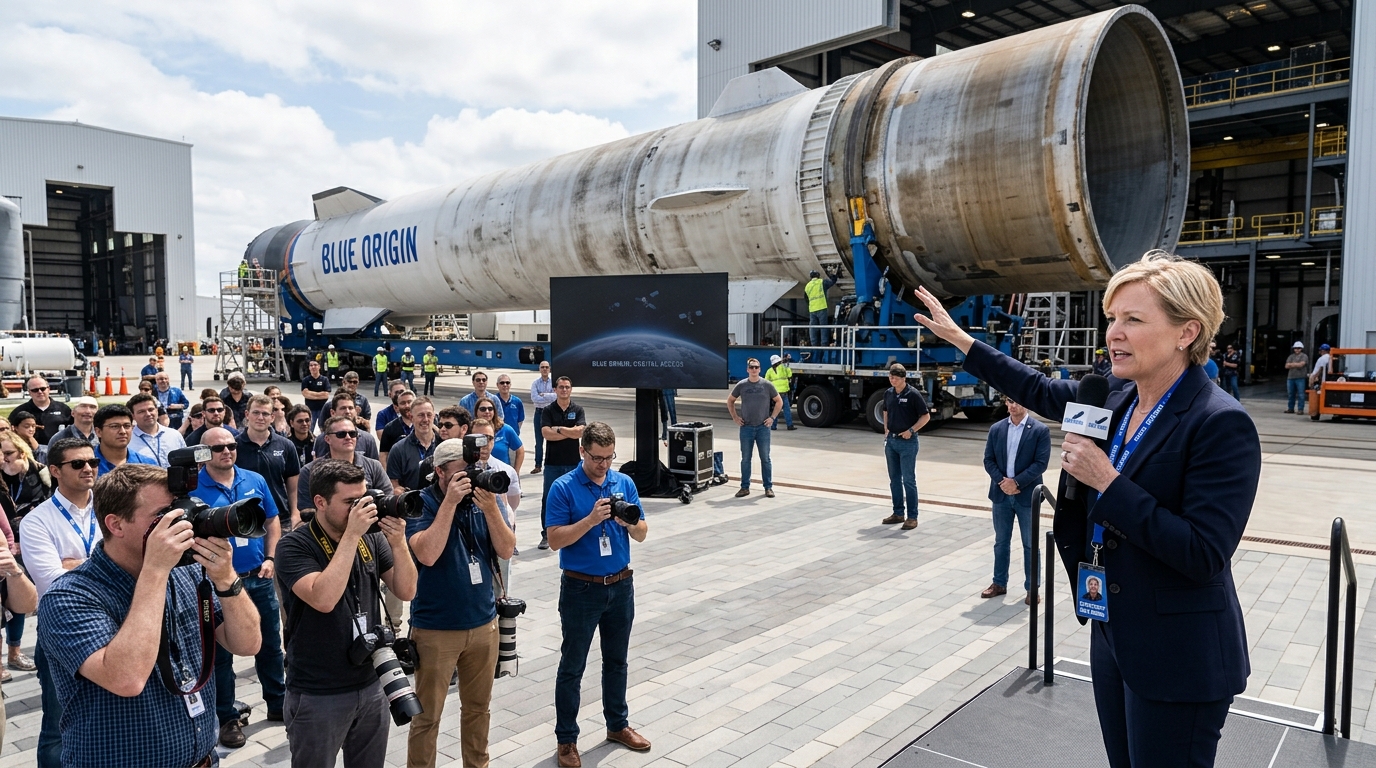
The global space industry is at a critical inflection point where orbital demand vastly outstrips launch supply. In a recent interview with Bloomberg, Blue Origin CEO Dave Limp, who took the helm after a storied career at Amazon, made it clear that Jeff Bezos’s aerospace firm is no longer a "sleeping giant" but an aggressive contender targeting the heart of the launch market.
Transitioning from Tourism to Infrastructure
For years, Blue Origin was synonymous in the public eye with New Shepard and brief suborbital hops for wealthy tourists. However, under Limp’s leadership, the focus has shifted dramatically toward New Glenn, the heavy-lift rocket that promises to upend the status quo. Limp emphasized that the target of eight to twelve launches within the year is not just a number—it is a strategic necessity in an environment dominated by Elon Musk’s SpaceX.
New Glenn, with its massive payload capacity and reusable first stage, is Blue Origin’s direct answer to the Falcon Heavy and Starship. While development delays have cost the company precious time, Limp argues that the technological maturity now reached will allow for a rapid scaling of flight cadence. The goal is to move from experimental milestones to a predictable, commercial heartbeat.
The Project Kuiper Imperative
A primary driver of this surging demand is Amazon’s Project Kuiper. This is Jeff Bezos’s counter to Starlink—a constellation of thousands of Low Earth Orbit (LEO) satellites designed to provide global broadband. Blue Origin is contracted for a significant portion of these launches, creating a massive internal "anchor customer" for New Glenn.
However, Limp clarified that the demand isn't localized to Amazon. Governments, telecommunications giants, and research institutions are desperately seeking launch alternatives. Geopolitical instability has effectively removed Russian Soyuz rockets from the Western market, and Europe is grappling with its own delays regarding the Ariane 6. This has created a vacuum that Blue Origin is eager to fill.
"We aren't just building rockets; we are building the bridge for a new economy in space," Limp stated, stressing that reliability and frequency are the twin keys to commercial longevity.
Production and Supply Chain Hurdles
Ambitioning 12 launches per year requires an industrial infrastructure that Blue Origin is only now finalizing. The production of the BE-4 engines—which power both New Glenn and United Launch Alliance’s (ULA) Vulcan rocket—remains the most significant bottleneck. Limp admitted that manufacturing these complex engines at scale is one of the most formidable challenges his team has faced.
Furthermore, managing a supply chain in a sector where components must withstand extreme thermal and mechanical stress requires precision akin to high-end watchmaking rather than traditional heavy industry. Blue Origin is pouring billions into automated production lines at its Merritt Island facility in Florida, hoping to slash costs and assembly lead times.
The Future: Beyond Earth Orbit
Limp’s strategy extends far beyond satellite deployment. Blue Origin envisions a future where "millions of people live and work in space." This roadmap includes Orbital Reef, a commercial space station, and Blue Moon, the lunar lander selected by NASA for the Artemis program.
The company’s ability to meet launch demands this year will be the litmus test for whether it can realize this grand vision. If Limp can successfully transform Blue Origin into a high-cadence launch machine, the space race will enter a new, more mature phase, ultimately benefiting global connectivity and scientific exploration.