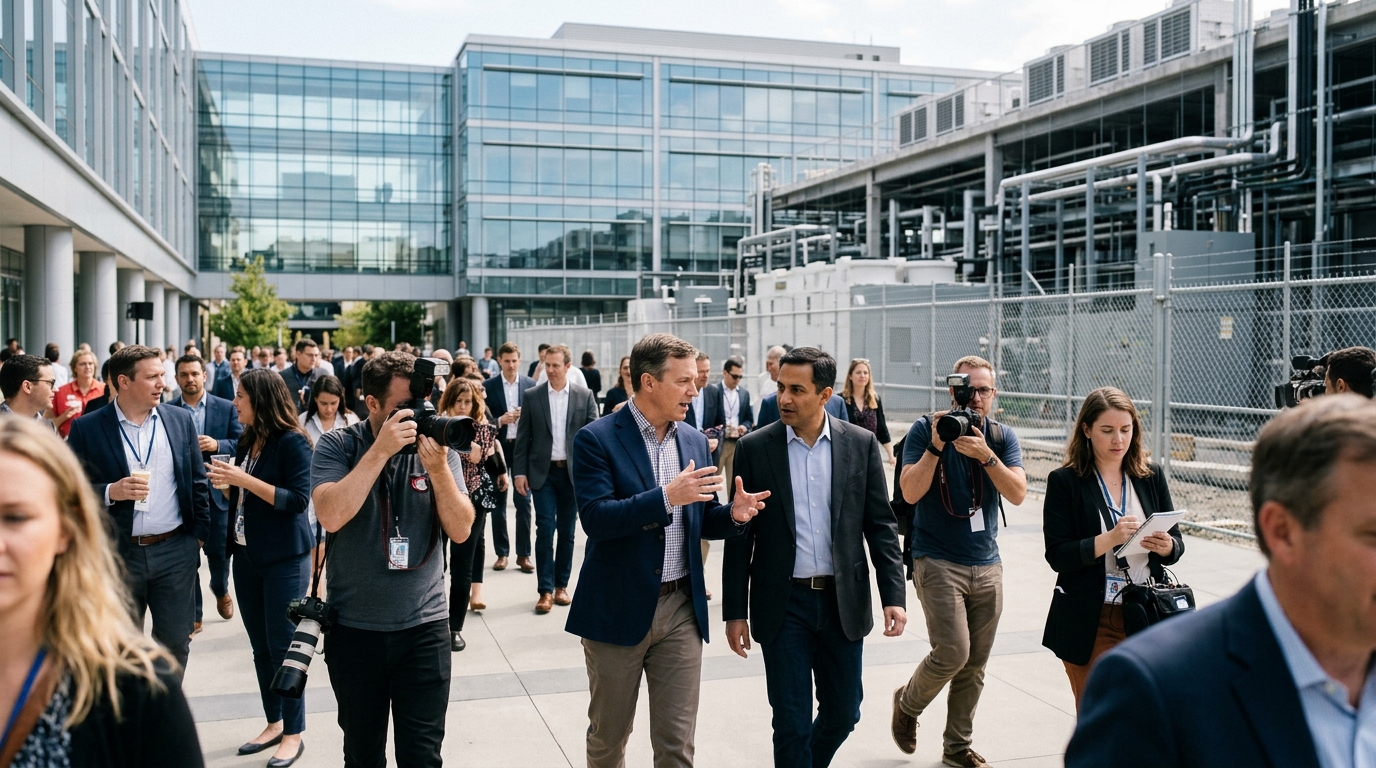
The era of experimental Artificial Intelligence has come to an end. Today, we are witnessing the 'industrialization' of intelligence, where power is no longer measured solely by lines of code, but by massive data centers, millions of GPUs, and gigawatts of electricity. Recent announcements from Microsoft, Google, Amazon, and Meta confirm a unified strategy: dominance in the next decade will be decided by who owns the physical infrastructure to 'house' the world's knowledge.
The Arms Race and the Capital Expenditure Surge
The figures are staggering. Capital expenditures (CapEx) for Silicon Valley's major players have skyrocketed to levels reminiscent of the 19th-century railroad expansion. Microsoft and Google are investing tens of billions of dollars every quarter—no longer just to maintain existing services, but to acquire Nvidia chips and erect gargantuan facilities across the globe. This strategy is not without significant risk. Wall Street investors are beginning to ask the critical question: when will we see the return on investment (ROI)?
However, for the CEOs of these firms, the answer is straightforward: the cost of falling behind is far greater than the cost of over-investing. If a company runs out of compute capacity, it loses the ability to train next-generation models, effectively ceding the future to its rivals. This 'logic of fear' is driving an unprecedented concentration of resources, making the barrier to entry for new players nearly insurmountable.
The Energy Bottleneck and the Nuclear Pivot
The primary challenge for AI expansion is no longer funding or silicon; it is energy. AI data centers consume significantly more power than traditional cloud facilities due to the extreme heat generated by H100 and Blackwell processors. This has led to an unlikely alliance between Big Tech and the nuclear industry. Microsoft’s deal to restart the Three Mile Island nuclear plant is just the beginning.
- Google is investing in Small Modular Reactors (SMRs) to ensure a steady carbon-free power supply.
- Amazon is acquiring data centers located adjacent to nuclear power plants in Pennsylvania.
- Meta is exploring geothermal energy sources to power its massive AI clusters.
This pivot to clean, firm energy highlights a new geopolitical dimension: AI is no longer a 'virtual' entity but a heavy industrial sector that depends directly on national power grids and environmental policies.
Sovereign AI and Localized Infrastructure
Beyond the United States, the demand for 'Sovereign AI' is forcing governments in Europe and the Middle East to collaborate with American giants to build local infrastructure. France and Germany, for instance, are pushing for data centers within their borders to ensure that citizen data remains under local jurisdiction. This creates a new model of 'localized Big Tech,' where the underlying infrastructure is global, but the governance is local.
"AI is the new electricity, and data centers are the power plants of the 21st century. Whoever controls the plants, controls the economy."
In conclusion, Big Tech is not just doubling down on AI; it is building the foundation of a new global economic order. Whether through developing custom silicon to reduce reliance on Nvidia or securing entire energy grids, the goal remains the same: total control over the intelligence value chain.