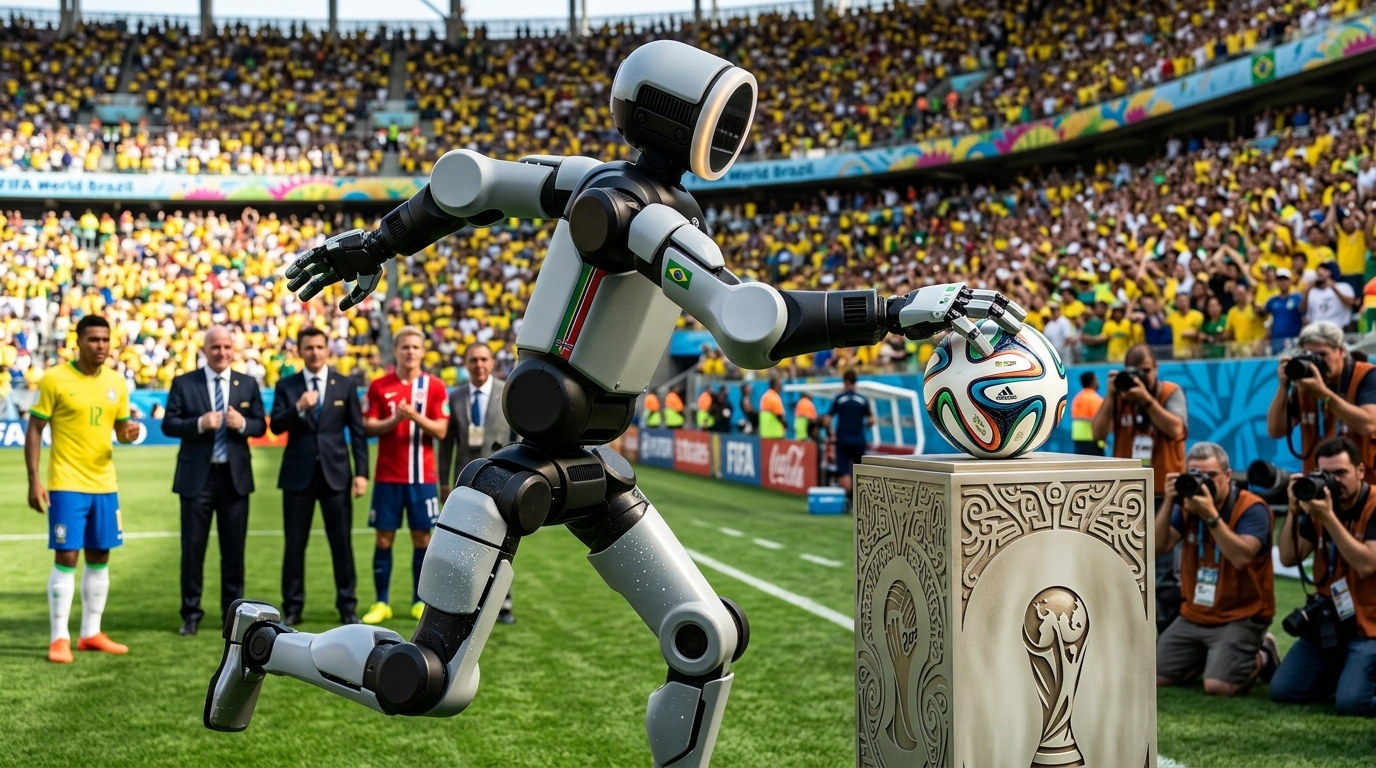
July 6, 2026, will be etched in the memory of football fans not just for the gripping match between Brazil and Norway, but for a moment that seemed plucked from a science fiction novel. As the teams lined up on the pitch, a 5-foot-tall humanoid robot—the new electric Atlas from Boston Dynamics—walked with uncanny naturalness toward the center circle, holding the official World Cup match ball. This move was far more than a marketing stunt; it was the official unveiling of the most sophisticated machine ever built by humanity to a global audience of billions.
The Technological Evolution of Boston Dynamics
The Atlas we saw on the pitch is not the familiar hydraulic ancestor that used to perform impressive but clunky backflips. This is the fully electric version, boasting 56 degrees of freedom, allowing it a range of motion that exceeds even human joints. Its ability to rotate its torso and limbs 360 degrees gives it an eerie yet efficient kinesiology, ideal for environments designed for humans but requiring robotic precision.
The most striking element, however, is not the hardware, but the software. Boston Dynamics, under the Hyundai umbrella, utilized reinforcement learning techniques to teach Atlas not just to walk on turf—a notoriously difficult surface for bipedal robots—but to perceive the stadium environment dynamically. The autonomy with which it moved, avoiding players and officials, proves that humanoids have transitioned from controlled experiments to real-world applications.
Hyundai’s Strategy and the Humanoid Economy
The choice of the World Cup for Atlas's demonstration underscores Hyundai's ambition to transform from a traditional automaker into a global leader in "smart mobility." The acquisition of Boston Dynamics in 2021, once viewed by many as an expensive risk, is now beginning to bear fruit. Hyundai does not see Atlas as a stadium toy, but as the future worker on its production lines, where flexibility and the ability to use human tools are essential.
- Production Line Versatility: Atlas can perform tasks that traditional robotic arms cannot, such as moving components through narrow spaces.
- Reduction in Workplace Accidents: Replacing humans in dangerous or repetitive tasks reduces insurance costs and compensation claims.
- Brand Equity: Associating Hyundai with cutting-edge robotics reinforces its image as an innovative powerhouse.
Competition in the sector is now fierce. With Tesla's Optimus promising mass production and Figure AI partnering with BMW, Boston Dynamics needed to make a power statement. Delivering the ball at the FIFA World Cup was their "moonshot," proof that Atlas is ready for the real world.
Social Implications and the Future of Labor
Despite the excitement in the stands, Atlas's presence raises serious questions. If a robot can navigate a crowded stadium with such ease, what stops it from replacing workers in warehouses, delivery services, or even elderly care? The debate over a "universal basic robotics tax" is returning to the fore, as automation now threatens not only manual labor but specialized roles as well.
"We are not just seeing a robot deliver a ball. We are seeing the dawn of a new era where the distinction between biological and mechanical movement becomes blurred," said a leading Silicon Valley analyst.
Boston Dynamics maintains that its goal is human-robot collaboration. However, the image of Atlas standing among the world's elite athletes was a reminder that artificial intelligence has finally found a body. And this body is stronger, more resilient, and in many cases, more capable than our own. The question is not whether robots will integrate into our society, but whether we are ready to share our space—and our livelihoods—with them.
In conclusion, Atlas's appearance at the 2026 World Cup will go down in history as the tipping point where robotics became mainstream. From the labs of MIT and Hyundai's test tracks, humanoids have stepped into the spotlight, claiming their place not as tools, but as active participants in human culture. The game has just begun, and the rules have changed forever.