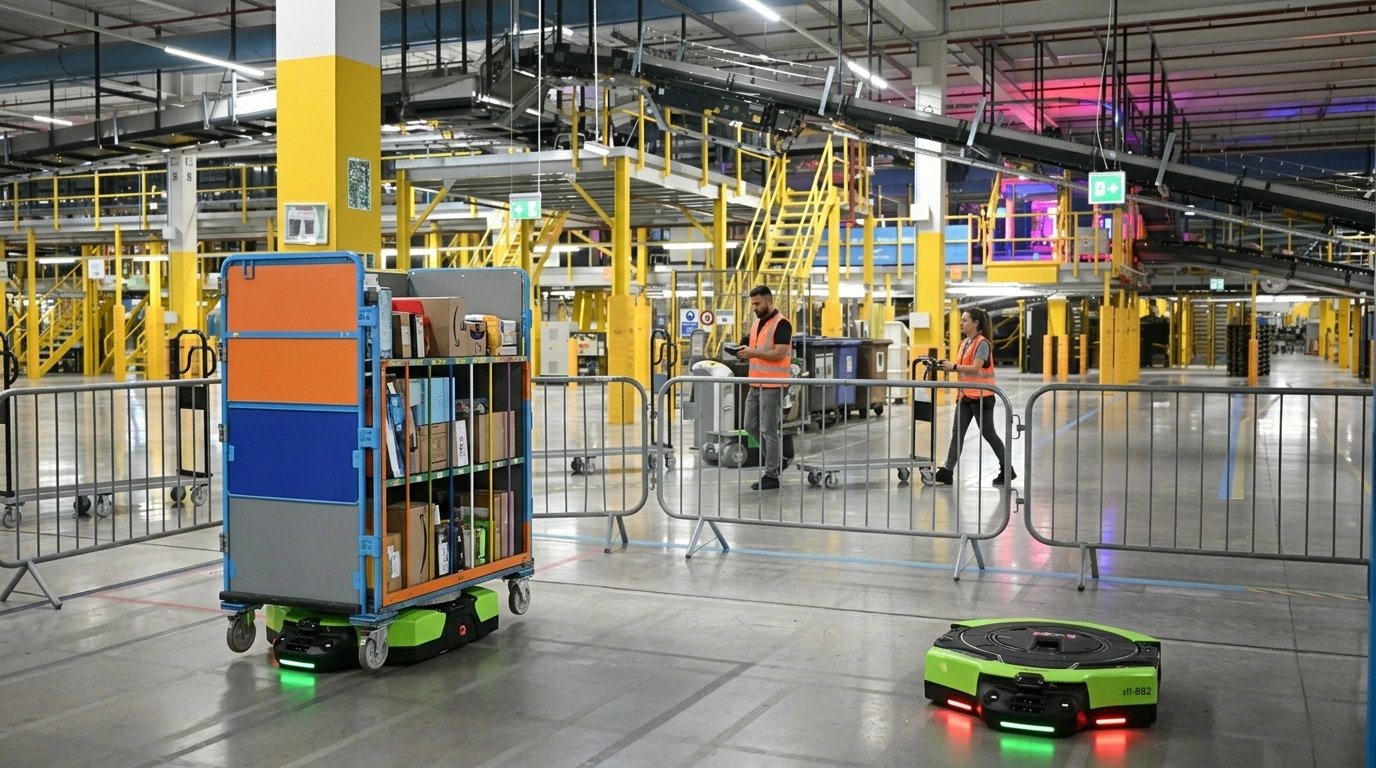
The visual landscape of an Amazon fulfillment center in 2026 is a far cry from the industrial warehouses of the past. Today, the company stands at the zenith of a transformation that began over a decade ago with the acquisition of Kiva Systems, but has now entered a new, radical phase. The introduction of Proteus, Amazon’s first fully autonomous mobile robot (AMR), combined with the integration of Generative AI, marks a shift from simple automation to the intelligent orchestration of the entire supply chain.
Proteus is not merely a pallet mover. Unlike its predecessors, which required caged-off areas to operate away from humans for safety reasons, Proteus navigates freely among workers. It utilizes sophisticated sensors and AI to perceive its environment in real-time, stopping or altering its path when it encounters obstacles. This capability for "coexistence" is the cornerstone of Amazon’s vision: a hybrid warehouse where machine and human interact without the barriers of the past.
The Technological Edge: Sequoia and Sparrow
Beyond the movement of goods, Amazon has focused on sorting and picking—two of the most challenging tasks for robots due to the immense variety of product shapes and materials. The Sequoia system, developed in the company’s robotics labs, allows for the storage of goods in containers that robots can manage with millimeter precision. Sequoia reduces the time required to process an order by up to 25%, accelerating Prime deliveries to levels previously considered impossible.
At the edge of this chain lies Sparrow, a robotic arm equipped with advanced computer vision. Sparrow can identify and handle millions of individual items—from a soft plush toy to a glass bottle—using suction cups and tactile sensors. The AI’s ability to learn from every movement (reinforcement learning) means the system becomes smarter with every package it touches, reducing errors and damage significantly.
AI as the Brain of the Operation
The true revolution, however, lies not just in the metal and wires, but in the algorithms that direct them. Amazon is now using Generative AI to simulate billions of warehouse operating scenarios before they are ever implemented in reality. These "digital twins" allow the company to optimize robot flows, avoiding congestion and predicting maintenance needs before a breakdown occurs.
Furthermore, AI takes on the role of the "orchestrator." By analyzing massive datasets of consumer preferences, the system positions products in warehouses so that robots travel the shortest possible distance. This level of predictive logistics is what allows Amazon to maintain its competitive moat against traditional retailers struggling to modernize their aging infrastructure.
The Future of Labor: Collaboration or Replacement?
Rapid automation brings to the fore the inevitable question: what will become of the hundreds of thousands of warehouse workers? Amazon’s official stance is that robots "take over repetitive and physically demanding tasks," allowing humans to focus on higher-value roles such as systems oversight and technical support. The company claims that automation has created over 700 new categories of jobs that did not exist previously.
However, critics and labor unions express concerns regarding work intensification. With robots setting an unceasing pace, human workers often feel pressured to keep up with the machines. The challenge for Amazon in the coming years will be to prove that technology can improve worker safety and well-being, rather than turning them into cogs in a massive, algorithmically controlled machine. The testing of the humanoid robot Digit, which can walk and climb stairs, indicates that near-total automation is approaching, making the need for social dialogue more urgent than ever.
Conclusion: The New Era of Retail
Amazon’s investment in robotics is not just about cost reduction. It is a survival strategy in a world where consumer demands for speed are relentless. As AI becomes the brain behind the mechanical muscle, the line between the physical and digital worlds blurs. The success of this venture will be judged not only by quarterly profits but by whether Amazon can balance technological supremacy with social responsibility, shaping the future of work for the 21st century.