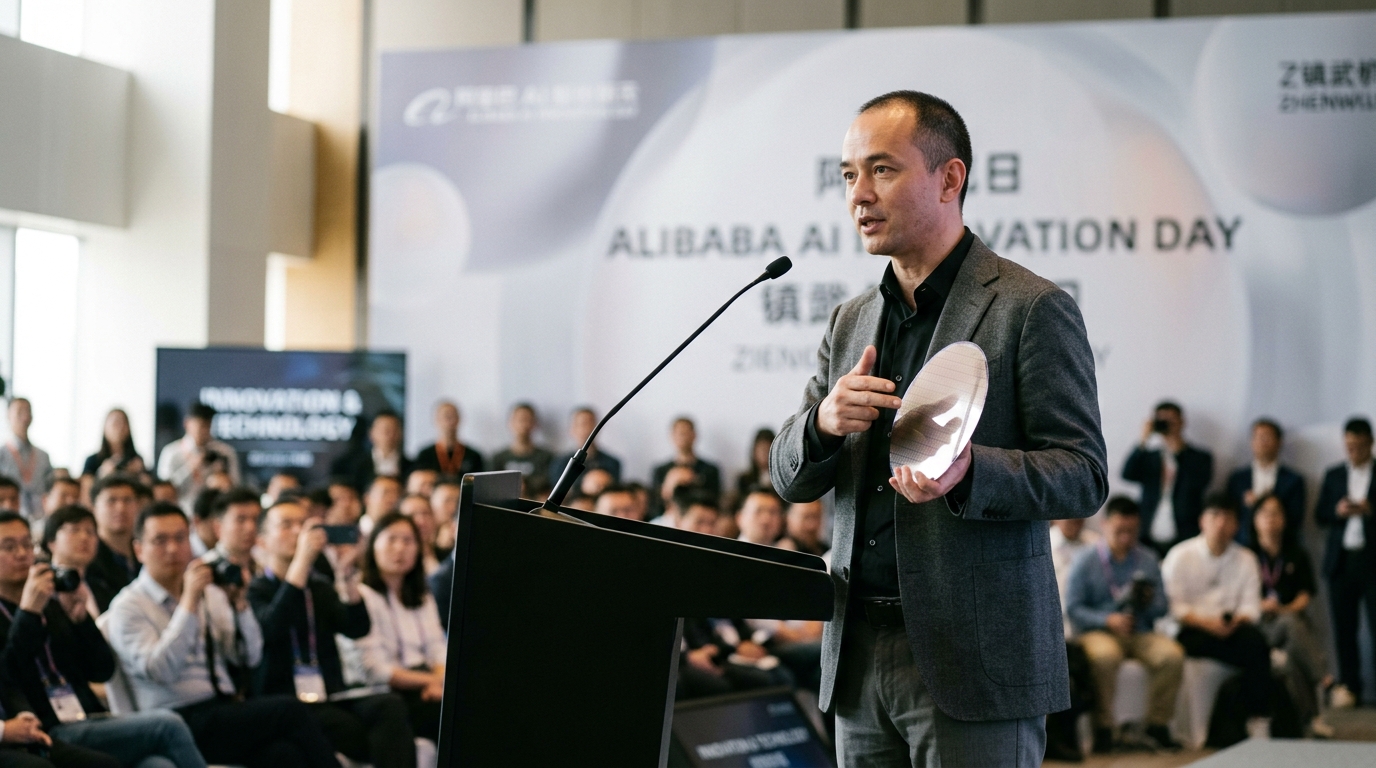
In the heart of Hangzhou, where the pulse of China's digital economy beats strongest, Alibaba Cloud has announced a development that many in the West feared and many in the East have spent years preparing for. The unveiling of the Zhenwu M890, a next-generation AI processor developed entirely by the company's T-Head semiconductor division, marks a critical turning point in China's quest for technological self-reliance. As geopolitical tensions between Washington and Beijing solidify into a long-term standoff, Alibaba is not merely choosing survival—it is launching an offensive.
The Architecture of Independence
The Zhenwu M890 is not just a reaction to the shortages caused by U.S. export restrictions on Nvidia's flagship GPUs, such as the H100 and H200. According to the technical specifications released, the new chip offers performance that edges remarkably close to Western standards in training Large Language Models (LLMs), while outperforming them in specific inference tasks. Its architecture is optimized for the Alibaba ecosystem, allowing the Qwen series of models to run with significantly lower power consumption and increased throughput.
Alibaba’s strategy focuses on creating a vertically integrated system. By controlling both the hardware and the software, the company can bypass the "moat" Nvidia has built through its CUDA platform. While CUDA remains the gold standard for developers globally, Alibaba is investing billions in developing its own software stack, which promises a seamless transition for Chinese enterprises seeking an exit from American dependency.
Geopolitical Chess and the "Silicon Curtain"
This move comes at a time when the Biden administration is considering further tightening technology export controls. For Alibaba, the creation of the Zhenwu M890 is a matter of existential importance. Without access to powerful processors, its ambitions for dominance in Cloud and AI would remain hostage to Washington's whims. China, through state subsidies and strategic guidance, has made it clear that "domestic substitution" is the only path to digital sovereignty.
However, the manufacturing challenge remains the elephant in the room. While the design of the Zhenwu M890 is world-class, producing it at scale requires advanced lithography. With access to ASML’s EUV machines blocked, Alibaba and its manufacturing partners (such as SMIC) must innovate not just in design, but in production methods—perhaps utilizing multi-patterning techniques on older DUV machines to achieve densities approaching 5nm or 7nm.
Economic Implications and Market Reaction
For investors, this news is a double-edged sword. On one hand, the successful development of in-house chips reduces long-term capital expenditure (CAPEX), as Alibaba will no longer need to pay the "Nvidia premium" for the downgraded chips (like the H20) currently permitted for sale in China. On the other hand, R&D spending is astronomical, and uncertainty regarding manufacturing yields remains high.
The market understands that if Alibaba can convince other Chinese giants to adopt the Zhenwu M890, Nvidia risks permanently losing a massive portion of its Chinese revenue, which has historically accounted for 20-25% of its total. This pivot toward the local market could create two parallel technological universes: a Western one built on Nvidia and a Chinese one built on Alibaba and Huawei.
The Future of Global AI Infrastructure
In the long run, the success of the Zhenwu M890 will be judged by its ability to support the next generation of models approaching Artificial General Intelligence (AGI). Alibaba is not just targeting internal consumption; it aims to offer these chips through its Cloud services to clients in Southeast Asia, the Middle East, and Africa—regions where Chinese influence is growing and U.S. restrictions may not be as strictly enforced.
The battle for silicon is the battle for the future of power. With the Zhenwu M890, Alibaba has proven that the "Silicon Curtain" is not just a barrier, but a springboard for a new global order in computing. Nvidia may still be the king, but its throne has never been more contested.