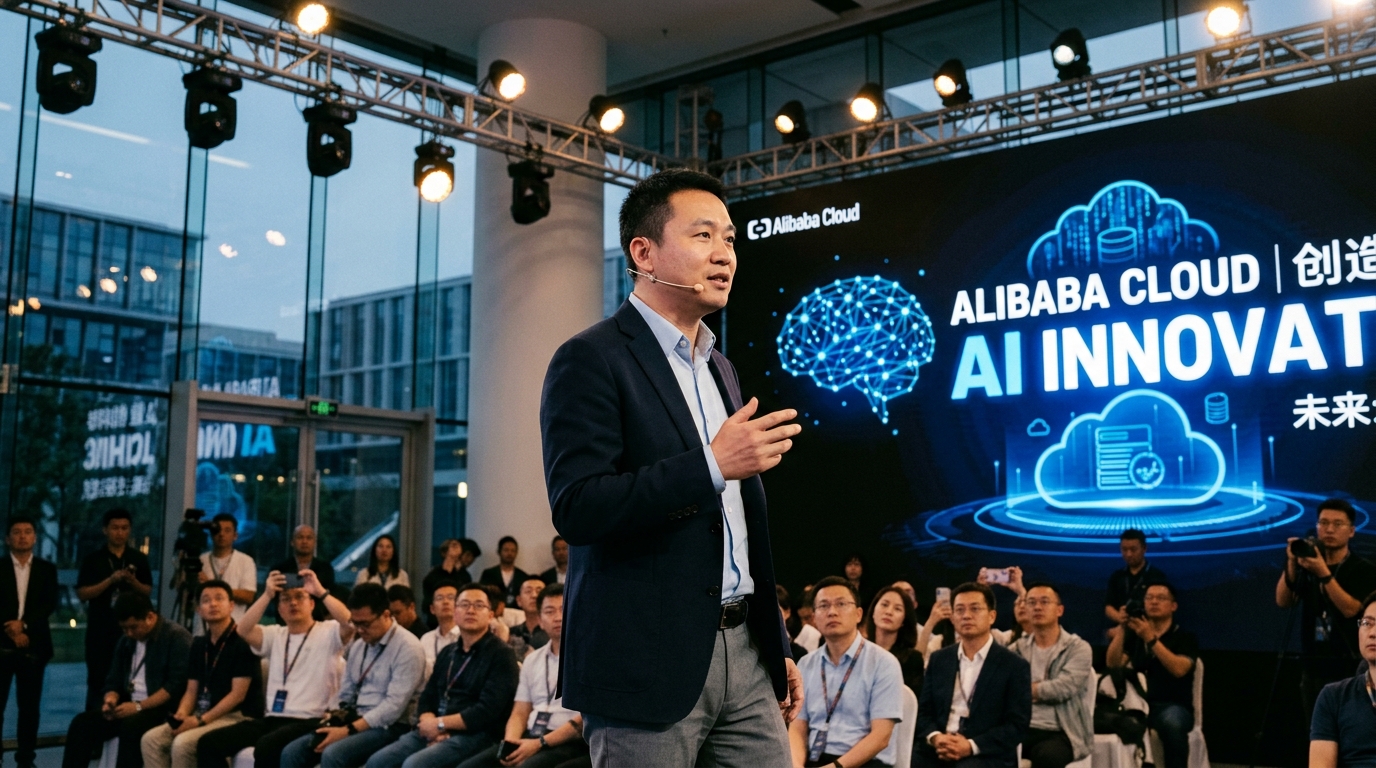
In the ever-shifting landscape of global technology, Alibaba (NYSE:BABA) finds itself at a critical juncture. For decades, its name was synonymous with e-commerce, operating as the Chinese answer to Amazon. However, as of mid-2026, the narrative has fundamentally changed. Management has made it clear that the company's future lies not in parcels and warehouses, but in servers and algorithms. As China's largest cloud service provider, Alibaba is uniquely positioned to reap the benefits of the Artificial Intelligence (AI) revolution, provided it can navigate the turbulent waters of geopolitics and domestic competition.
Infrastructure as the Foundation of Intelligence
Alibaba's strategy is built on a simple yet powerful premise: AI requires immense computing power, and whoever controls the pipes through which this power flows, controls the future. Alibaba Cloud (Aliyun) currently holds the largest market share in China, outperforming domestic rivals like Tencent and Huawei. This dominance is not just quantitative but qualitative. The company has developed its own "Model-as-a-Service" (MaaS) ecosystem, allowing thousands of businesses to train and deploy their own AI models on its infrastructure.
The integration of Tongyi Qianwen, Alibaba's large language model (LLM), into all aspects of its operations—from DingTalk (the collaboration platform) to Tmall—demonstrates a holistic approach. Alibaba is not just selling AI; it is using it to reinvent itself. The company's ability to offer lower model training costs through hardware and software optimization gives it a competitive advantage that few companies worldwide possess.
The Geopolitical Hurdle and Chinese Self-Reliance
However, the path to the top is not without obstacles. Strict US restrictions on the export of advanced semiconductors, such as Nvidia's H100 cards, have directly impacted the capabilities of Chinese tech firms. Alibaba was forced to cancel the full spin-off of its Cloud intelligence group due to this uncertainty. Nevertheless, this challenge also acted as a catalyst for innovation. Alibaba is now investing heavily in developing its own chips, such as the YiTian 710 processor, seeking technological sovereignty without dependence on the West.
Furthermore, the company's shift toward open-source with its Qwen model series has created a massive community of developers relying on its technology. This "soft power" strategy in the software sector could prove as vital as hardware, establishing Alibaba's standards as the de facto choice for the next generation of AI applications in Asia and emerging markets.
The Investment Divergence: Value vs. Price
From a financial perspective, Alibaba presents a paradox. While its fundamentals show a company leading in one of the most profitable sectors of the future, its stock market valuation remains stagnant at levels reminiscent of the "old economy." Investors remain cautious due to China's regulatory environment and the risk of delisting from US exchanges. Yet, for those with a long-term view, Alibaba is not just an e-commerce stock, but a call option on Chinese technological supremacy.
The Cloud division's profitability is steadily improving, and the focus on "quality over quantity" in revenue shows maturity. Alibaba is choosing to shed low-margin customers to focus on contracts requiring deep AI integration. This strategy may slow revenue growth in the short term, but it builds a more resilient and profitable business for the long haul.
Conclusion: The Battle for Digital Sovereignty
In conclusion, Alibaba is the sleeping giant of AI. It possesses the data, the infrastructure, and the talent. The question is not whether its technology is capable, but whether the global political climate will allow it to flourish. If AI is indeed the new electricity, then Alibaba Cloud is the distribution grid that will power the world's second-largest economy. For market observers, watching Alibaba is not just an exercise in stock analysis, but a glimpse into how the multipolar world of technology will be shaped in the years to come.