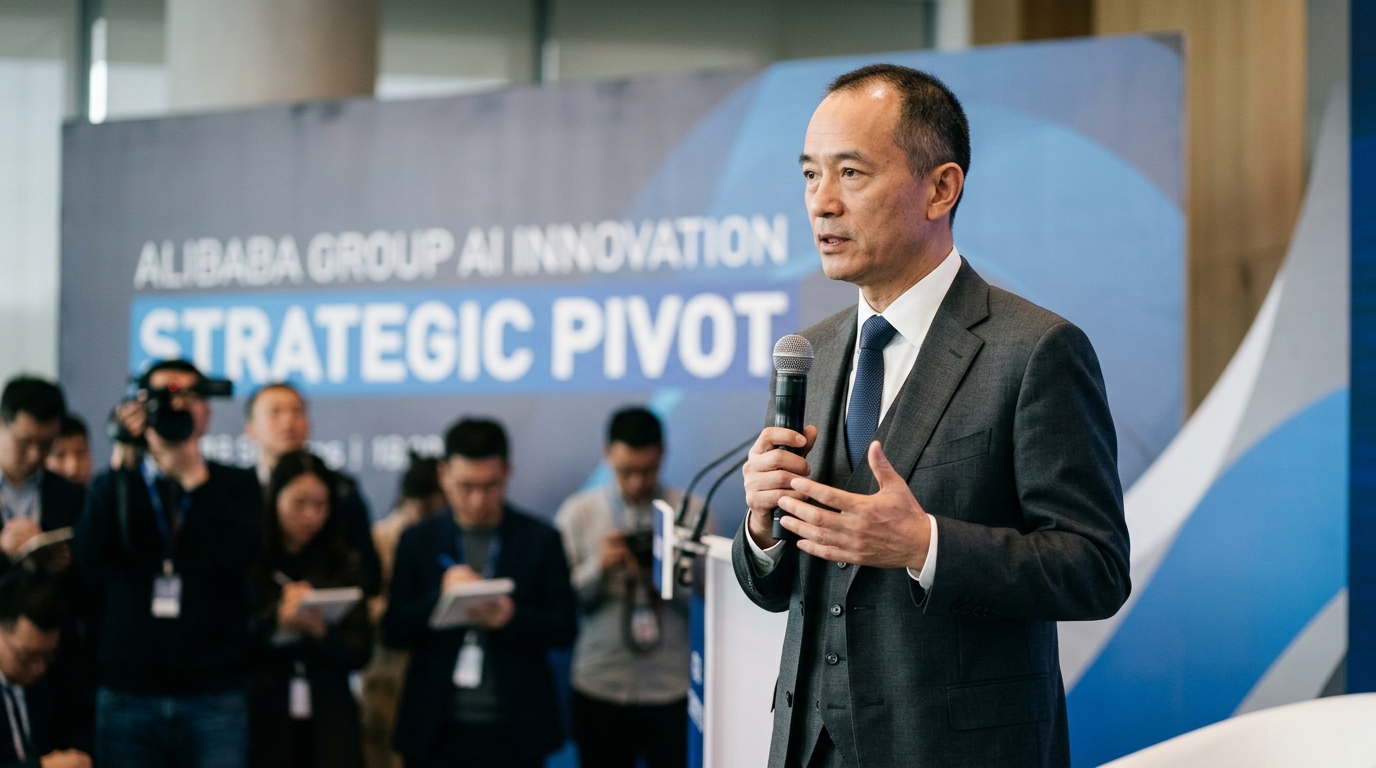
In a move that underscores the existential importance of Artificial Intelligence for the future of Chinese tech giants, Alibaba Group CEO Eddie Wu has announced he is taking direct control of a newly established AI business unit. This decision marks a radical shift in the group’s strategy, as it appears to abandon its previous decentralization plan in favor of a more centralized, "AI-first" approach.
The Return to Centralization
A little over a year ago, Alibaba announced its ambitious "1+6+N" plan, which envisioned splitting the group into six independent business units with their own boards and the potential for autonomous IPOs. However, the meteoric rise of Generative AI and mounting geopolitical pressures seem to have forced a rethink. Eddie Wu, who already holds the positions of Group CEO, CEO of the Cloud Intelligence Group, and CEO of the Taobao Tmall Commerce Group, is now adding the new AI unit to his portfolio, effectively consolidating decision-making across the company’s most critical sectors.
This move is not merely administrative; it is deeply strategic. Alibaba is attempting to bridge the gap between cloud infrastructure and e-commerce applications through AI. As competition from PDD Holdings (Pinduoduo/Temu) and ByteDance (TikTok) intensifies, Alibaba is betting that integrating its proprietary large language model, Tongyi Qianwen, into every facet of its operations will provide the edge needed to reclaim its dominance.
The Semiconductor Challenge and Global Competition
One of the primary drivers for this consolidation of power is the need for centralized resource management, particularly in hardware. Stringent US export restrictions on advanced AI chips, such as those from NVIDIA, have created a resource-scarce environment for Chinese firms. Under Wu’s direct leadership, Alibaba can allocate limited computing power where it is most needed, avoiding internal competition between its various departments.
- Resource Optimization: Centralized control of GPUs for training AI models.
- Data Integration: Utilizing massive e-commerce data to refine AI algorithms.
- Decision Speed: Bypassing the bureaucracy of individual business units.
Furthermore, Alibaba faces the risk of falling behind Baidu, which is considered China’s AI frontrunner with its Ernie Bot model. Wu taking the reins sends a clear message to the markets: AI is no longer an experimental department but the backbone of the entire empire.
Financial Implications and the Path Ahead
The market has reacted with cautious optimism to these changes. The cancellation of the Cloud Intelligence Group spinoff several months ago caused investor jitters, but the new direction offers a sense of stability. Alibaba is no longer trying to become a holding company managing subsidiaries; it is returning to the model of a unified technological powerhouse.
"Artificial Intelligence will be the driving force for Alibaba’s next decade of growth. We must move fast and remain united," stated a source close to the management.
In conclusion, Eddie Wu’s move to place the new AI unit under his direct control is an admission that in the age of AI, speed and vertical integration are more vital than corporate flexibility through divestment. The stakes are high: if Alibaba can successfully turn Tongyi Qianwen into a tool that boosts the efficiency of the millions of merchants on its platform, it will secure its place in the new digital landscape. If it fails, it risks becoming a lumbering giant in a world moving at the speed of light.