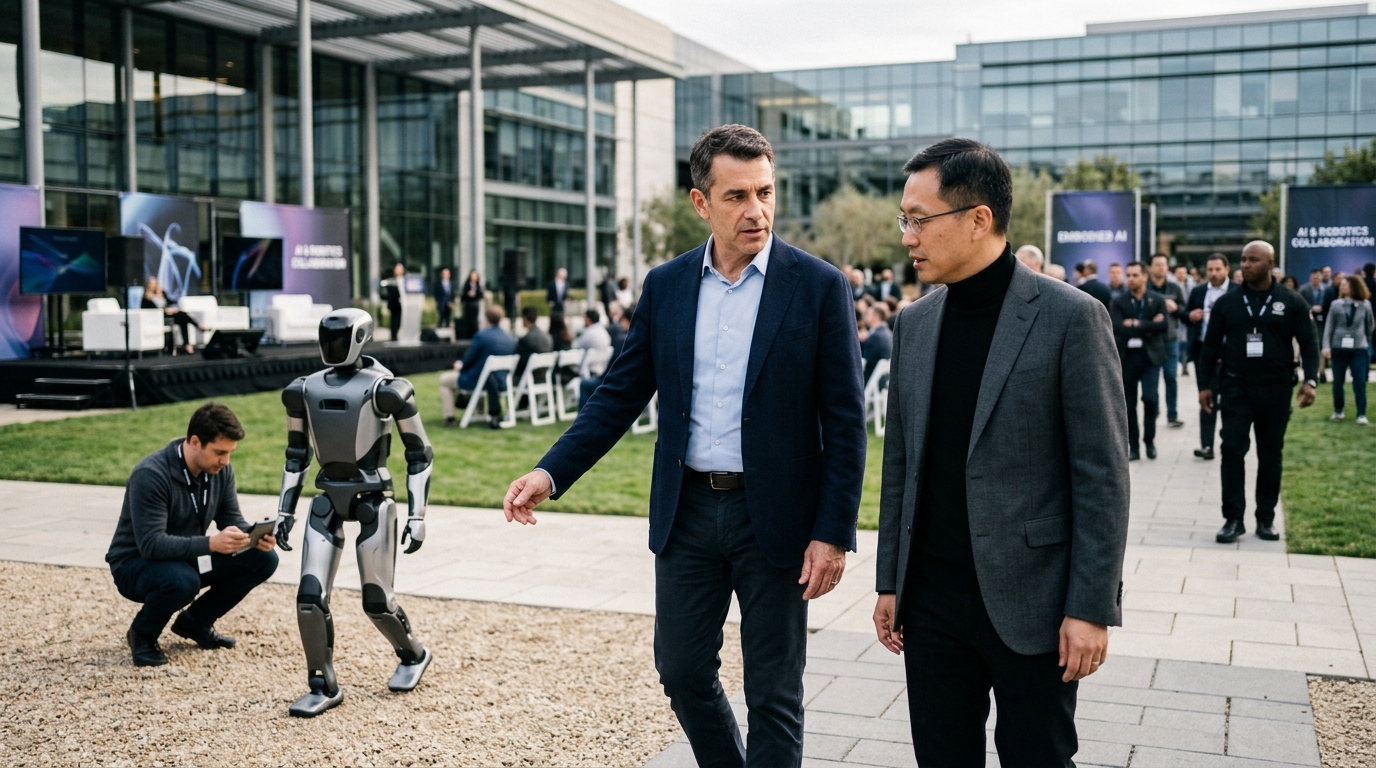
The history of technology often moves in cycles of transition from the intangible to the material. For decades, Alibaba and ByteDance dominated the digital ether—one through e-commerce and cloud computing, the other through the algorithmic allure of short-form video. Today, however, we stand at the threshold of a new era: Embodied Artificial Intelligence. It is no longer just about code that answers questions or suggests products, but about intelligence that possesses a "body," perceives space, and interacts with the physical environment.
Alibaba's Strategy: From Cloud to Factory Floor
Alibaba does not approach robotics as an isolated sector, but as an extension of its cloud ecosystem. Through its Alibaba Cloud division and the Qwen large language model, the company seeks to create the "brain" that will control the robots of the future. Its investment in startups like Unitree and Galbot indicates a clear intention: to become the infrastructure provider for the robotics revolution.
Alibaba's advantage lies in its massive database from the logistics industry. Robots in the warehouses of Cainiao (Alibaba's logistics arm) are no longer simple automated machines but are evolving into agents capable of making real-time decisions. By utilizing Qwen, Alibaba enables robots to understand complex voice commands, such as "find the lightest package and place it on the top shelf," a task requiring simultaneous linguistic understanding, spatial perception, and fine motor skills.
ByteDance: The Power of Video Data
If Alibaba is the brain of the infrastructure, ByteDance is the master of movement. The parent company of TikTok possesses something no other robot manufacturer has: the world's largest treasure trove of video data. For training Embodied AI, videos showing humans performing everyday tasks—from cooking to assembling furniture—are invaluable.
ByteDance has established internal research teams focusing on Vision-Language-Action (VLA) models. These models allow robots to "see" an action in a video and translate it into motor commands. The company's approach is deeply research-oriented, aiming to create a general-purpose robotics model that can adapt to different hardware bodies, whether they are quadruped robots or humanoids.
The Geopolitical and Demographic Dimension
The pivot of these giants toward robotics does not happen in a vacuum. China faces an acute demographic crisis with a shrinking workforce. Automation is no longer a luxury but a national imperative. Simultaneously, competition with the US and companies like Tesla (with Optimus) or Figure AI (backed by OpenAI) has taken on the characteristics of a technological cold war.
"Robotics is the final frontier of artificial intelligence. Whoever manages to connect digital intelligence with physical action will control the next phase of the global economy."
Chinese companies have a unique advantage: proximity to the global manufacturing base. While Silicon Valley excels in software, Shenzhen and Hangzhou offer the ability to build, test, and iterate hardware at speeds the West struggles to match.
Challenges and the Road Ahead
Despite the progress, the challenges remain immense. Power consumption, battery life, and, most importantly, the safety of human-robot interaction are issues that have not been fully resolved. Furthermore, moving from the controlled environment of a warehouse to the chaotic environment of a home requires a level of intelligence that even the most advanced LLMs still struggle to achieve.
However, the entry of Alibaba and ByteDance into the game changes the rules. They bring with them billions in capital, top-tier IT talent, and a culture of rapid development. The future will be judged not only by how smart our chatbots are but by how capable our robots are of assisting us in real life.