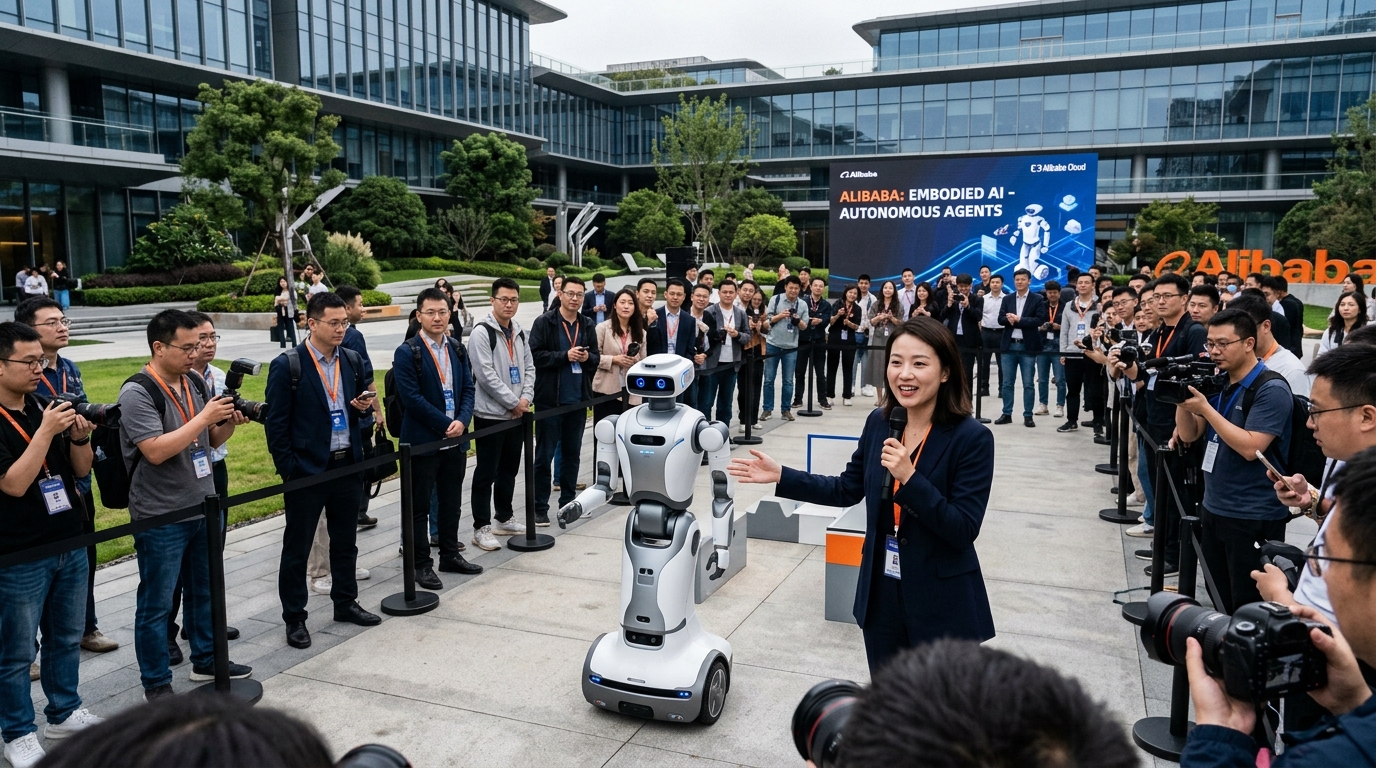
In the high-stakes arena of global technology, Alibaba Cloud has executed a strategic pivot that fundamentally alters the trajectory of Artificial Intelligence development. As the initial euphoria surrounding conversational chatbots begins to stabilize, the Chinese giant is refocusing its resources on "Embodied AI," unveiling a suite of models specifically designed to provide robotic systems with both cognitive reasoning and sensory perception.
The announcement, delivered at the annual Alibaba Cloud Summit, centered on a significant upgrade to its Qwen model family. The new iteration, Qwen2-VL, transcends traditional text processing by integrating advanced computer vision and spatial reasoning. This allows robots to interact with their physical environment with a degree of precision previously unseen, marking a critical transition from passive information retrieval to active, autonomous execution.
From Digital Dialogue to Physical Agency
For the past two years, the AI industry has been dominated by Large Language Models (LLMs) capable of generating prose or debugging code. However, Alibaba posits that the next frontier lies in "Agents." An AI agent does not merely respond to a prompt; it completes a task. When such an agent is housed within a robotic frame, the implications for productivity and industry are profound.
Alibaba’s new models enable robots to comprehend complex instructions that necessitate visual analysis. For instance, a robot powered by Qwen2-VL can identify specific items in a chaotic warehouse environment, assess their structural integrity, and determine the most efficient path for relocation without human intervention. This is achieved through "multimodality"—the model’s ability to simultaneously process data from cameras, depth sensors, and auditory inputs.
Strategic Implications for the Chinese Industrial Complex
Alibaba’s move is more than a technological showcase; it is a direct response to China’s national strategic priorities. Faced with a shrinking workforce and escalating labor costs, Beijing has identified full-scale manufacturing automation as a non-negotiable goal. Alibaba, as the nation's premier cloud provider, is positioning itself to become the foundational operating system for this new robotic era.
- Integration of hardware and software through open-source initiatives.
- Reduction of development barriers for small and medium-sized enterprises (SMEs).
- Strengthening domestic supply chain resilience against Western technological sanctions.
Eddie Wu, CEO of Alibaba Cloud, emphasized the company’s intent to make AI "accessible and operational" across diverse robotic platforms, ranging from humanoid robots to specialized industrial arms. A key component of this strategy is the release of many of these models as open-source, a tactic designed to foster rapid adoption and build a developer ecosystem capable of rivaling Western giants like OpenAI and Google.
Challenges and the Geopolitical Landscape
Despite these technological strides, the path to full robotic autonomy is fraught with challenges. Training sophisticated models for physical interaction requires immense computational power—a resource currently constrained in China due to U.S.-led export restrictions on high-end semiconductors, such as those produced by Nvidia. Consequently, Alibaba is forced to innovate at the architectural level, seeking to extract maximum performance from less powerful, domestically available hardware.
"The challenge is no longer making AI talk like a human, but making it move and perceive the world with the safety and reliability of a human," noted a prominent industry analyst.
Furthermore, safety remains a paramount concern. While a hallucinating chatbot might provide incorrect trivia, a 200-kilogram industrial robot operating on a flawed logic loop could cause catastrophic physical damage. Alibaba is heavily investing in "alignment" protocols to ensure that its AI agents remain within safety parameters, even when navigating the unpredictable variables of the real world.
The Future of Labor and Social Impact
The shift toward robotic agents reignites the debate over the future of work. While Alibaba markets these tools as "collaborators" that will liberate humans from hazardous and repetitive chores, the reality of mass automation remains a point of social friction. In China, the adoption of this technology is expected to be significantly faster than in the West, driven by top-down economic directives and the urgent need to maintain export competitiveness.
In conclusion, Alibaba has not just released new models; it has declared its ambition to dominate the physical manifestation of digital intelligence. The battle for AI supremacy is moving from computer screens to factory floors and urban infrastructure, and Alibaba is positioning itself as the vanguard of this transition.