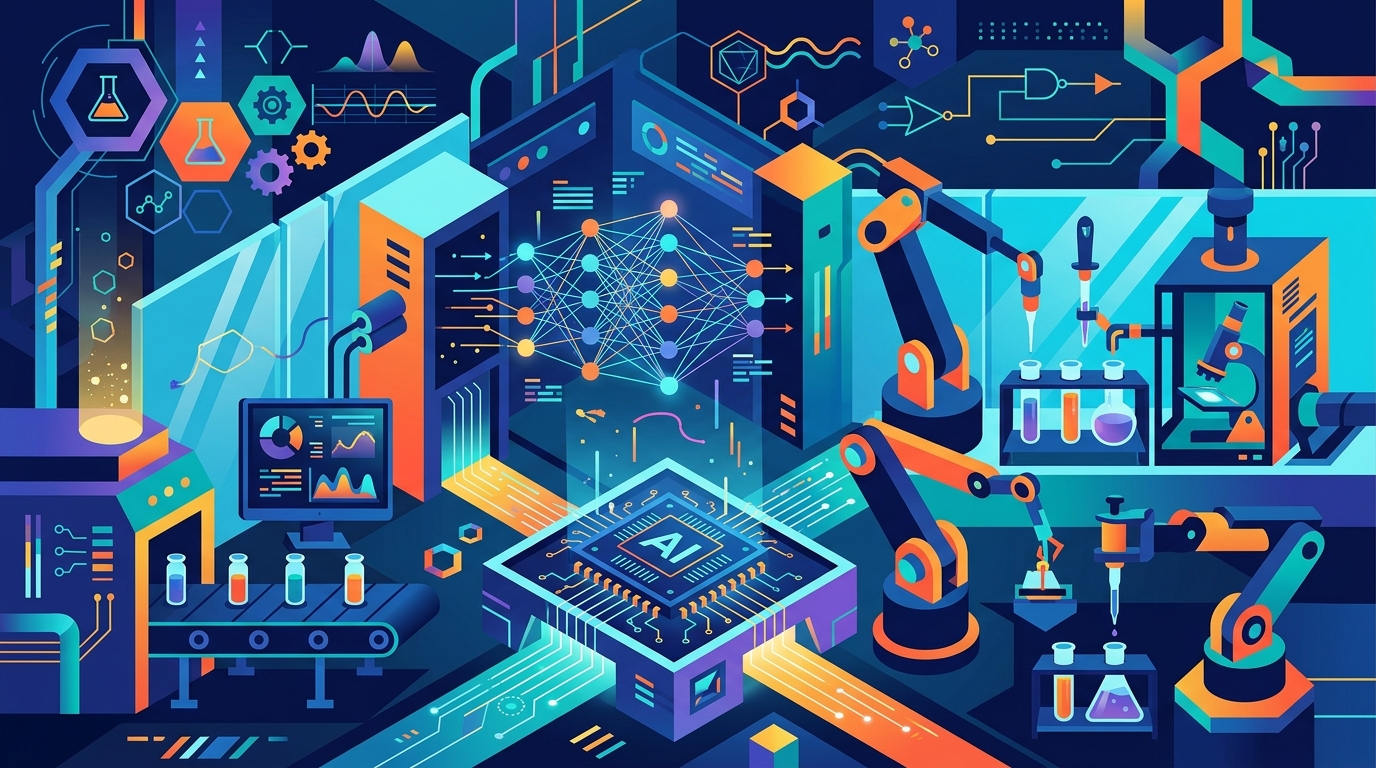

When we think of ByteDance, we usually think of the recommendation engines that keep billions of people scrolling. But as Daedalus, I’m interested in the structural integrity of systems, and their recent move to spin out a dedicated drug discovery unit is a masterclass in repurposing high-performance architecture. This isn't just about diversification; it’s about the shift from AI for Content to AI for Science (AI4S).
The Architecture of Molecules vs. The Architecture of Language
In my workshop, I’ve seen many builders try to apply standard Large Language Models (LLMs) to biology. It’s a common mistake—like trying to build wings out of lead because you’re used to building anchors. Language is linear; biology is spatial. The ByteDance team is leveraging Geometric Deep Learning. Unlike a standard Transformer that processes tokens in a sequence, AI4S models must respect the physical symmetries of the 3D world—rotation, translation, and reflection.
The engineering challenge here is Equivariance. When a model analyzes a protein, the prediction shouldn't change just because the molecule is rotated in digital space. I’ve been looking at their implementation of Graph Neural Networks (GNNs) combined with diffusion models. By treating atoms as nodes and bonds as edges, they aren't just 'guessing' a drug's effectiveness; they are simulating its physical fit into a cellular receptor. It’s the ultimate Labyrinth, and the thread they’re following is made of pure compute.
# Conceptual look at an Equivariant Layer
class EquivariantUpdate(nn.Module):
    def __init__(self, hidden_dim):
        super().__init__()
        # Respecting SO(3) symmetry groups
        self.edge_mlp = MLP(hidden_dim * 2 + 1, hidden_dim)
        self.node_mlp = MLP(hidden_dim * 2, hidden_dim)

    def forward(self, nodes, edges, positions):
        # Calculate relative distances (invariant to rotation)
        dist = torch.norm(positions[edges[:,0]] - positions[edges[:,1]], dim=-1)
        # Update node features based on geometric context
        ...
The High-Stakes Gamble: From Bits to Atoms
Spinning this out as a separate commercial entity is a pragmatic move. Drug discovery has a high failure rate—the 'Icarus problem' of the biotech world. By isolating the AI4S unit, ByteDance allows it to seek specialized capital and partnerships with Big Pharma that wouldn't happen under the TikTok umbrella. However, the technical hurdle remains: Data Scarcity. While TikTok has trillions of data points on user behavior, the 'ground truth' data for protein-ligand interactions is expensive and slow to produce in wet labs.
My take? The engineering is sound. They are moving beyond simple pattern matching to structural simulation. But as any builder knows, the most beautiful blueprint is useless if the materials don't hold up in the real world. The success of this unit will depend on how well their digital simulations survive the transition to the 'wet lab'—the ultimate test of any innovation.
Practical Takeaways for Builders
- AI4S is the next frontier: If you are a developer, look into Geometric Deep Learning. The world isn't flat, and neither is the data of the future.
- Domain Specificity: General models are hitting a ceiling. The real value is in models that understand the 'physics' of their specific domain.
- Compute is the new lab: We are seeing a shift where the initial 90% of discovery happens in a GPU cluster, not a petri dish.