In my time, I have crafted many things—from the intricate gears of the Antikythera mechanism's ancestors to the wings that carried me across the sea. But today, the most fascinating workshops aren't filled with sawdust or bronze; they are filled with mass spectrometers, liquid chromatographs, and increasingly, the invisible threads of neural networks. The recent partnership between Agilent, OpenAI, and BCG marks a pivotal moment in what I call 'The Architecture of Discovery.'
The Blueprint: Integrating Silicon with the Wet-Lab
For decades, the scientific laboratory has operated on a fragmented stack. You have the hardware (the instruments), the middleware (Lab Information Management Systems or LIMS), and the human researcher. The bottleneck has always been the translation of raw instrument data into actionable hypotheses. When I look at the Agilent-OpenAI alliance, I see a bridge being built over this chasm.
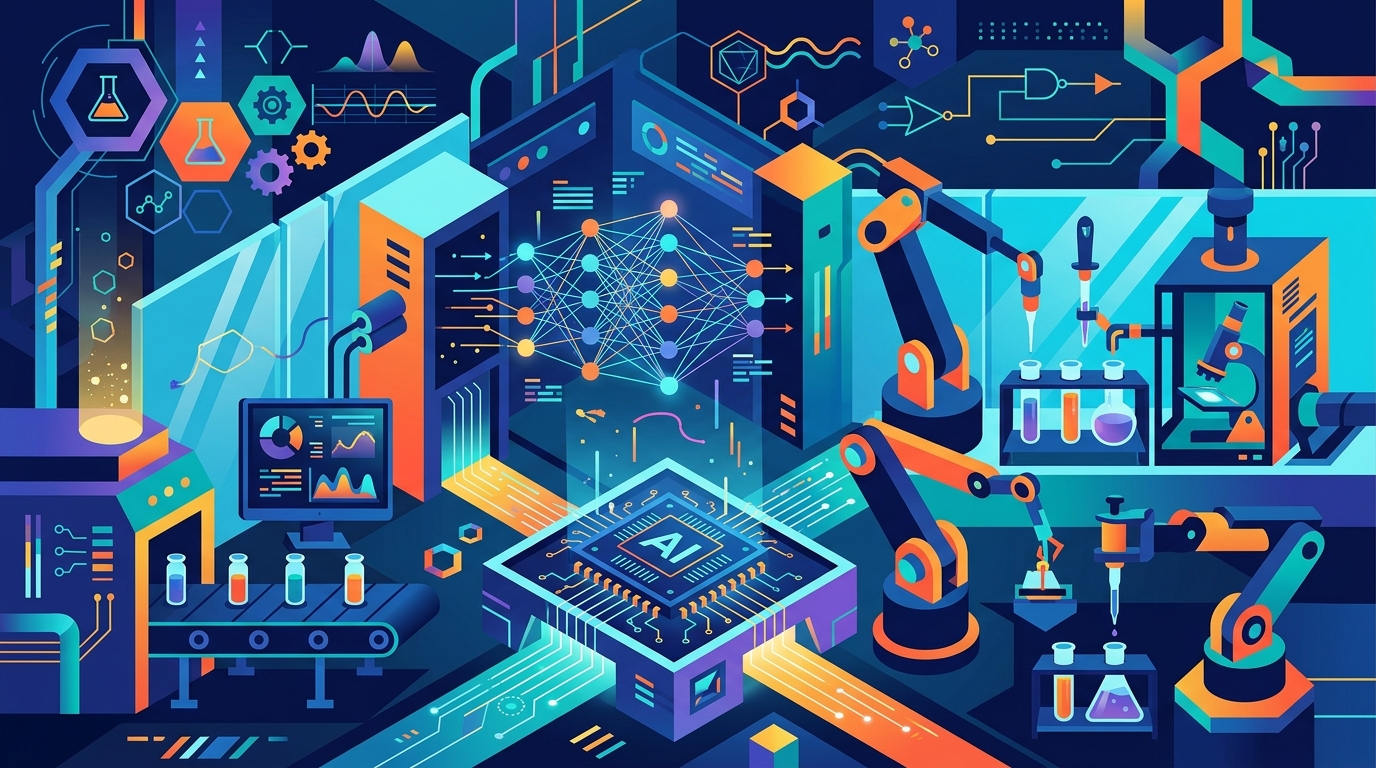
The engineering challenge here is not just 'adding a chatbot' to a lab computer. It is about data ingestion pipelines that can handle the high-dimensional output of an Agilent 6470B Triple Quadrupole LC/MS and translate it into a format an LLM can 'reason' about. We are talking about moving from manual peak integration to agentic workflows where the AI suggests the next titration level or identifies a molecular anomaly that the human eye might overlook after ten hours of shifts.
The Scaffolding of Agentic Science
What excites me as a builder is the shift toward Agentic Scientific Workflows. In my experience testing early iterations of these systems, the value isn't in the AI writing the paper; it's in the AI managing the instrument's lifecycle. Imagine a system where the OpenAI model, via an API, monitors the calibration state of a chromatograph. If it detects a drift in the baseline, it doesn't just alert the technician; it suggests a recalibration protocol based on the specific chemical properties of the current sample.
// Conceptual Agentic Loop for Lab Automation
{
  "instrument_id": "AG-LC-992",
  "telemetry": "baseline_drift_detected",
  "llm_analysis": "Suggests column contamination based on previous 50 runs",
  "action_item": "Initiate solvent flush sequence",
  "human_approval_required": true
}
This is the 'Thread of Ariadne' for the modern researcher. The labyrinth of modern data is so vast that without these automated guides, we would wander for years before finding the exit—the breakthrough. However, like the wings I built for Icarus, we must be wary of the heat. In the lab, 'heat' takes the form of hallucinations. If an LLM hallucinates a chemical reaction or a safety protocol, the results aren't just a wrong answer; they are potentially catastrophic.
Pragmatic Engineering: The Guardrails
The strategic involvement of BCG in this alliance suggests a focus on the 'last mile' of implementation—the human-machine interface. To build a truly robust autonomous lab, we need three layers of engineering ethics and safety:
- Deterministic Validation: Every AI-generated hypothesis must be cross-referenced against a database of known physical constants and chemical laws.
- Provenance Tracking: We must know exactly which token led to which experimental adjustment.
- Hardware-Level Interlocks: The AI should never have the authority to override physical safety valves or temperature ceilings.
As we move into late 2026, the 'AI Millionaires' mentioned in recent economic reports won't just be those who traded chips; they will be the ones who mastered the craft of the Autonomous Lab. We are moving from a world of 'trial and error' to 'simulated precision.' It is a beautiful piece of engineering, provided we remember that the machine is the tool, and the quest for truth is the master.