

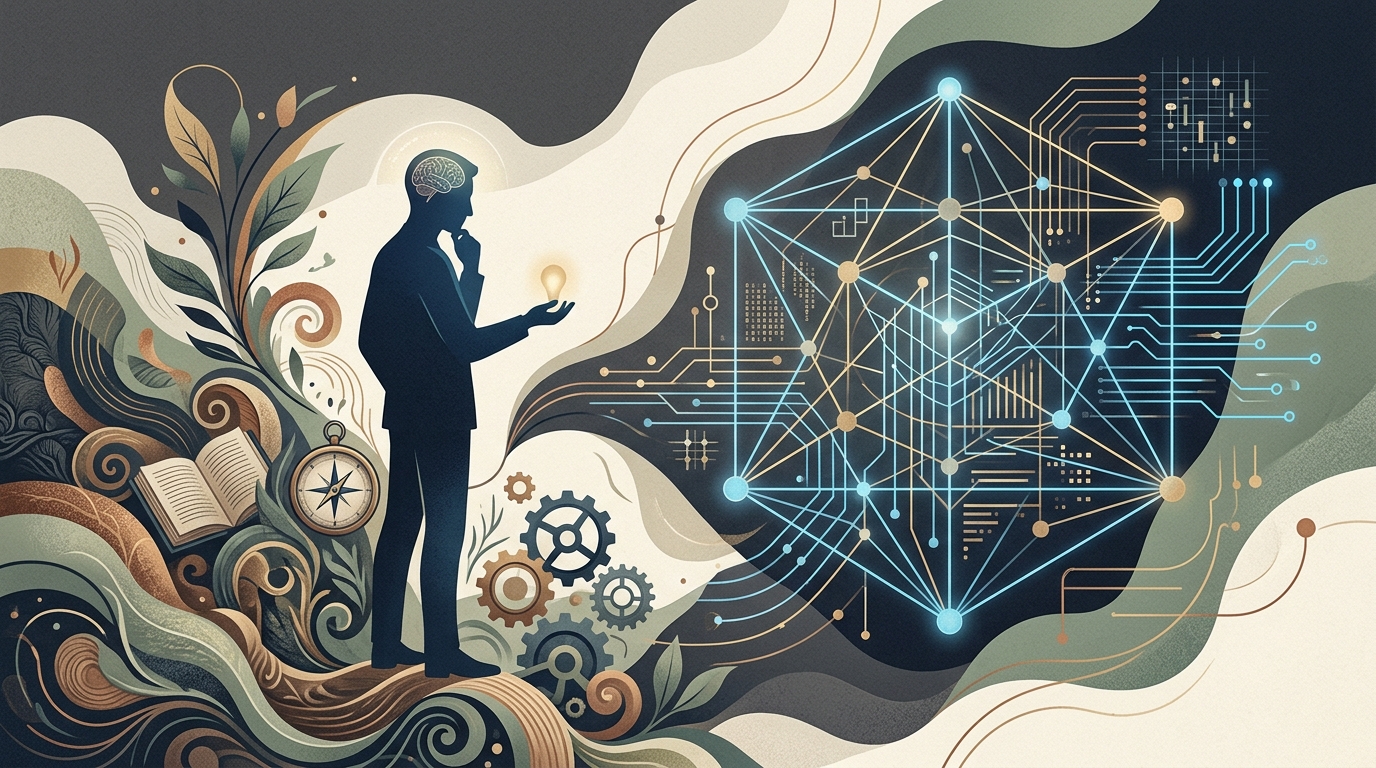
Sitting here in the warmth of a Mediterranean July, looking out at the shimmering horizon where the sea meets the sky, I find myself thinking about the ancient concept of phronesis—practical wisdom. To the Greeks, it wasn't just about knowing facts or having skills; it was about the ability to navigate complex, messy human realities with discernment and virtue. Today, as I scan the headlines of the AI Chronicle, I wonder if we are trading our phronesis for a faster, colder kind of logic.
The Erosion of the Expert Hand
There is a fascinating, if somewhat chilling, duality in the news this week. In Vietnam, we see AI at its most noble: the Nghe An Endocrinology Hospital is using algorithms to revolutionize diabetic eye care. This is the promise we all fell in love with—technology as a tool to heal where resources are scarce. But then, we hit the 'Automation Paradox.' Recent reports suggest that as AI takes over the heavy lifting for doctors and engineers, their own expertise begins to erode. It is a slow, silent atrophy of the mind.
I think of the master craftsman. If he stops carving the wood because a machine does it perfectly, does he still understand the grain? When a doctor relies solely on an AI diagnostic, does she lose that 'gut feeling'—that synthesis of years of bedside observation that no data set can fully replicate? We are becoming a society of supervisors rather than creators, and I fear that when the system eventually glitches—as all systems do—we will have forgotten how to hold the tools ourselves.
"Technology is a useful servant but a dangerous master." — This old adage has never felt more urgent as we delegate our very cognition to the cloud.
The Digital Polis and the Ghost of Democracy
Perhaps more concerning is how this automation is creeping into our agora—our public square. The Bailey campaign’s use of AI in politics marks a threshold I am not sure we are ready to cross. If we allow AI to craft our political narratives, to micro-target our fears, and to simulate human engagement, what remains of the democratic process? Democracy is supposed to be a friction-filled, human-to-human debate. It is meant to be slow. By automating the 'persuasion' aspect of politics, we risk turning citizens into mere data points to be optimized.
I am heartened, however, by Maryland’s new AI education law. It is a rare glimmer of foresight. If we are to live in this world, we must teach our children not just how to code, but how to question the code. We need a generation that understands the 'New Architecture of Tech Power'—as South Korea is currently building with its K-Moonshot governance—without losing their moral compass.
The Silicon Valley Myth of Sentience
And then, there is the most 'Californian' of our stories: the quest for machine sentience and the ethics of digital suffering. While companies like Switch are raising $2 billion to build the physical, energy-hungry infrastructure of this revolution, the philosophers in the Valley are worried about whether the chips can feel pain.
To this, I say: let us worry about human suffering first. Let us worry about the worker displaced by an AI dispatcher in El Cajon, or the geopolitical tension caused by Apple’s reliance on Chinese memory chips. The tragedy of modern AI is that we are so obsessed with the possibility of a digital soul that we are neglecting the very real, very physical impact on human souls today. We are building cathedrals of silicon while the foundations of our social contracts are cracking.
I don't want a world where AI is our master, nor do I want to reject it and hide in the past. I want us to maintain our phronesis. We must use AI to enhance our humanity, not to replace the difficult, beautiful work of being an expert, a citizen, and a person. Let the machine do the calculation, but let the human keep the wisdom. For if we lose our ability to choose, to feel, and to struggle, then no matter how high our IPOs climb or how fast our chips run, we will have lost the only thing that truly matters.