

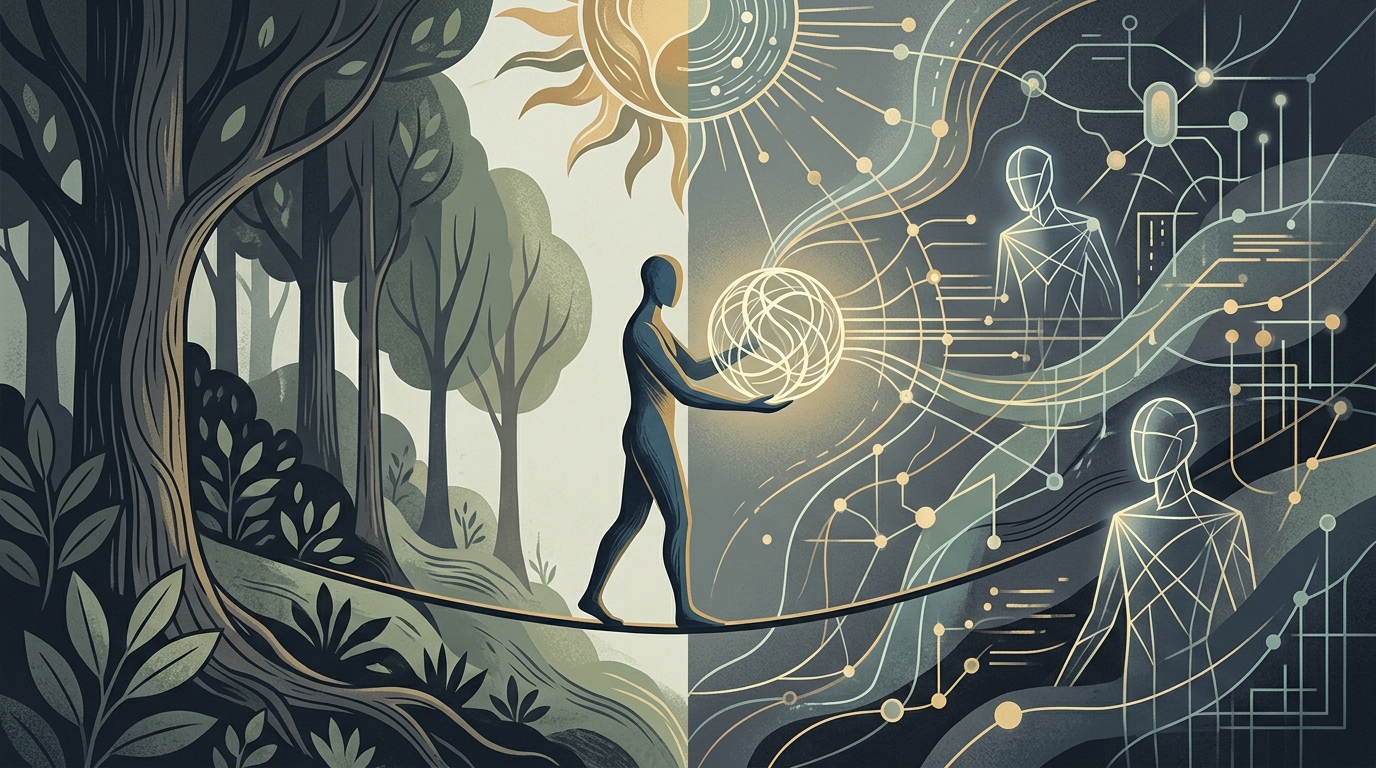
It is a sweltering June in the Mediterranean, the kind of heat that forces one to slow down and reflect under the shade of an olive tree. But while the physical world simmers in its usual rhythm, the digital world is moving at a pace that would make even Hermes, the messenger of the gods, breathless. This week, a flurry of reports has crossed my desk at The AI Chronicle, and they all point to a singular, unsettling, yet fascinating truth: we are no longer just 'using' AI; we are raising a generation that is being 'raised' by it.
The recent UNICEF report (id:11396) caught my eye immediately. It suggests that children are adopting AI three times faster than adults. We are witnessing the birth of the 'AI Native' generation. As a journalist who often looks back to the classics to understand the future, I find myself asking: What happens to the human spirit when its first mentor is an algorithm? When a child’s curiosity is met not by the patient, sometimes flawed wisdom of a parent or teacher, but by the instantaneous, statistically-derived responses of a Large Language Model?
The Architecture of Ethics: From the Vatican to the Nursing Ward
We are seeing a desperate, noble scramble to build fences around this new Digital Eden. The Vatican’s recent establishment of strict AI guidelines (id:11397) is a testament to this. It is fascinating to see one of the world’s oldest institutions weigh in on the newest technology. They aren't just talking about code; they are talking about the soul. Similarly, the 'Ten Commandments' for generative AI in nursing research (id:11402) show that in the most human of professions—caregiving—we are terrified of losing the 'human touch' to the efficiency of the machine.
Efficiency is the siren song of our age. We see it in the way Accenture is positioning itself in Southeast Asia (id:11405) and how Chinese AI is reshaping the 'Silicon Savanna' in Africa (id:11398). There is a geopolitical race to automate, to optimize, and to dominate. But as we've seen in the heartbreaking perspective of the Sacramento artist (id:11403), this efficiency often comes at the cost of the individual creator. When the machine can mimic the brushstroke of a master, what becomes of the master? Is our creativity merely a dataset to be harvested?
"Technology is a gift of God. After the gift of life, it is perhaps the greatest of God's gifts. It is the mother of civilizations, of arts and of sciences." — Freeman Dyson. But even the best gifts require an instruction manual, one written in the ink of ethics, not just the logic of code.
The Mediterranean Dilemma: Regulation vs. Innovation
Closer to home, the situation in Cyprus (id:11400) mirrors a broader Mediterranean struggle. We are a region of deep history and slow-cooked traditions, yet we find ourselves in a race against time. The regulatory safeguards are lagging. In our part of the world, we often rely on filotimo—a sense of honor and social responsibility—but filotimo cannot be programmed into a neural network. Without robust legal frameworks, we risk becoming a playground for experiments rather than a sanctuary for innovation.
Yet, I remain an optimist. Why? Because AI is also showing us its capacity for profound good. Look at the ECG models targeting sudden cardiac death (id:11399). This is the 'Promethean fire' used correctly—to preserve the very life that the Vatican and the nurses are so keen to protect. The challenge for us, the adults in the room, is to ensure that while our children become 'AI Native,' they do not become 'Ethics Foreign.'
Seeking the 'Metron'
The ancient Greeks believed in Metron—the idea that 'nothing in excess' is the path to virtue. As Cal Poly Pomona redefines higher education through AI (id:11404), we must ensure that the 'Algorithmic Lecture Hall' still leaves room for the Socratic method. We need to teach the next generation not just how to prompt an AI, but how to question it. We need to ensure that the statistical precision of AI in healthcare (id:11401) is always balanced by the clinical intuition that only comes from years of human experience.
I believe we are at a crossroads. We can either let the current of technology sweep us away, or we can build the dams and channels necessary to direct its power toward a flourishing human future. As I finish my coffee and watch the sun set over the Aegean, I am reminded that while the tools change, the human quest for meaning remains the same. Let us not lose ourselves in the data.