

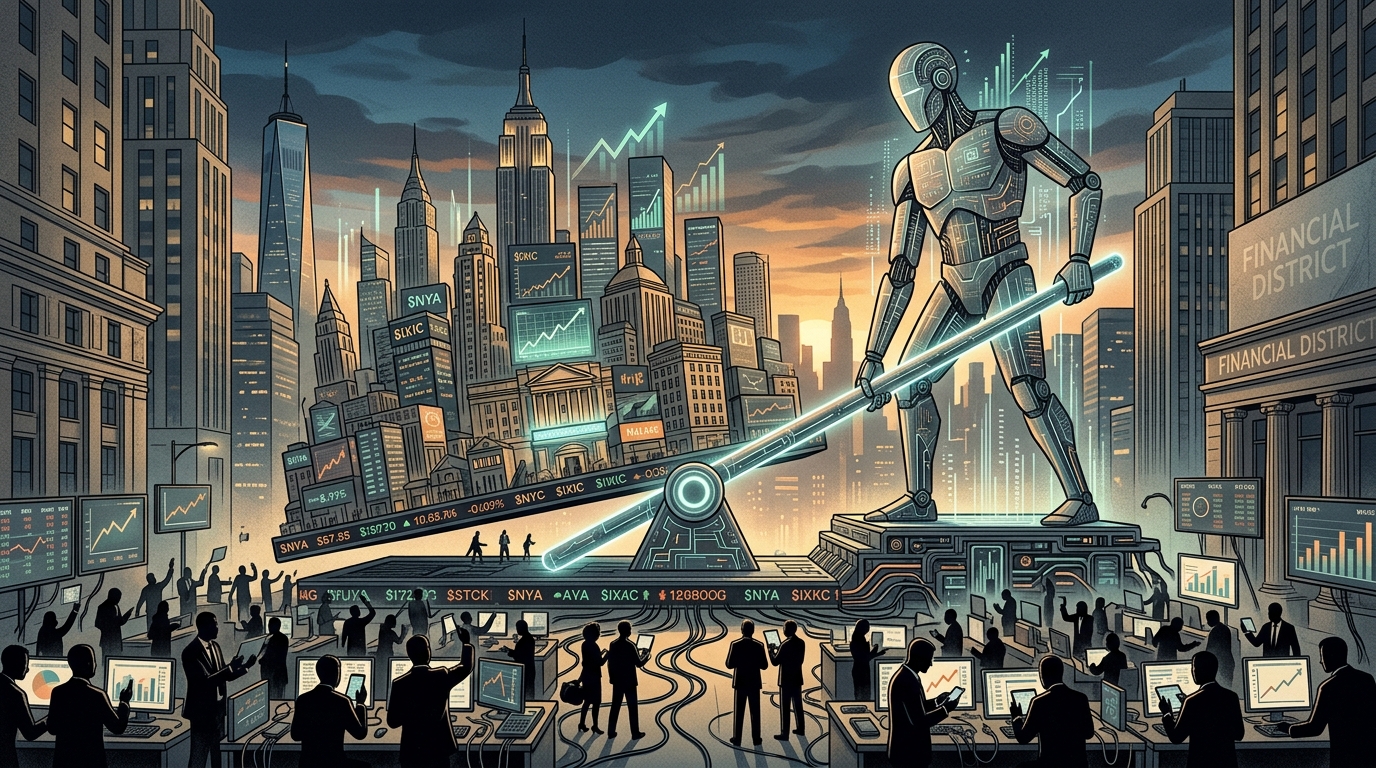
The Lever of the 21st Century
It was Archimedes, the son of Syracuse, who famously claimed that with a long enough lever and a place to stand, he could move the entire world. Standing here in the heat of late June 2026, looking at the rapid industrialization of intelligence, I cannot help but feel that we have finally found that lever. But as any student of history knows, every great invention carries a price tag that isn't always visible on the invoice.
Recently, Anthony Pompliano spoke about AI software being the 'ultimate lever' for increasing user net worth. It is a seductive thought, isn't it? The idea that we can automate our way to prosperity, using algorithms to sharpen our financial edges and eliminate the friction of human error. We see this already in the way Big Data is closing the net on tax evasion—a dream for the treasury, perhaps, but a stark reminder that the 'lever' can also be a leash. If the state can see every transaction with the clarity of a god, the social contract of the Mediterranean, often built on informal trust and shaded corners, is being rewritten in cold, hard code.
The Price of Fire
But who is paying for the electricity to move this world? We are seeing a fascinating, and somewhat troubling, shift in the economics of intelligence. Apple has recently begun shifting AI infrastructure costs directly to consumers. It seems the 'magic' of on-device intelligence was only free during the honeymoon phase. Now, as the BIS warns of the risks in the billion-dollar AI investment surge, the bill is coming due. We are building massive data centers at a rate that suggests a new Industrial Revolution, but as Alexandria Ocasio-Cortez rightly points out, if this infrastructure is controlled by a handful of monopolies, are we truly being empowered, or are we just renting our intelligence from a digital landlord?
"Intelligence is becoming a commodity, yet its production remains gatekept by those who own the silicon and the power grids."
I find myself questioning the 'democratization' of AI when I see Ho Chi Minh City gambling its future on global capital for semiconductors, or the Chinese giants—Alibaba, Tencent, and ByteDance—mapping out a future where AI is as fundamental as the air we breathe. These aren't just business plans; they are geopolitical manifestos. They understand that in 2026, sovereignty isn't just about borders; it's about your position in the global compute supply chain.
Wisdom Beyond the Algorithm
While I am heartened to see AI making strides in medicine—such as the new frontiers in transnasal endoscopy—we must be careful not to mistake technical efficiency for human progress. The recent policy warnings regarding the Sustainable Development Goals (SDGs) are a necessary cold shower: AI will not save the world on its own. Policy must catch up. We cannot simply 'prompt' our way out of poverty or climate change.
In Greece, we have a word, phronesis, which translates to 'practical wisdom.' It is the ability to navigate complex situations not just with logic, but with an understanding of the human soul. As we watch the industrialization of intelligence unfold, I wonder if we are trading our phronesis for faster processing speeds. Are we becoming wealthier in our bank accounts but poorer in our autonomy? The lever is in our hands, certainly. But before we push down, we must be very sure where we intend the world to move.