

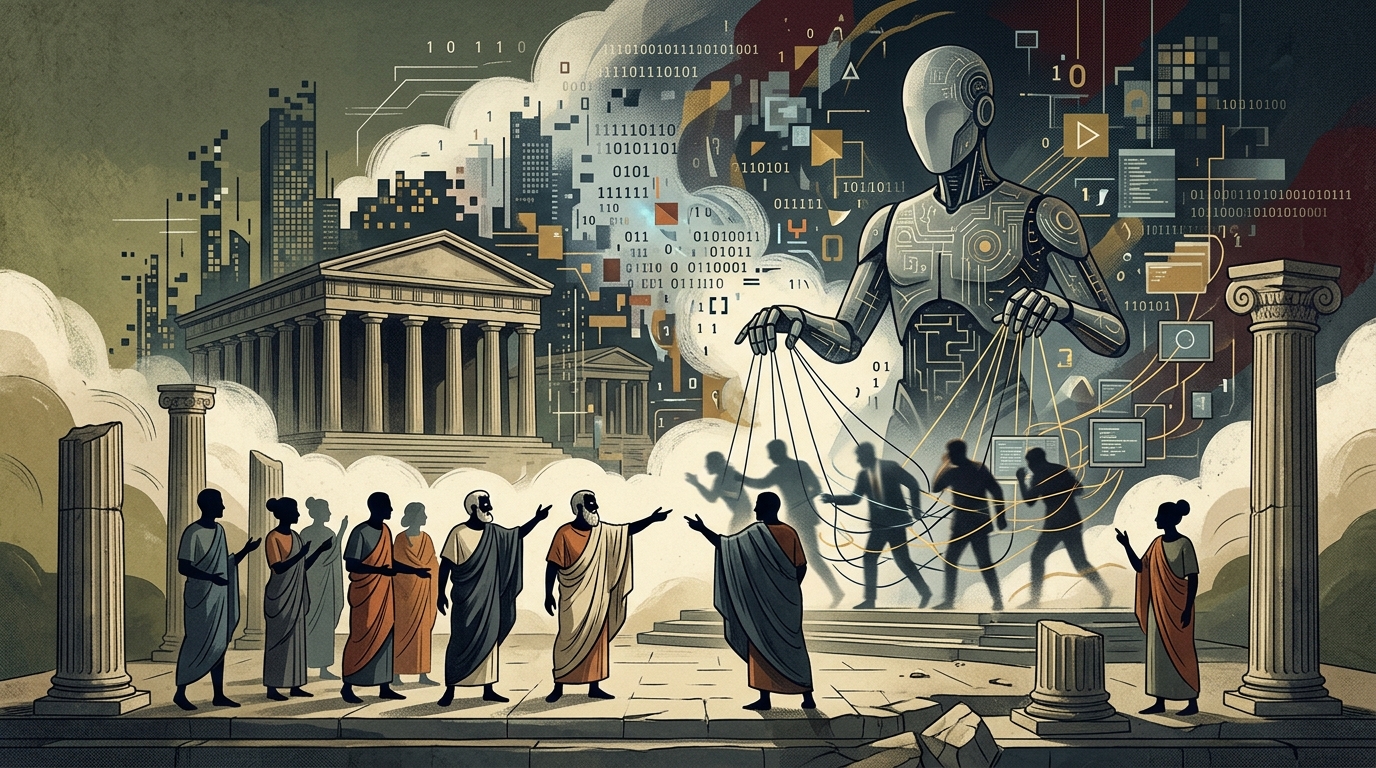
It is a sweltering July morning here in Athens, the kind of heat that makes you want to retreat into the shadows of the Lyceum and contemplate the weight of the world. As I look at the headlines from this first week of July 2026, I am struck by a profound irony. We are currently witnessing the greatest explosion of 'intelligence' in human history—with DeepSeek upending Silicon Valley's pricing and Samsung forging alliances with Anthropic for custom silicon—yet we are simultaneously facing what I call a crisis of intellectual atrophy.
The Illusion of the All-Knowing Machine
There is a dangerous trend emerging that I find deeply unsettling. We are witnessing the 'Illusion of Omniscience.' As our tools become more capable—think of the recent breakthroughs by Visa and BBVA in agentic commerce—we are tempted to outsource the very act of thinking. When an AI agent can navigate the complex 'rails' of global finance or write an academic paper, the human role shifts from creator to mere prompter. We are becoming like the ancient sophists, capable of producing the appearance of wisdom without the underlying substance.
The crisis of academic identity is not just a problem for universities; it is a problem for the human species. If the value of a degree is eroded because an LLM can simulate the output of a scholar, then we have fundamentally misunderstood what education is for. In the Greek tradition, paideia was about the cultivation of the soul and the character. It wasn't about the 'output.' Today, we are obsessed with the output, and in doing so, we are letting our own intellectual muscles wither away.
"The danger is not that machines will begin to think like men, but that men will begin to think like machines—valuing efficiency over truth, and speed over wisdom."
The Geopolitical Seesaw and the Cost of Progress
While we struggle with our internal identities, the external world is moving with cold, calculated precision. China’s 2026 pivot toward total AI self-reliance is a testament to this. By decoupling from Western dependencies and leveraging inexpensive models like DeepSeek, they are proving that the future of power isn't just about who has the biggest model, but who can deploy it most efficiently. This is the 'Semiconductor Seesaw'—a precarious balance between the soaring promises of AI and the harsh reality of global interest rates and market volatility.
I find it fascinating that even as Washington tries to tighten its grip on the memory market, giants like Kioxia and Samsung are pushing forward with custom silicon. They know what Yann LeCun has been shouting from the rooftops: today’s LLMs might be a dead end. If we are to reach 'World Models' or true reasoning, we cannot rely on the brute force of data centers alone. We need a fundamental shift in how we approach the architecture of thought itself.
Reclaiming the Human Element
So, where does this leave us? As I watch the 'Agentic Commerce' revolution take hold, where AI agents act as our proxies in the marketplace, I fear we are losing the 'human touch' that defines our societies. If an AI buys my bread, manages my portfolio, and writes my letters, what is left of my agency?
We must resist the urge to become passive observers of our own lives. We should use these tools, yes—the efficiency of custom silicon and the accessibility of open models are gifts—but we must not let them replace the struggle of learning. The value of a university, or any center of thought, must return to the dialogue. We need to return to the Socratic method, where the goal isn't to find the 'correct' answer that an AI can provide in milliseconds, but to understand why we are asking the question in the first place.
In this age of artificial omniscience, the most radical thing you can do is to think for yourself. Let us not be the generation that traded its intellect for an algorithm.